Birth Chart
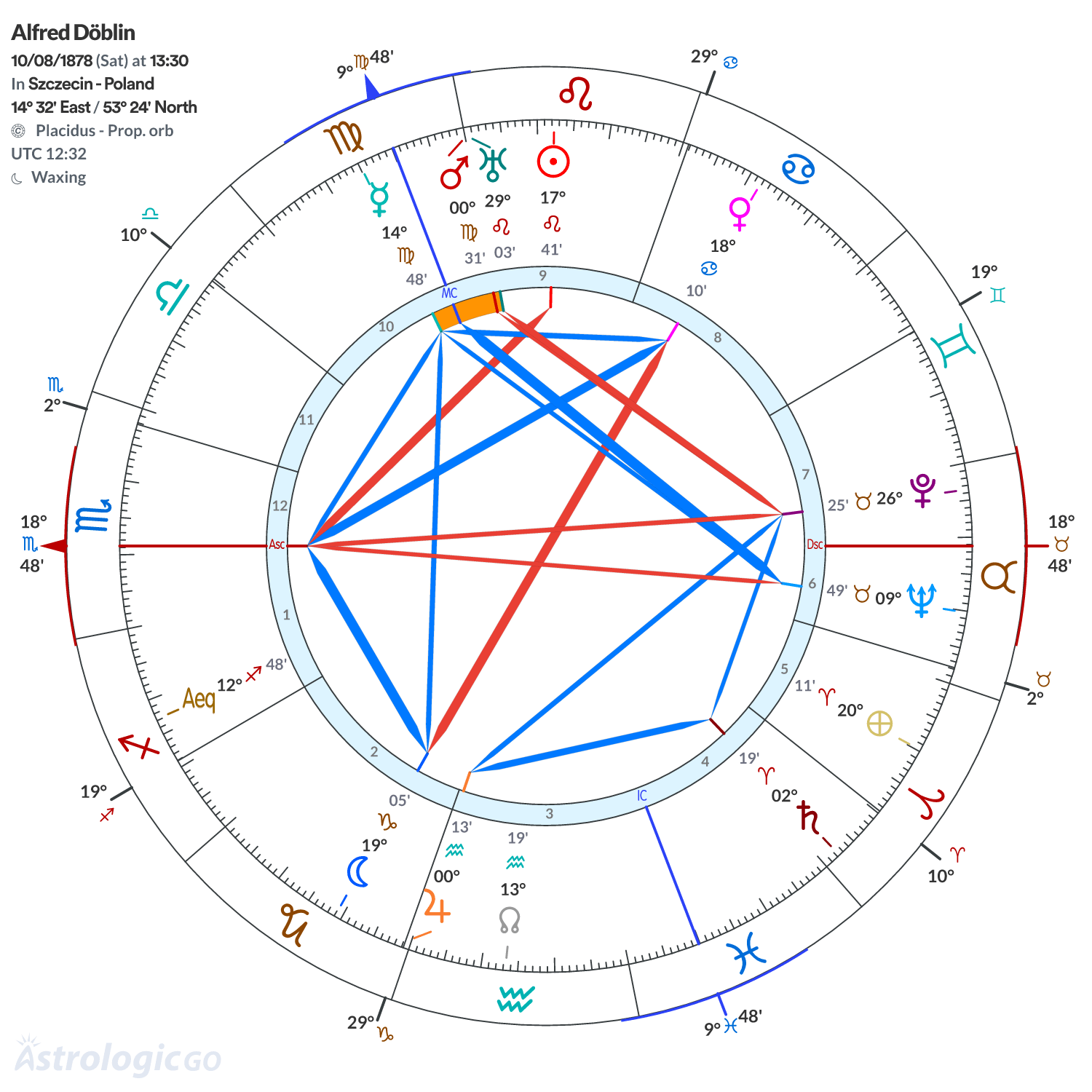
Alfred Döblin
Bruno Alfred Döblin
Sun Leo
Moon Capricorn
Ascendant Scorpio
Influences in signs
↣ Sun in Leo - 17°42' - in house 9
↣ Moon in Capricorn - 19°05' - in house 2/3
↣ Mercury in Virgo - 14°49' - in house 10
↣ Venus in Cancer - 18°10' - in house 8/9
↣ Mars in Virgo - 00°32' - in house 10
↣ Jupiter in Aquarius - 00°13' - in house 3 - retrograde
↣ Saturn in Aries - 02°19' - in house 4/5 - retrograde
↣ Uranus in Leo - 29°03' - in house 10
↣ Neptune in Taurus - 09°49' - in house 6
↣ Pluto in Taurus - 26°26' - in house 7
↣ North Node in Aquarius - 13°20' - in house 3
↣ Ascendant in Scorpio - 18°49' - in house 1
↣ Midheaven in Virgo - 09°48' - in house 10
↣ Equatorial Ascendant in Sagittarius - 12°48'
Influences in houses
↣ Sun in house 9
↣ Moon in house 2/3
↣ Mercury in house 10
↣ Venus in house 8/9
↣ Mars in house 10
↣ Jupiter in house 3
↣ Saturn in house 4/5
↣ Uranus in house 10
↣ Neptune in house 6
↣ Pluto in house 7
↣ North Node in house 3
↣ Ascendant in house 1
↣ Midheaven in house 10
Aspects
↣ Sun and North Node opposition (4°22' separating) antiparallel
↣ Sun and Equatorial Ascendant trine (4°54' applying)
↣ Sun and Ascendant square (1°07' separating)
↣ Moon and Mercury trine (4°16' separating)
↣ Moon and Venus opposition (0°55' separating)
↣ Moon and Ascendant sextile (0°17' applying)
↣ Mercury and Venus sextile (3°21' separating)
↣ Mercury and Neptune trine (5°00' separating)
↣ Mercury and Pluto parallel
↣ Mercury and Equatorial Ascendant square (2°01' applying)
↣ Mercury and Ascendant sextile (4°00' separating)
↣ Mercury and Midheaven conjunction (5°01' applying)
↣ Venus and Ascendant trine (0°38' separating)
↣ Mars and Uranus conjunction (1°29' separating) parallel
↣ Mars and Neptune parallel
↣ Mars and Pluto square (4°06' separating)
↣ Mars and Midheaven conjunction (9°17' separating)
↣ Jupiter and Saturn sextile (2°06' separating)
↣ Jupiter and Pluto trine (3°47' applying)
↣ Saturn and Pluto sextile (5°53' applying)
↣ Uranus and Neptune parallel
↣ Uranus and Pluto square (2°37' separating)
↣ Neptune and North Node square (3°31' separating)
↣ Neptune and Ascendant opposition (8°59' separating)
↣ Neptune and Midheaven trine (0°01' applying)
↣ Pluto and Ascendant opposition (7°37' applying)
↣ North Node and Equatorial Ascendant sextile (0°32' applying)
↣ North Node and Ascendant square (5°28' separating) parallel
Birth data
- Original name
- Bruno Alfred Döblin
- Chart date
- 10/08/1878
- Chart time
- 13:30
- Date and time quality
- AA Birth record in hand what does this mean?
- Data origin
- Astro-Databank
- Location
-
 Szczecin, Poland
 - Latitude and longitude
- 53°24' North · 14°32' East
- Time zone
- 00:58 East
The data used to calculate the charts comes from public sources, as do the descriptive texts. We use sources such as Wikipedia.

About
Alfred Döblin was a German writer and physician associated with Expressionism and a pioneer of literary modernism in Germany. Trained as a medical doctor, he practiced as a neurologist while producing a body of literary work notable for innovative techniques, the integration of media (radio and screenplay), and a critical stance toward radical artistic movements such as Futurism.
He gained recognition with historical and urban novels that probe social and technological conflicts: Die drei Sprünge des Wang-lun earned him the Fontane Prize and influenced subsequent writers; Wallenstein (1920) offered a critical reading of the Thirty Years’ War as a political-economic phenomenon; and Berge, Meere und Giganten (1924) anticipated themes such as mechanization, ecological devastation, and totalitarianism.
Döblin’s commercial and critical breakthrough came with Berlin Alexanderplatz (1929), a big-city novel whose narrative technique and portrayal of modernity made it a central work in his oeuvre. Persecuted by the Nazis because of his Jewish origins, he went into exile in France and the United States, returning to Germany in 1945 and taking part in the country’s postwar cultural reconstruction.
His legacy lies in renewing German narrative forms, influencing contemporary playwrights and novelists, and foreshadowing the social and technological problems of the twentieth century.
Charts like this one
- Sun Leo 1,151 charts
- Moon Capricorn 1,136 charts
- Ascendant Scorpio 1,217 charts
- Born on August 10 32 charts


