Birth Chart
Andrew Mellon
Andrew William Mellon
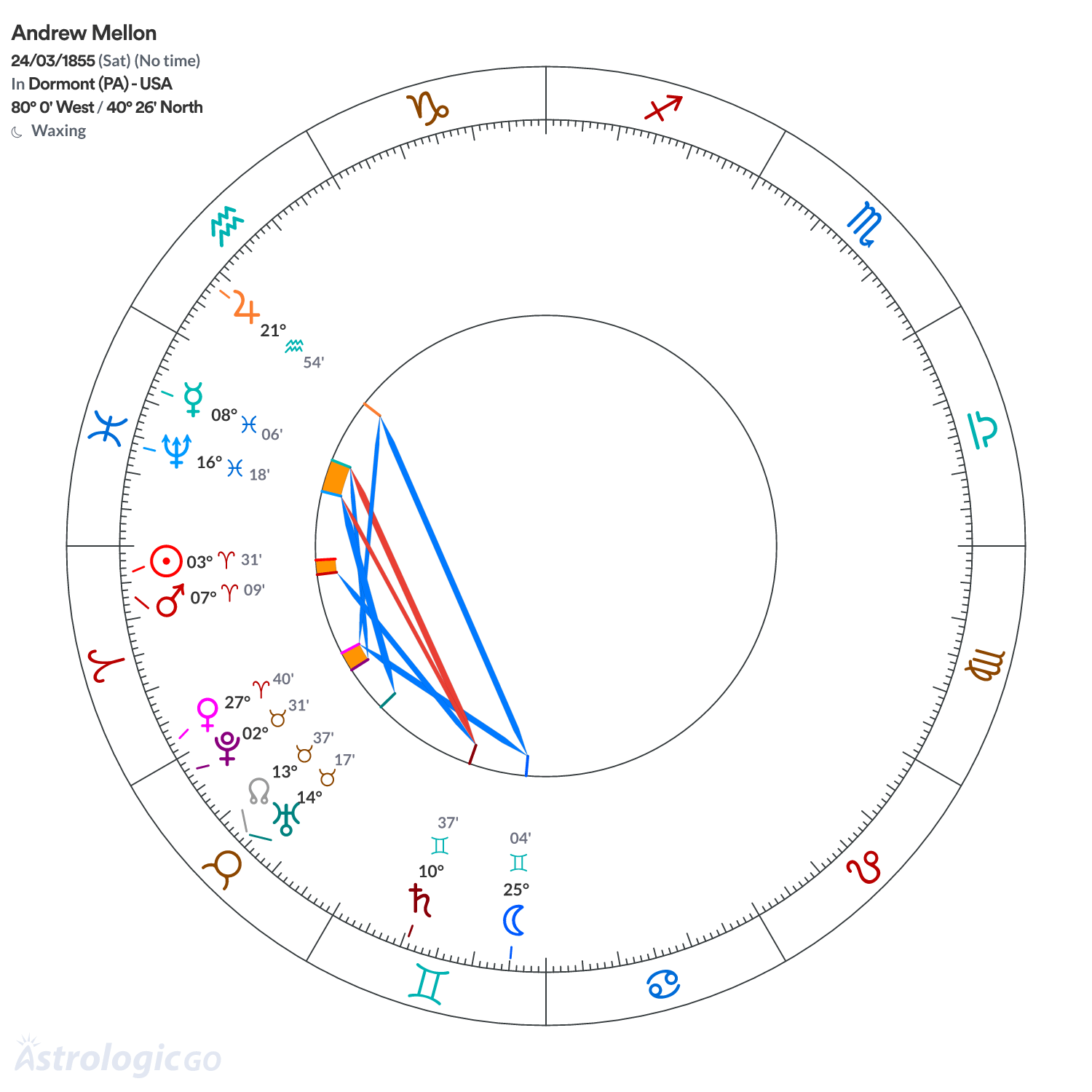
Sun Aries
Moon Gemini or Cancer
When the birth time is unknown, the chart is calculated for 12:00 noon without using the astrological houses system. Are the planets in the wrong houses?
Influences in signs
↣ Sun in Aries - 03°31'
↣ Moon in Gemini - 25°05'
↣ Mercury in Pisces - 08°07'
↣ Venus in Aries - 27°40'
↣ Mars in Aries - 07°09'
↣ Jupiter in Aquarius - 21°55'
↣ Saturn in Gemini - 10°38'
↣ Uranus in Taurus - 14°18'
↣ Neptune in Pisces - 16°19'
↣ Pluto in Taurus - 02°31'
↣ North Node in Taurus - 13°38'
Aspects
↣ Sun and Mars conjunction (3°38' applying) parallel
↣ Moon and Venus sextile (2°35' applying)
↣ Moon and Jupiter trine (3°10' separating)
↣ Mercury and Saturn square (2°31' applying)
↣ Mercury and Neptune conjunction (8°12' applying)
↣ Mercury and Pluto sextile (5°35' separating)
↣ Mercury and North Node sextile (5°31' applying)
↣ Venus and Jupiter sextile (5°45' separating)
↣ Venus and Pluto conjunction (4°51' applying)
↣ Mars and Saturn sextile (3°29' applying)
↣ Mars and Pluto antiparallel
↣ Jupiter and Uranus antiparallel
↣ Saturn and Neptune square (5°41' applying)
↣ Uranus and Neptune sextile (2°01' applying)
↣ Uranus and North Node conjunction (0°40' separating) parallel
↣ Neptune and North Node sextile (2°41' separating)
Birth data
- Original name
- Andrew William Mellon
- Chart date
- 24/03/1855
- Chart time
- No time
- Date and time quality
- BX No time - historical/organizational source what does this mean?
- Data origin
- Astro-Databank
- Location
-
 Dormont (PA), USA
 - Latitude and longitude
- 40°26' North · 80°00' West
- Time zone
- 05:20 West
The data used to calculate the charts comes from public sources, as do the descriptive texts. We use sources such as Wikipedia.

About
Andrew William Mellon was an American banker, businessman, industrialist, and philanthropist, a central figure in Pittsburgh’s influential Mellon family. Building a vast financial empire from the family bank, he became the controlling figure behind institutions such as Mellon National Bank and Union Trust, and invested in leading companies in the aluminum, steel, energy, and transportation sectors.
As a business leader, he was also a major donor to the Republican Party. Appointed Secretary of the Treasury in 1921, he held the office until 1932 under Presidents Harding, Coolidge, and Hoover. He promoted tax cuts and policies aimed at reducing the public debt in the post–World War I period, decisively shaping the fiscal agenda of the 1920s.
Mellon’s public reputation suffered after the 1929 crash and the Great Depression; he faced a tax investigation in the early 1930s and was reassigned to the embassy in the United Kingdom before returning to private life. Alongside his business and political career, he left a significant philanthropic legacy: among other initiatives, he was one of the founders of the National Gallery of Art and supported educational and cultural institutions bearing the Mellon name.


