Birth Chart
Anita Hill
Anita Faye Hill
Sun Leo
Moon Taurus
When the birth time is unknown, the chart is calculated for 12:00 noon without using the astrological houses system. Are the planets in the wrong houses?
Influences in signs
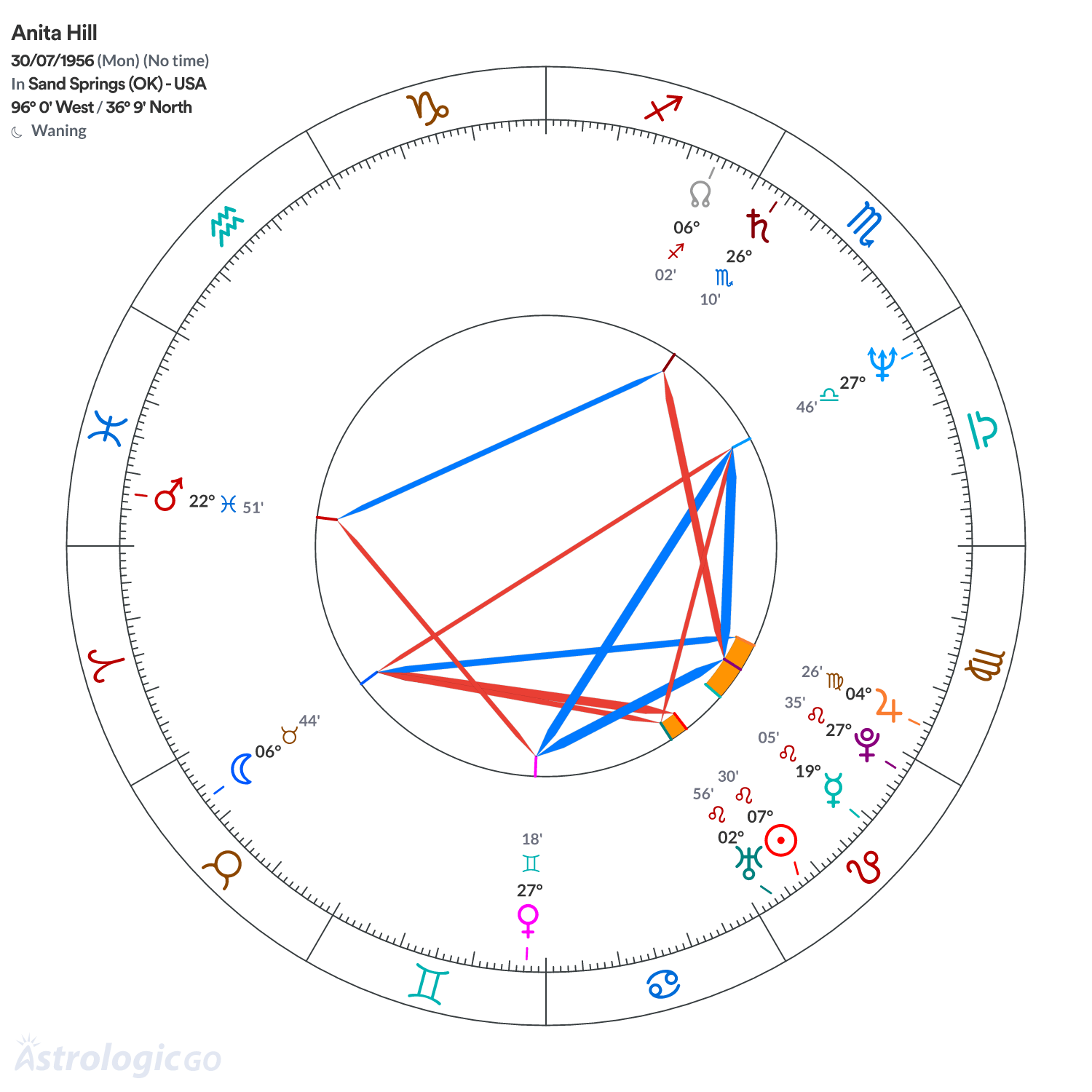
↣ Sun in Leo - 07°31'
↣ Moon in Taurus - 06°44'
↣ Mercury in Leo - 19°05'
↣ Venus in Gemini - 27°19'
↣ Mars in Pisces - 22°51'
↣ Jupiter in Virgo - 04°27'
↣ Saturn in Scorpio - 26°10' - retrograde
↣ Uranus in Leo - 02°56'
↣ Neptune in Libra - 27°46'
↣ Pluto in Leo - 27°36'
↣ North Node in Sagittarius - 06°02' - retrograde
Aspects
↣ Sun and Moon square (0°47' applying)
↣ Sun and Venus parallel
↣ Sun and Saturn antiparallel
↣ Sun and Uranus conjunction (4°34' separating)
↣ Sun and North Node trine (1°28' separating)
↣ Moon and Mercury parallel
↣ Moon and Jupiter trine (2°17' separating)
↣ Moon and Saturn antiparallel
↣ Moon and Uranus square (3°48' separating)
↣ Moon and Neptune opposition (8°58' separating)
↣ Mercury and Saturn antiparallel
↣ Mercury and Pluto conjunction (8°30' applying)
↣ Venus and Mars square (4°28' separating)
↣ Venus and Saturn antiparallel
↣ Venus and Neptune trine (0°27' applying)
↣ Venus and Pluto sextile (0°17' applying)
↣ Mars and Saturn trine (3°19' applying)
↣ Jupiter and Pluto conjunction (6°51' separating)
↣ Jupiter and North Node square (1°36' applying)
↣ Saturn and Pluto square (1°26' separating)
↣ Uranus and Neptune square (5°10' separating)
↣ Uranus and North Node trine (3°06' applying)
↣ Neptune and Pluto sextile (0°10' applying)
↣ Pluto and North Node antiparallel
Birth data
- Original name
- Anita Faye Hill
- Chart date
- 30/07/1956
- Chart time
- No time
- Date and time quality
- XX Time not informed what does this mean?
- Data origin
- Astro-Databank
- Location
-
 Sand Springs (OK), USA
 - Latitude and longitude
- 36°09' North · 96°00' West
- Time zone
- 06:00 West
The data used to calculate the charts comes from public sources, as do the descriptive texts. We use sources such as Wikipedia.

About
Anita Faye Hill is an American lawyer, professor, and author, known for her work in law, social policy, and women’s studies. She served on the faculty of the Heller School for Social Policy and Management and, since 2015, has been a professor at Brandeis University, with earlier appointments at Oral Roberts University and the University of Oklahoma College of Law, where she became the first tenured Black woman faculty member.
Her public notoriety stems from her 1991 testimony before the U.S. Senate, when she accused Clarence Thomas of sexual harassment while he had been her supervisor at the Department of Education and the Equal Employment Opportunity Commission (EEOC). Hill’s testimony reopened the national debate on sexual harassment, the credibility of testimony, and women’s participation in highly publicized proceedings, provoking intense political and media controversy.
The case had a lasting impact on discourse around civil rights and workplace harassment, shaping public perceptions and subsequent media coverage. Throughout her academic and public career, Hill has remained a prominent voice in discussions of equality, professional ethics, and gender policy in the United States.


