Birth Chart
Carl Friedrich Gauss
Johann Carl Friedrich Gauss
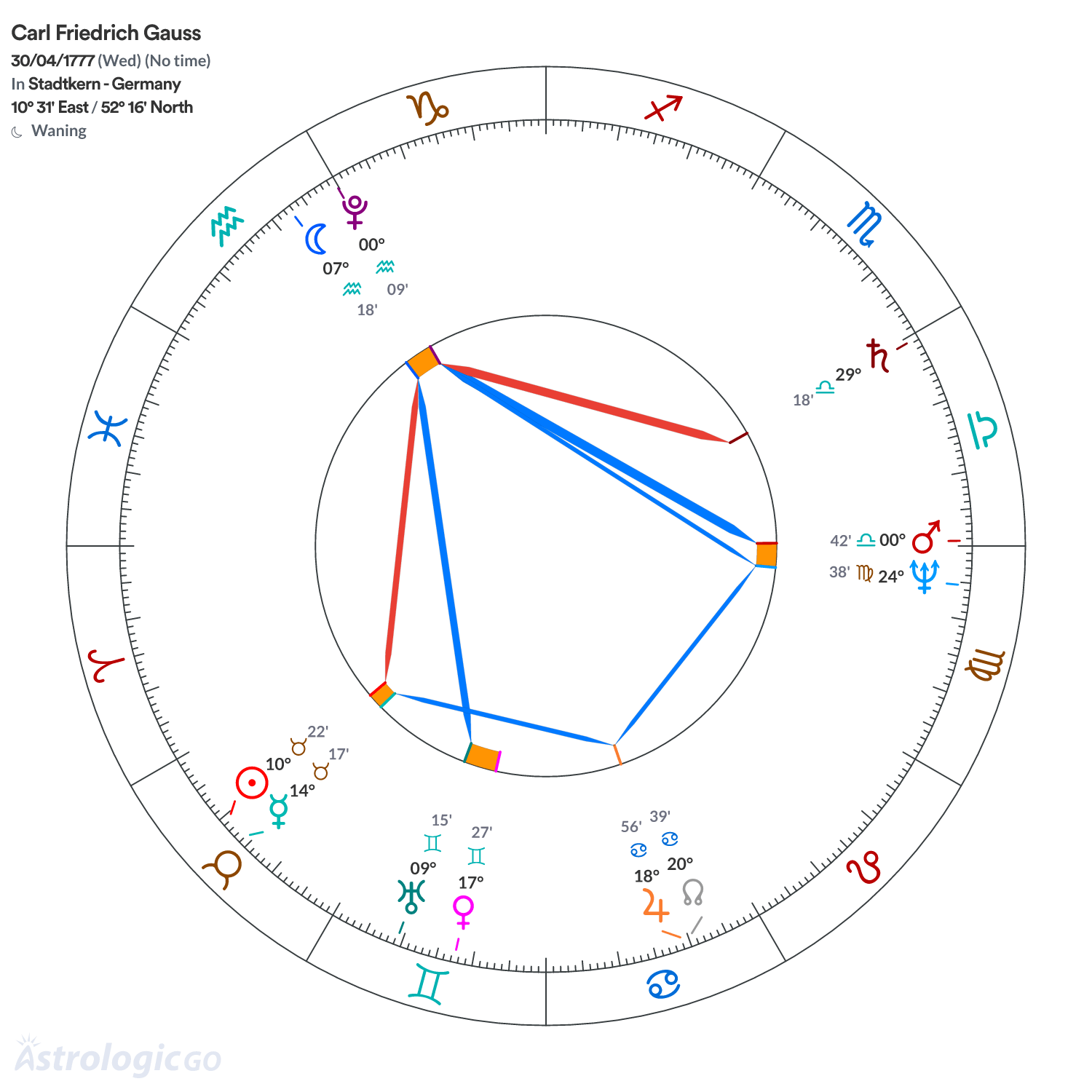
Sun Taurus
Moon Aquarius
When the birth time is unknown, the chart is calculated for 12:00 noon without using the astrological houses system. Are the planets in the wrong houses?
Influences in signs
↣ Sun in Taurus - 10°22'
↣ Moon in Aquarius - 07°18'
↣ Mercury in Taurus - 14°18'
↣ Venus in Gemini - 17°27'
↣ Mars in Libra - 00°43' - retrograde
↣ Jupiter in Cancer - 18°56'
↣ Saturn in Libra - 29°18' - retrograde
↣ Uranus in Gemini - 09°16'
↣ Neptune in Virgo - 24°38' - retrograde
↣ Pluto in Aquarius - 00°10'
↣ North Node in Cancer - 20°40'
Aspects
↣ Sun and Moon square (3°04' applying)
↣ Sun and Mercury conjunction (3°56' separating)
↣ Moon and Uranus trine (1°57' applying)
↣ Moon and Pluto conjunction (7°09' separating)
↣ Mercury and Jupiter sextile (4°38' applying)
↣ Venus and Uranus conjunction (8°11' separating)
↣ Mars and Neptune conjunction (6°04' applying)
↣ Mars and Pluto trine (0°33' applying)
↣ Jupiter and Uranus parallel
↣ Jupiter and Neptune sextile (5°42' applying)
↣ Jupiter and Pluto antiparallel
↣ Jupiter and North Node conjunction (1°43' applying) parallel
↣ Saturn and Pluto square (0°52' separating)
↣ Uranus and North Node parallel
↣ Neptune and Pluto trine (5°31' separating)
↣ Neptune and North Node sextile (3°59' applying)
Birth data
- Original name
- Johann Carl Friedrich Gauss
- Chart date
- 30/04/1777
- Chart time
- No time
- Date and time quality
- XX Time not informed what does this mean?
- Data origin
- Astro-Databank
- Location
-
 Stadtkern, Germany
 - Latitude and longitude
- 52°16' North · 10°31' East
- Time zone
- 00:42 East
The data used to calculate the charts comes from public sources, as do the descriptive texts. We use sources such as Wikipedia.

About
Johann Carl Friedrich Gauss was a German mathematician, astronomer and physicist whose work had a profound impact on many areas of the exact sciences. He became known for number theory — where he published the foundational Disquisitiones Arithmeticae — and made decisive contributions to statistics, analysis, differential geometry, geodesy, geophysics, electrostatics, astronomy and optics. He is frequently cited as one of the most influential mathematicians in history.
Of modest origins, his early talent was recognized by teachers and patrons, which secured him advanced education and academic opportunities. While still young he showed critical rigor, seeking to fill gaps in proofs and formulating original results that would only be fully appreciated decades later. His habit of thoroughly polishing his work led to late publications, but ones of high precision.
Gauss also left a legacy of practical methods, such as the use of least squares and the normal error curve, which are fundamental in the theory of observational errors and in statistics. His influence permeated both theoretical development and scientific applications, earning him a lasting reputation in the canon of mathematical sciences.


