Birth Chart
Carl Spitteler
Carl Friedrich Georg Spitteler
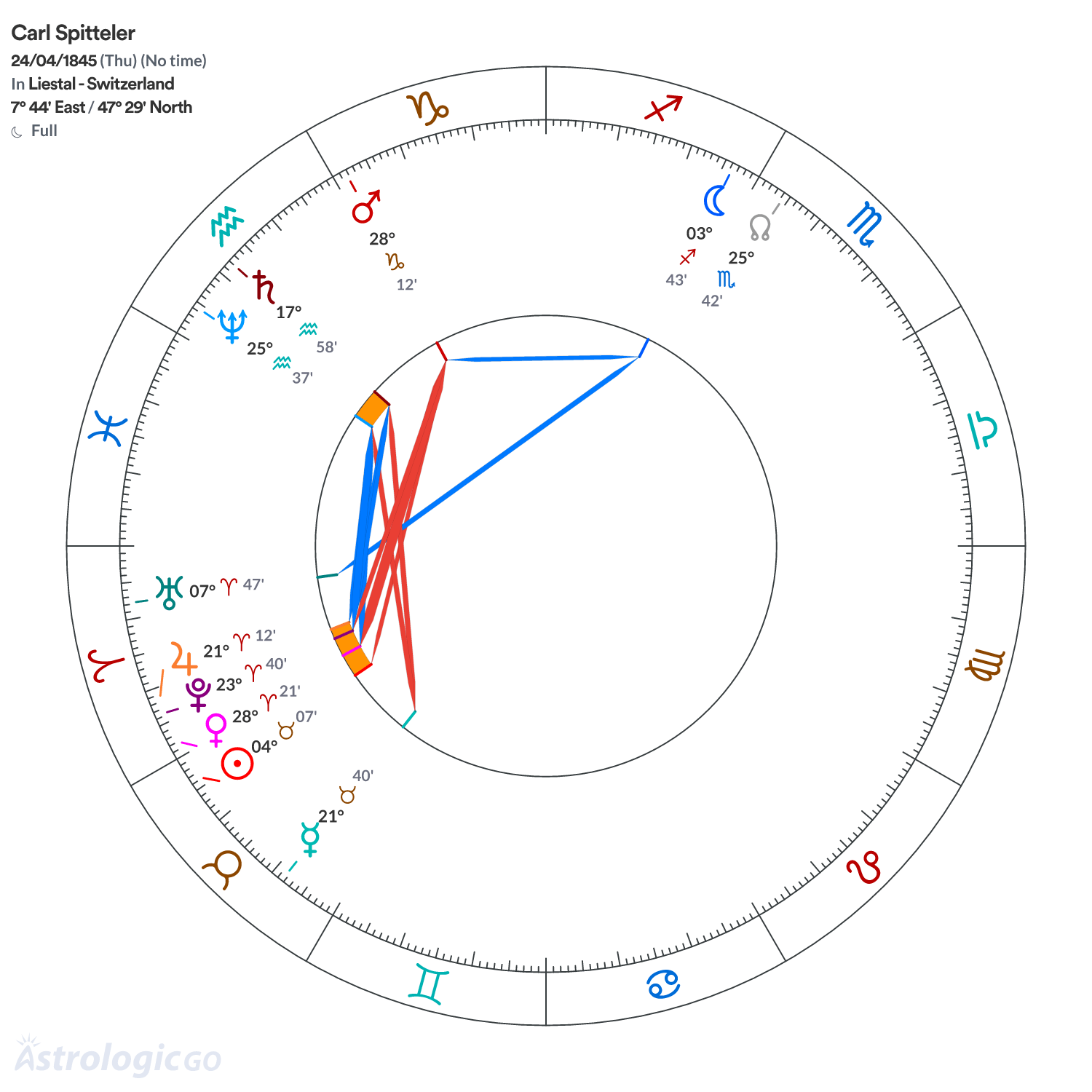
Sun Taurus
Moon Scorpio or Sagittarius
When the birth time is unknown, the chart is calculated for 12:00 noon without using the astrological houses system. Are the planets in the wrong houses?
Influences in signs
↣ Sun in Taurus - 04°07'
↣ Moon in Sagittarius - 03°43'
↣ Mercury in Taurus - 21°41'
↣ Venus in Aries - 28°21'
↣ Mars in Capricorn - 28°13'
↣ Jupiter in Aries - 21°13'
↣ Saturn in Aquarius - 17°59'
↣ Uranus in Aries - 07°47'
↣ Neptune in Aquarius - 25°37'
↣ Pluto in Aries - 23°41'
↣ North Node in Scorpio - 25°43'
Aspects
↣ Sun and Venus conjunction (5°46' applying)
↣ Sun and Mars square (5°54' separating)
↣ Sun and Neptune antiparallel
↣ Moon and Mercury antiparallel
↣ Moon and Mars sextile (5°30' separating)
↣ Moon and Uranus trine (4°04' applying)
↣ Moon and North Node conjunction (8°00' separating) parallel
↣ Mercury and Mars antiparallel
↣ Mercury and Saturn square (3°42' separating)
↣ Mercury and Neptune square (3°57' applying)
↣ Mercury and North Node opposition (4°02' applying)
↣ Venus and Mars square (0°08' separating)
↣ Venus and Jupiter conjunction (7°08' separating)
↣ Venus and Neptune sextile (2°43' separating)
↣ Venus and Pluto conjunction (4°40' separating)
↣ Mars and Pluto square (4°32' separating)
↣ Mars and North Node sextile (2°30' separating)
↣ Jupiter and Saturn sextile (3°14' separating)
↣ Jupiter and Neptune sextile (4°25' applying)
↣ Jupiter and Pluto conjunction (2°28' applying) antiparallel
↣ Saturn and Neptune conjunction (7°38' applying)
↣ Saturn and Pluto sextile (5°42' applying)
↣ Neptune and Pluto sextile (1°57' applying)
↣ Neptune and North Node square (0°05' applying)
Birth data
- Original name
- Carl Friedrich Georg Spitteler
- Chart date
- 24/04/1845
- Chart time
- No time
- Date and time quality
- XX Time not informed what does this mean?
- Data origin
- Astro-Databank
- Location
-
 Liestal, Switzerland
 - Latitude and longitude
- 47°29' North · 7°44' East
- Time zone
- 00:31 East
The data used to calculate the charts comes from public sources, as do the descriptive texts. We use sources such as Wikipedia.

About
Carl Friedrich Georg Spitteler was a Swiss writer in the German language whose work lies between allegorical poetry and the autobiographical novel. Trained in law and theology, he studied in Zurich, Heidelberg and Basel and worked as a tutor in Russia—experiences that shaped his literary outlook and the creation of personal myths in prose poetry.
His output includes prose poems and epic-allegorical verse: Prometheus and Epimetheus (first published under a pseudonym and later reissued as Prometheus the Patient) and, above all, the long poem Olympic Spring, for which he was awarded the Nobel Prize in Literature in 1919. In 1906 he also published Imago, an autobiographically inclined novella that increased his renown.
Over his career he collected essays, short narratives and poetry volumes that engage with mythical, existential and cultural themes of his time. Recognized for combining scholarship, symbolism and formal ingenuity, his work influenced German-language literature at the turn of the twentieth century and remains a point of reference in studies of modern poetry and allegorical narrative.


