Birth Chart
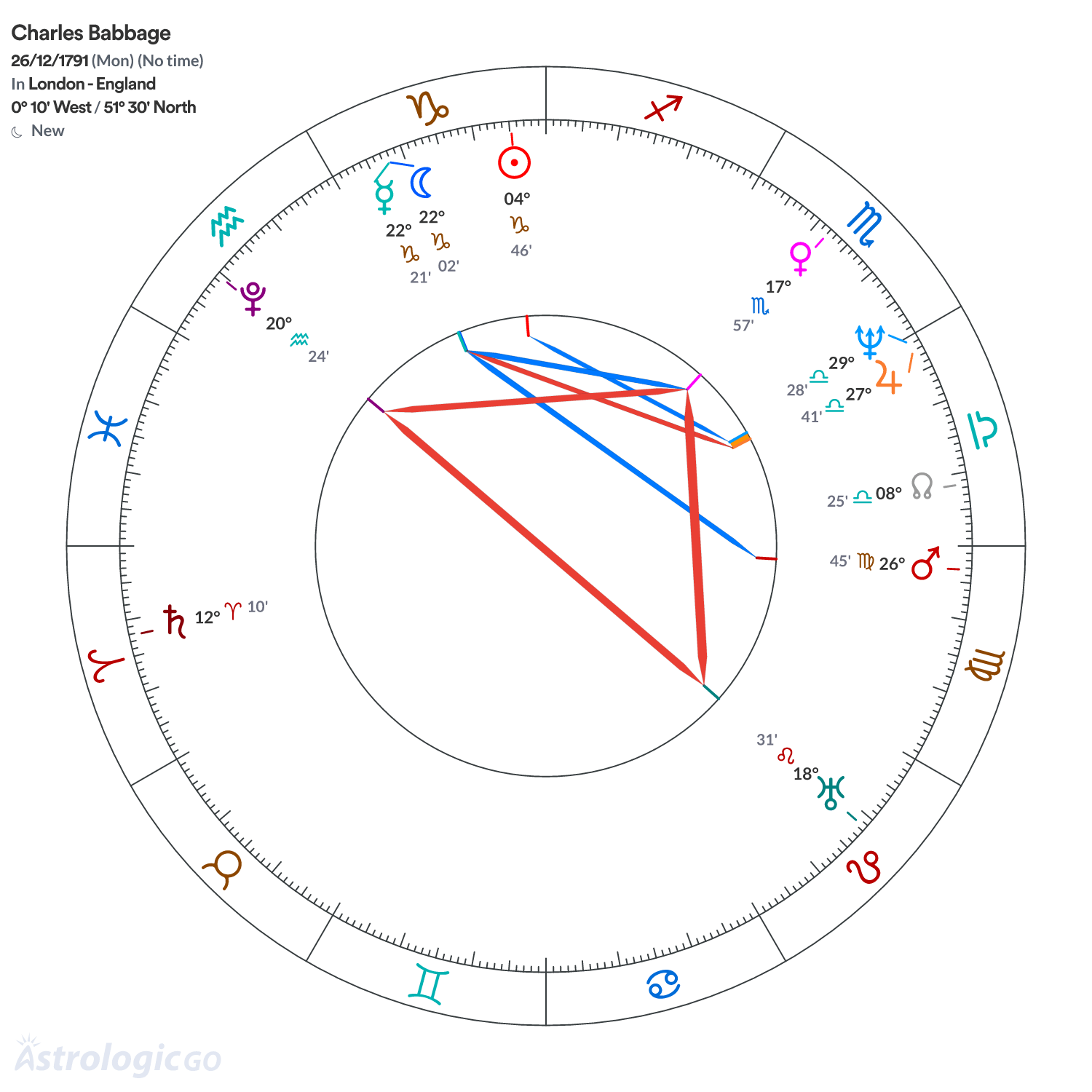
Charles Babbage
Sun Capricorn
Moon Capricorn
When the birth time is unknown, the chart is calculated for 12:00 noon without using the astrological houses system. Are the planets in the wrong houses?
Influences in signs
↣ Sun in Capricorn - 04°46'
↣ Moon in Capricorn - 22°02'
↣ Mercury in Capricorn - 22°22'
↣ Venus in Scorpio - 17°58'
↣ Mars in Virgo - 26°46'
↣ Jupiter in Libra - 27°41'
↣ Saturn in Aries - 12°10'
↣ Uranus in Leo - 18°32' - retrograde
↣ Neptune in Libra - 29°29'
↣ Pluto in Aquarius - 20°25'
↣ North Node in Libra - 08°26' - retrograde
Aspects
↣ Sun and Mercury parallel
↣ Sun and Neptune sextile (5°17' separating)
↣ Sun and Pluto parallel
↣ Sun and North Node square (3°40' applying)
↣ Moon and Mercury conjunction (0°19' applying)
↣ Moon and Venus sextile (4°05' separating)
↣ Moon and Mars trine (4°43' applying)
↣ Moon and Jupiter square (5°39' applying)
↣ Moon and Uranus antiparallel
↣ Mercury and Venus sextile (4°24' separating)
↣ Mercury and Mars trine (4°24' applying)
↣ Mercury and Jupiter square (5°20' applying)
↣ Mercury and Pluto parallel
↣ Venus and Uranus square (0°34' applying)
↣ Venus and Pluto square (2°27' applying)
↣ Mars and North Node antiparallel
↣ Jupiter and Neptune conjunction (1°48' applying) parallel
↣ Saturn and North Node opposition (3°45' separating) antiparallel
↣ Uranus and Pluto opposition (1°53' separating)
Birth data
- Chart date
- 26/12/1791
- Chart time
- No time
- Date and time quality
- XX Time not informed what does this mean?
- Data origin
- Astro-Databank
- Location
-
 London, England
 - Latitude and longitude
- 51°30' North · 0°10' West
- Time zone
- 00:01 West
The data used to calculate the charts comes from public sources, as do the descriptive texts. We use sources such as Wikipedia.

About
Charles Babbage was an English scientist and inventor recognized as a pioneer of computing for conceiving the Analytical Engine, a design for a mechanical programmable computer that established fundamental principles of modern computers. Although the machine was never completed due to the technical and cost limitations of his era, his ideas about calculation units, memory, and punched cards influenced later generations.
In addition to the Analytical Engine, Babbage designed the Difference Engine and worked across several academic fields: mathematics, statistics, physics, and geology. He helped reform the English postal service and applied methods of statistical analysis and cryptanalysis, contributing to the defeat of ciphers such as the Vigenère cipher.
A Cambridge-educated academic, he was active in the Analytical Society and served as a professor of mathematics. Although many of his inventions remained unfinished, his technical and intellectual legacy was recognized posthumously; the Science Museum in London later built one of his designs using period techniques, demonstrating the viability of his drawings.


