Birth Chart
Claes Oldenburg
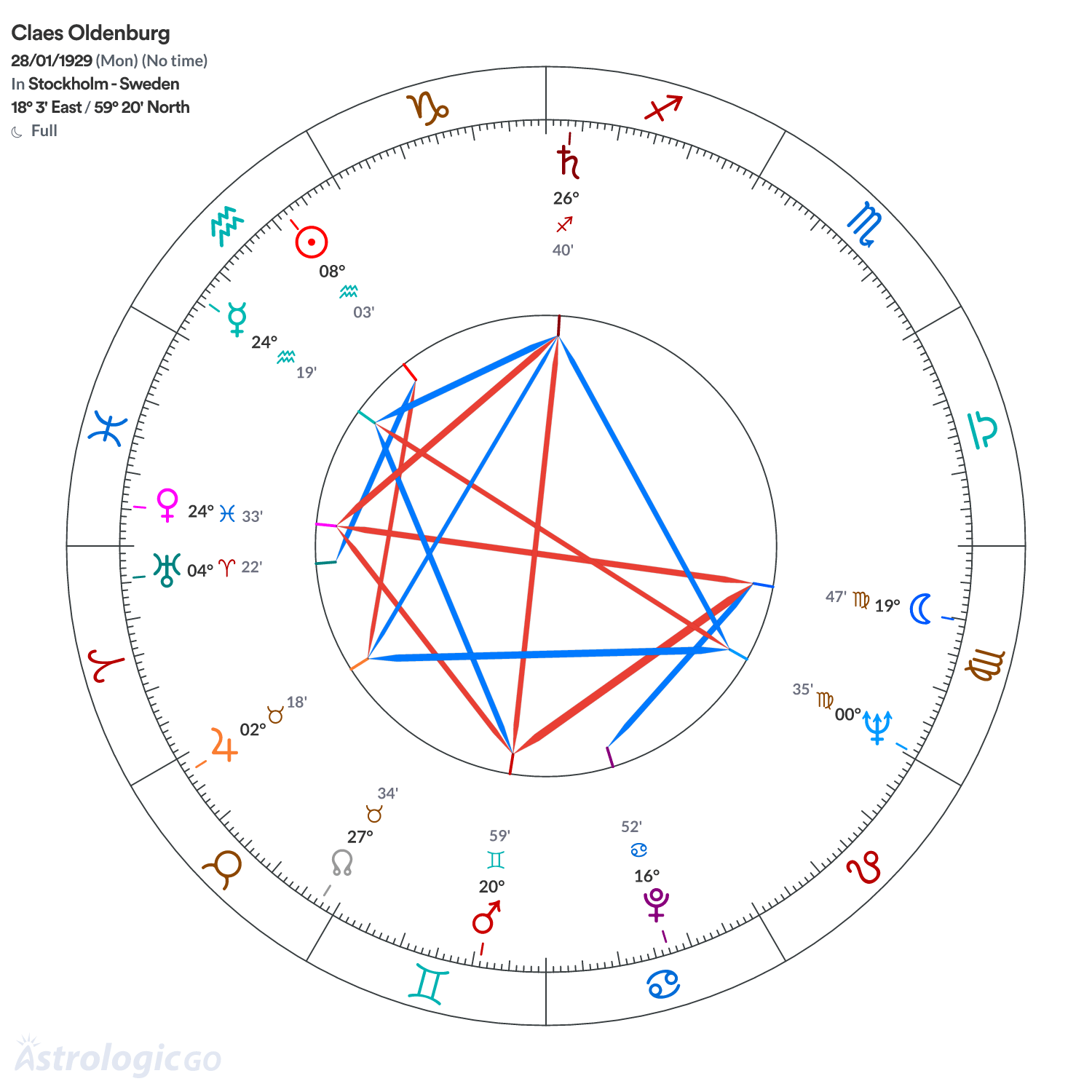
Sun Aquarius
Moon Virgo
When the birth time is unknown, the chart is calculated for 12:00 noon without using the astrological houses system. Are the planets in the wrong houses?
Influences in signs
↣ Sun in Aquarius - 08°04'
↣ Moon in Virgo - 19°47'
↣ Mercury in Aquarius - 24°20'
↣ Venus in Pisces - 24°33'
↣ Mars in Gemini - 20°59'
↣ Jupiter in Taurus - 02°19'
↣ Saturn in Sagittarius - 26°40'
↣ Uranus in Aries - 04°22'
↣ Neptune in Virgo - 00°36' - retrograde
↣ Pluto in Cancer - 16°53' - retrograde
↣ North Node in Taurus - 27°35' - retrograde
Aspects
↣ Sun and Jupiter square (5°45' separating)
↣ Sun and Uranus sextile (3°41' separating)
↣ Sun and North Node antiparallel
↣ Moon and Venus opposition (4°46' applying)
↣ Moon and Mars square (1°12' applying)
↣ Moon and Pluto sextile (2°55' separating)
↣ Mercury and Mars trine (3°20' separating)
↣ Mercury and Jupiter antiparallel
↣ Mercury and Saturn sextile (2°20' applying)
↣ Mercury and Neptune opposition (6°16' applying) antiparallel
↣ Mercury and North Node square (3°15' applying)
↣ Venus and Mars square (3°33' separating)
↣ Venus and Saturn square (2°07' applying)
↣ Venus and North Node sextile (3°02' applying)
↣ Mars and Saturn opposition (5°40' separating)
↣ Jupiter and Saturn trine (5°39' separating)
↣ Jupiter and Neptune trine (1°43' separating) parallel
↣ Saturn and Neptune trine (3°56' applying)
↣ Saturn and Pluto antiparallel
↣ Neptune and North Node square (3°01' separating)
Birth data
- Chart date
- 28/01/1929
- Chart time
- No time
- Date and time quality
- XX Time not informed what does this mean?
- Data origin
- Astro-Databank
- Location
-
 Stockholm, Sweden
 - Latitude and longitude
- 59°20' North · 18°03' East
- Time zone
- 01:00 East
The data used to calculate the charts comes from public sources, as do the descriptive texts. We use sources such as Wikipedia.

About
Sculptor of Swedish origin based in the United States, Claes Oldenburg became a central figure of Pop Art by transforming everyday objects into large-scale public monuments. His best-known works present enlarged replicas of banal items — foods, tools, and utensils — often rendered with irony and bright colors, subverting sculptural tradition and the institutional tone of public art.
Another important strand of his work is the “soft sculptures,” soft textile pieces that reinterpret domestic objects, broadening his range of materials and the relationship between form and humor. In the 1960s Oldenburg took an active part in happenings and performative actions that challenged the dominant abstractionism and brought art closer to everyday life.
From the 1970s he focused on public commissions and, beginning in 1976, in collaboration with artist and historian Coosje van Bruggen, completed more than forty large-scale projects. Those partnerships cemented his legacy: internationally recognized public sculptures that could provoke both ridicule and admiration, influencing later generations of artists and shaping perceptions of urban space.