Birth Chart
Claude Shannon
Claude Elwood Jr Shannon
Sun Taurus
Moon Aries
When the birth time is unknown, the chart is calculated for 12:00 noon without using the astrological houses system. Are the planets in the wrong houses?
Influences in signs
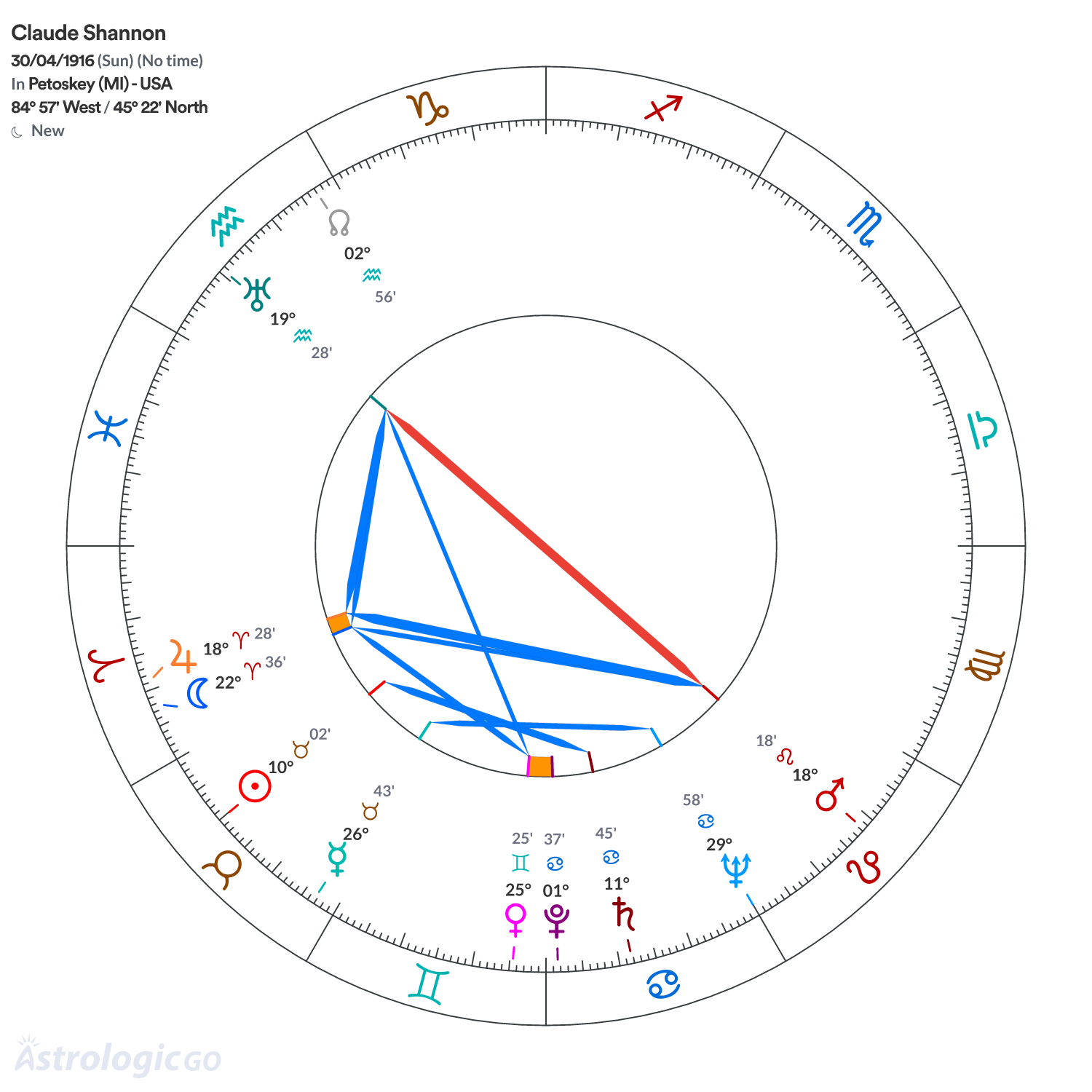
↣ Sun in Taurus - 10°02'
↣ Moon in Aries - 22°36'
↣ Mercury in Taurus - 26°43'
↣ Venus in Gemini - 25°26'
↣ Mars in Leo - 18°18'
↣ Jupiter in Aries - 18°29'
↣ Saturn in Cancer - 11°45'
↣ Uranus in Aquarius - 19°28'
↣ Neptune in Cancer - 29°59'
↣ Pluto in Cancer - 01°38'
↣ North Node in Aquarius - 02°57' - retrograde
Aspects
↣ Sun and Moon parallel
↣ Sun and Saturn sextile (1°43' applying)
↣ Sun and Uranus antiparallel
↣ Moon and Venus sextile (2°50' applying)
↣ Moon and Mars trine (4°18' separating)
↣ Moon and Jupiter conjunction (4°07' separating)
↣ Moon and Uranus sextile (3°08' separating)
↣ Mercury and Neptune sextile (3°16' applying)
↣ Venus and Uranus trine (5°58' separating)
↣ Venus and Pluto conjunction (6°12' applying)
↣ Mars and Jupiter trine (0°11' applying)
↣ Mars and Uranus opposition (1°10' applying)
↣ Jupiter and Uranus sextile (0°59' applying)
↣ Neptune and North Node opposition (2°58' applying) antiparallel
Birth data
- Original name
- Claude Elwood Jr Shannon
- Chart date
- 30/04/1916
- Chart time
- No time
- Date and time quality
- AX No time - documented source what does this mean?
- Data origin
- Astro-Databank
- Location
-
 Petoskey (MI), USA
 - Latitude and longitude
- 45°22' North · 84°57' West
- Time zone
- 06:00 West
The data used to calculate the charts comes from public sources, as do the descriptive texts. We use sources such as Wikipedia.

About
Claude Elwood Shannon was an American mathematician, electrical engineer and cryptographer, widely recognized as the father of information theory. His 1948 publication, A Mathematical Theory of Communication, established the basis for measuring information and for message encoding—concepts that transformed telecommunications, coding theory and signal processing. The 1949 book version, coauthored with Warren Weaver, helped popularize these ideas among non-specialists.
Earlier, Shannon’s 1937 MIT master’s thesis showed that Boolean algebra could be applied to the design of switching circuits, providing the practical foundation for digital computers and digital circuit design. That work became a central reference for electrical engineering and computer science in the following decades.
During World War II he worked on cryptanalysis and fire-control problems at Bell Labs, bringing together issues of communications, noise and security. He also participated in the Macy Conferences, contributing to the consolidation of cybernetics. His legacy spans theory, methods and applications that shaped the information age and modern electronics.


