Birth Chart
Clement Attlee
Clement Richard Attlee
Sun Capricorn
Moon Libra or Scorpio
When the birth time is unknown, the chart is calculated for 12:00 noon without using the astrological houses system. Are the planets in the wrong houses?
Influences in signs
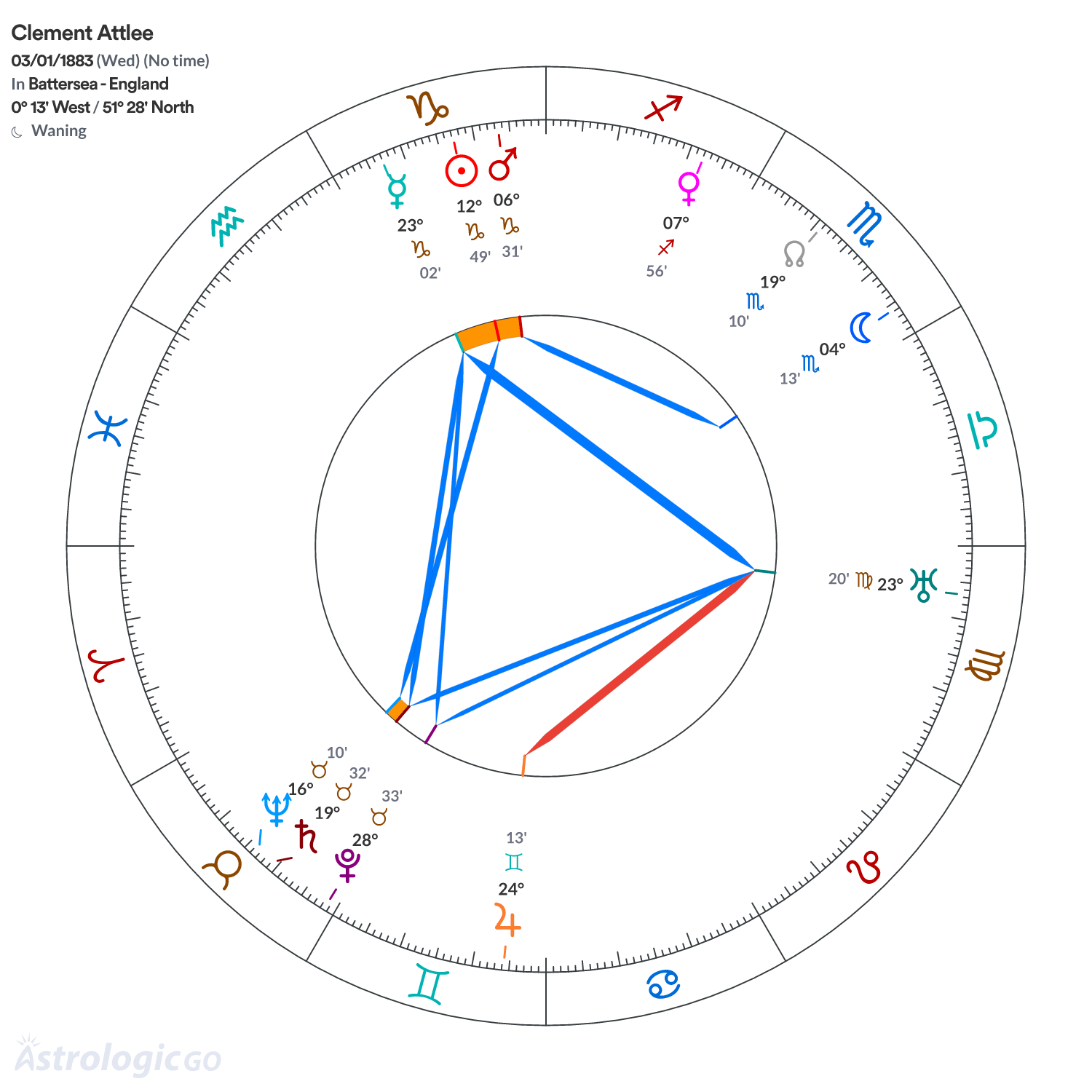
↣ Sun in Capricorn - 12°50'
↣ Moon in Scorpio - 04°14'
↣ Mercury in Capricorn - 23°02'
↣ Venus in Sagittarius - 07°56'
↣ Mars in Capricorn - 06°32'
↣ Jupiter in Gemini - 24°14' - retrograde
↣ Saturn in Taurus - 19°32' - retrograde
↣ Uranus in Virgo - 23°20' - retrograde
↣ Neptune in Taurus - 16°11' - retrograde
↣ Pluto in Taurus - 28°34' - retrograde
↣ North Node in Scorpio - 19°10'
Aspects
↣ Sun and Mercury conjunction (10°13' separating) parallel
↣ Sun and Mars conjunction (6°18' separating) parallel
↣ Sun and Jupiter antiparallel
↣ Sun and Neptune trine (3°21' applying)
↣ Moon and Mars sextile (2°18' applying)
↣ Moon and Saturn antiparallel
↣ Moon and Neptune antiparallel
↣ Mercury and Mars parallel
↣ Mercury and Jupiter antiparallel
↣ Mercury and Saturn trine (3°30' separating)
↣ Mercury and Uranus trine (0°18' applying)
↣ Mercury and Pluto trine (5°31' applying)
↣ Mercury and North Node sextile (3°52' separating)
↣ Venus and North Node parallel
↣ Jupiter and Uranus square (0°53' applying)
↣ Saturn and Uranus trine (3°48' separating)
↣ Saturn and Neptune conjunction (3°22' applying) parallel
↣ Saturn and North Node opposition (0°22' applying)
↣ Uranus and Pluto trine (5°13' applying)
↣ Uranus and North Node sextile (4°10' applying)
↣ Neptune and North Node opposition (3°00' separating)
Birth data
- Original name
- Clement Richard Attlee
- Chart date
- 03/01/1883
- Chart time
- No time
- Date and time quality
- XX Time not informed what does this mean?
- Data origin
- Astro-Databank
- Location
-
 Battersea, England
 - Latitude and longitude
- 51°28' North · 0°13' West
- Time zone
- 00:00
The data used to calculate the charts comes from public sources, as do the descriptive texts. We use sources such as Wikipedia.

About
Clement Richard Attlee was a prominent British politician, leader of the Labour Party from 1935 to 1955 and Prime Minister of the United Kingdom from 1945 to 1951. Trained as a lawyer, he moved into public service after volunteer work in London’s East End, rising through local and national politics to lead the post‑war Labour government.
His tenure was marked by a comprehensive transformation of the state: he adopted Keynesian policies to promote full employment and implemented an extensive programme of social reforms and nationalizations. Central achievements include the creation of the National Health Service (NHS) in 1948, the National Insurance Act of 1946, National Assistance legislation, major investment in public housing, and the nationalization of strategic services and industries.
In foreign policy, he oversaw decisive processes in the decline of the British Empire, such as the partition and independence of India and the transition of colonies like Burma and Ceylon. He was also an important figure in the Western alliance during the Cold War, supporting the Marshall Plan and the United Kingdom’s entry into NATO.
Attlee is remembered for his discreet, pragmatic style and for leaving a lasting legacy in the construction of the modern British welfare state, and he is frequently ranked among the great twentieth‑century prime ministers.


