Birth Chart
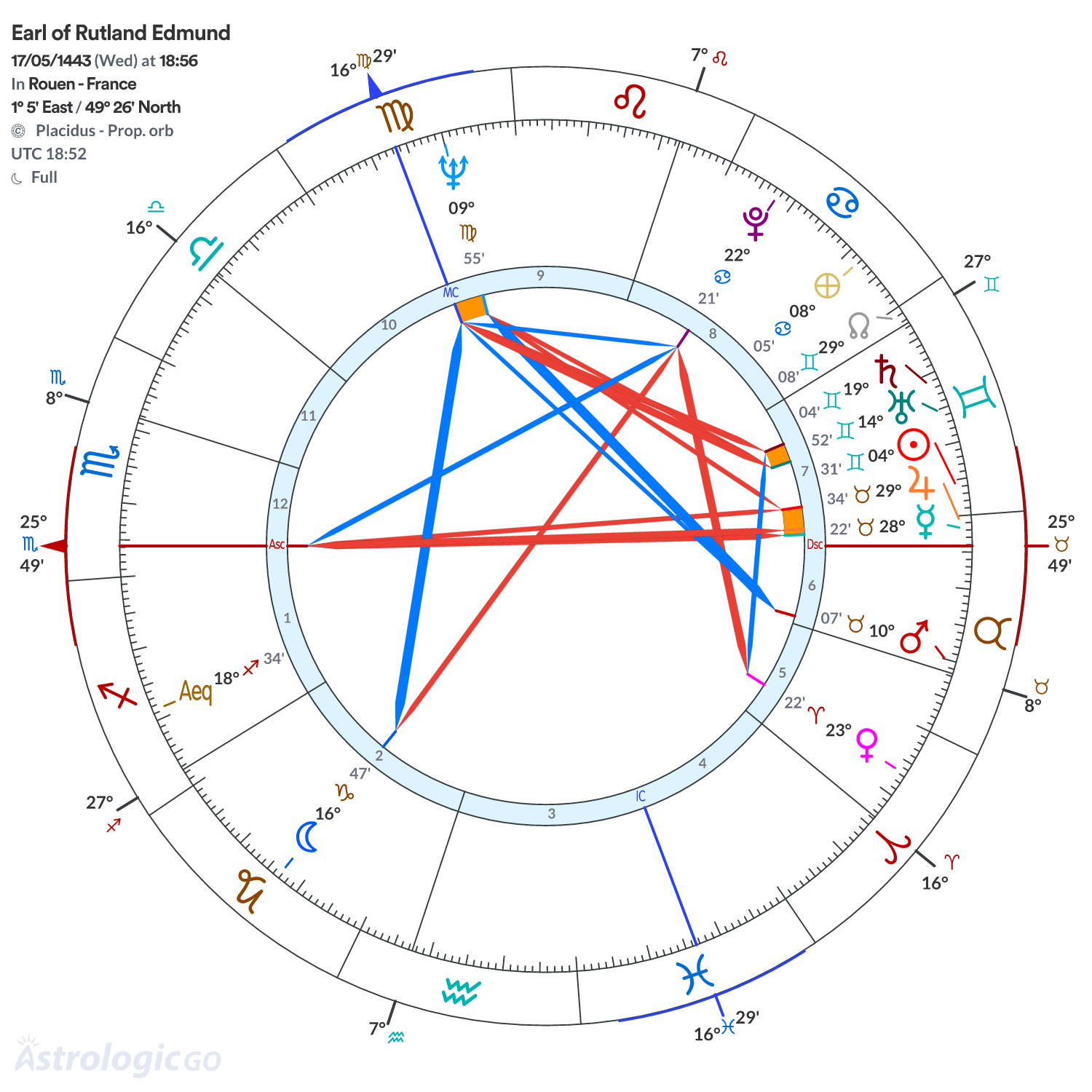
Earl of Rutland Edmund
Edmund Plantagenet
Sun Gemini
Moon Capricorn
Ascendant Scorpio
Influences in signs
↣ Sun in Gemini - 04°31' - in house 7
↣ Moon in Capricorn - 16°47' - in house 2
↣ Mercury in Taurus - 28°22' - in house 7 - retrograde
↣ Venus in Aries - 23°23' - in house 5
↣ Mars in Taurus - 10°07' - in house 6
↣ Jupiter in Taurus - 29°34' - in house 7
↣ Saturn in Gemini - 19°04' - in house 7/8
↣ Uranus in Gemini - 14°53' - in house 7
↣ Neptune in Virgo - 09°55' - in house 10
↣ Pluto in Cancer - 22°22' - in house 8
↣ North Node in Gemini - 29°08' - in house 8
↣ Ascendant in Scorpio - 25°49' - in house 1
↣ Midheaven in Virgo - 16°29' - in house 10
↣ Equatorial Ascendant in Sagittarius - 18°35'
Influences in houses
↣ Sun in house 7
↣ Moon in house 2
↣ Mercury in house 7
↣ Venus in house 5
↣ Mars in house 6
↣ Jupiter in house 7
↣ Saturn in house 7/8
↣ Uranus in house 7
↣ Neptune in house 10
↣ Pluto in house 8
↣ North Node in house 8
↣ Ascendant in house 1
↣ Midheaven in house 10
Aspects
↣ Sun and Mercury conjunction (6°09' separating)
↣ Sun and Jupiter conjunction (4°57' separating)
↣ Sun and Saturn parallel
↣ Sun and Neptune square (5°24' applying)
↣ Sun and Ascendant opposition (8°42' applying)
↣ Moon and Uranus antiparallel
↣ Moon and Pluto opposition (5°34' applying) antiparallel
↣ Moon and North Node antiparallel
↣ Moon and Midheaven trine (0°18' applying)
↣ Mercury and Jupiter conjunction (1°12' separating)
↣ Mercury and Ascendant opposition (2°33' applying)
↣ Venus and Saturn sextile (4°19' separating)
↣ Venus and Pluto square (1°01' separating)
↣ Venus and North Node sextile (5°45' applying)
↣ Venus and Equatorial Ascendant trine (4°48' applying)
↣ Mars and Neptune trine (0°12' separating)
↣ Mars and Midheaven trine (6°23' separating)
↣ Jupiter and Ascendant opposition (3°45' applying) antiparallel
↣ Saturn and Uranus conjunction (4°11' separating) parallel
↣ Saturn and Equatorial Ascendant opposition (0°29' applying)
↣ Saturn and Midheaven square (2°35' applying)
↣ Uranus and Neptune square (4°58' separating)
↣ Uranus and North Node parallel
↣ Uranus and Equatorial Ascendant opposition (3°42' separating)
↣ Uranus and Midheaven square (1°37' separating)
↣ Neptune and Midheaven conjunction (6°34' separating)
↣ Pluto and Ascendant trine (3°27' separating)
↣ Pluto and Midheaven sextile (5°52' applying)
Birth data
- Original name
- Edmund Plantagenet
- Chart date
- 17/05/1443
- Chart time
- 18:56
- Date and time quality
- AA Birth record cited what does this mean?
- Data origin
- Astro-Databank
- Location
-
 Rouen, France
 - Latitude and longitude
- 49°26' North · 1°05' East
- Time zone
- 00:04 East
The data used to calculate the charts comes from public sources, as do the descriptive texts. We use sources such as Wikipedia.

About
Edmund Plantagenet, Earl of Rutland, was a member of the fifteenth-century English nobility associated with the House of York. The son of Richard, Duke of York, and Cecily Neville, he was created Earl of Rutland as a child and formally held the office of Chancellor of Ireland, with the duties performed by vice-chancellors because of his minority. That episode linked his name to parliamentary decisions that strengthened the normative autonomy of the Irish Parliament in relation to the Kingdom of England.
When the Wars of the Roses broke out, Edmund served in campaigns alongside his father. He died at seventeen at the Battle of Wakefield (30 December 1460), when the defeat of the Yorkist forces led to his capture and execution. His death had symbolic repercussions: Edmund’s head was publicly displayed, alongside those of relatives, as a demonstration of political victory.
Rutland’s figure also received literary representation: William Shakespeare includes him in Henry VI, Part 3, where he appears as a victim of the war’s violence, a depiction that shaped cultural memory of his fate. Edmund was initially buried at Pontefract Priory and, years later, reinterred in the family pantheon at Fotheringhay.


