Birth Chart
Elias Canetti
Sun Leo
Moon Taurus
Ascendant Gemini
Influences in signs
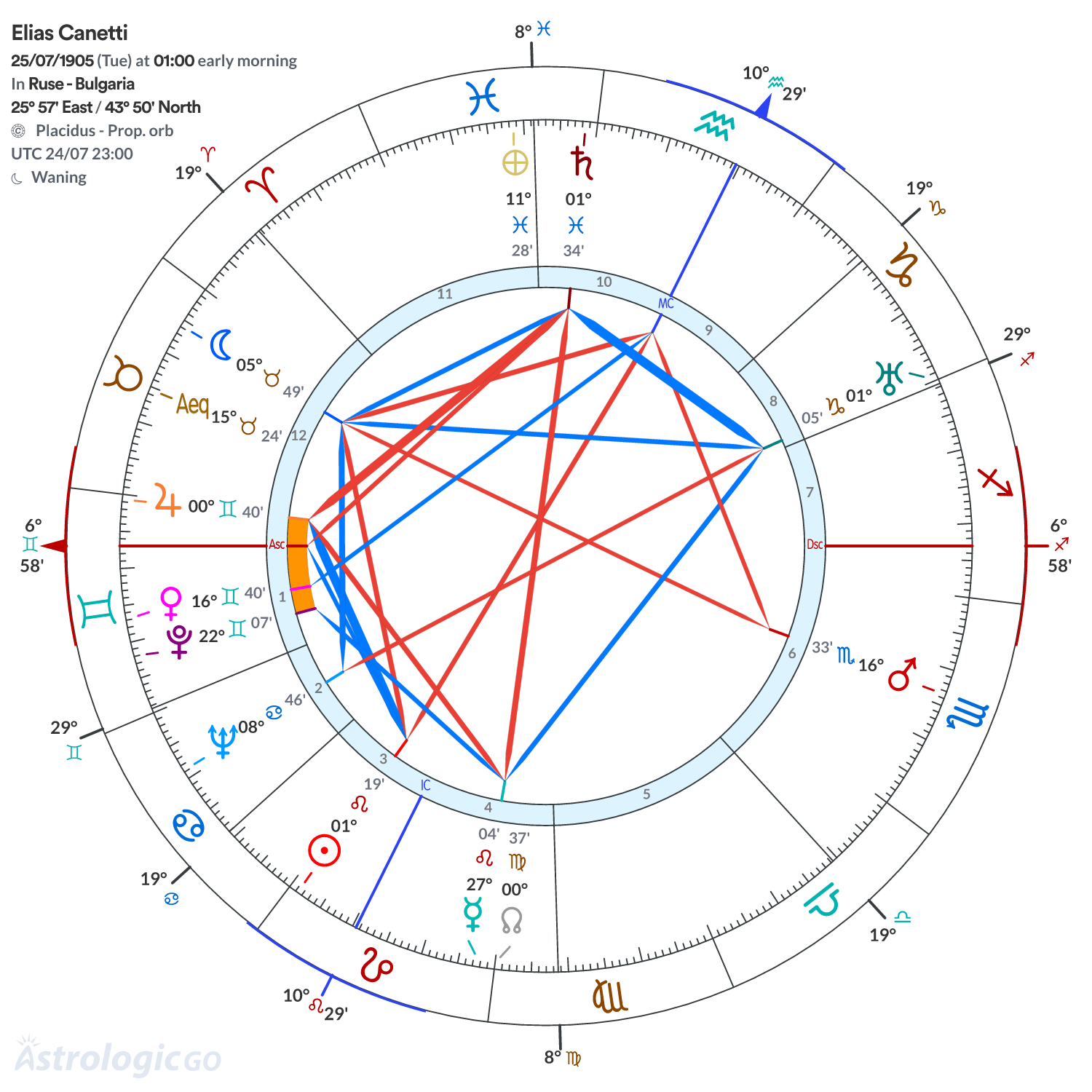
↣ Sun in Leo - 01°19' - in house 3
↣ Moon in Taurus - 05°49' - in house 12
↣ Mercury in Leo - 27°04' - in house 4
↣ Venus in Gemini - 16°40' - in house 1
↣ Mars in Scorpio - 16°33' - in house 6
↣ Jupiter in Gemini - 00°41' - in house 1
↣ Saturn in Pisces - 01°35' - in house 10/11 - retrograde
↣ Uranus in Capricorn - 01°05' - in house 8 - retrograde
↣ Neptune in Cancer - 08°47' - in house 2
↣ Pluto in Gemini - 22°07' - in house 1/2
↣ North Node in Virgo - 00°37' - in house 4/5 - retrograde
↣ Ascendant in Gemini - 06°58' - in house 1
↣ Midheaven in Aquarius - 10°29' - in house 10
↣ Equatorial Ascendant in Taurus - 15°25'
Influences in houses
↣ Sun in house 3
↣ Moon in house 12
↣ Mercury in house 4
↣ Venus in house 1
↣ Mars in house 6
↣ Jupiter in house 1
↣ Saturn in house 10/11
↣ Uranus in house 8
↣ Neptune in house 2
↣ Pluto in house 1/2
↣ North Node in house 4/5
↣ Ascendant in house 1
↣ Midheaven in house 10
Aspects
↣ Sun and Moon square (4°30' separating)
↣ Sun and Venus parallel
↣ Sun and Mars antiparallel
↣ Sun and Jupiter sextile (0°39' separating) parallel
↣ Sun and Ascendant sextile (5°39' separating)
↣ Sun and Midheaven opposition (9°10' separating)
↣ Moon and Mars opposition (10°44' applying)
↣ Moon and Saturn sextile (4°14' separating)
↣ Moon and Uranus trine (4°44' separating)
↣ Moon and Neptune sextile (2°58' applying)
↣ Moon and North Node trine (5°12' separating)
↣ Moon and Equatorial Ascendant conjunction (9°35' separating)
↣ Moon and Midheaven square (4°40' separating)
↣ Mercury and Jupiter square (3°36' applying)
↣ Mercury and Saturn opposition (4°31' applying) antiparallel
↣ Mercury and Uranus trine (4°01' applying)
↣ Mercury and Pluto sextile (4°57' separating)
↣ Mercury and North Node conjunction (3°33' applying)
↣ Venus and Jupiter parallel
↣ Venus and Pluto conjunction (5°27' applying)
↣ Venus and Ascendant conjunction (9°42' applying)
↣ Venus and Midheaven trine (6°11' applying)
↣ Mars and Jupiter antiparallel
↣ Mars and Equatorial Ascendant opposition (1°08' applying)
↣ Mars and Midheaven square (6°04' applying)
↣ Jupiter and Saturn square (0°54' applying)
↣ Jupiter and North Node square (0°03' separating)
↣ Jupiter and Ascendant conjunction (6°18' separating)
↣ Saturn and Uranus sextile (0°30' applying)
↣ Saturn and North Node opposition (0°58' applying)
↣ Saturn and Ascendant square (5°23' separating)
↣ Uranus and Neptune opposition (7°42' separating)
↣ Uranus and North Node trine (0°28' applying)
↣ Neptune and Ascendant parallel
↣ North Node and Ascendant square (6°21' separating)
Birth data
- Chart date
- 25/07/1905
- Chart time
- 01:00
- Date and time quality
- AA Birth record in hand what does this mean?
- Data origin
- Astro-Databank
- Location
-
 Ruse, Bulgaria
 - Latitude and longitude
- 43°50' North · 25°57' East
- Time zone
- 02:00 East
The data used to calculate the charts comes from public sources, as do the descriptive texts. We use sources such as Wikipedia.

About
Elias Canetti was a writer, essayist and playwright of Sephardic origin whose German-language work spanned the twentieth century. Born in the Danube region, he trained as a chemist and early on turned to translation and literature; his sole novel was Auto-da-Fé (Die Blendung), published in the 1930s. From that point he produced a varied body of work that includes plays, essays and an extensive series of autobiographical volumes.
His most influential theoretical work is Crowds and Power (1960), in which he examined the phenomenon of crowds and their social and political dynamics — a theme that ran through his entire thinking and gave intellectual weight to his oeuvre. As a dramatist, his plays criticized the moral corruption of contemporary society, while his memoirs offered detailed portraits of a life spent moving across Central and Western Europe.
Recognized for his critical rigor and sharp prose, Canetti received several awards, including the Georg Büchner Prize, the Grand Austrian State Prize and the Nobel Prize in Literature in 1981. His legacy endures chiefly in his analysis of collective forms of power and in autobiographical literature that mapped the boundaries between individual and crowd.