Birth Chart
Ernest Lawrence
Ernest Orlando Lawrence
Sun Leo
Moon Taurus or Gemini
When the birth time is unknown, the chart is calculated for 12:00 noon without using the astrological houses system. Are the planets in the wrong houses?
Influences in signs
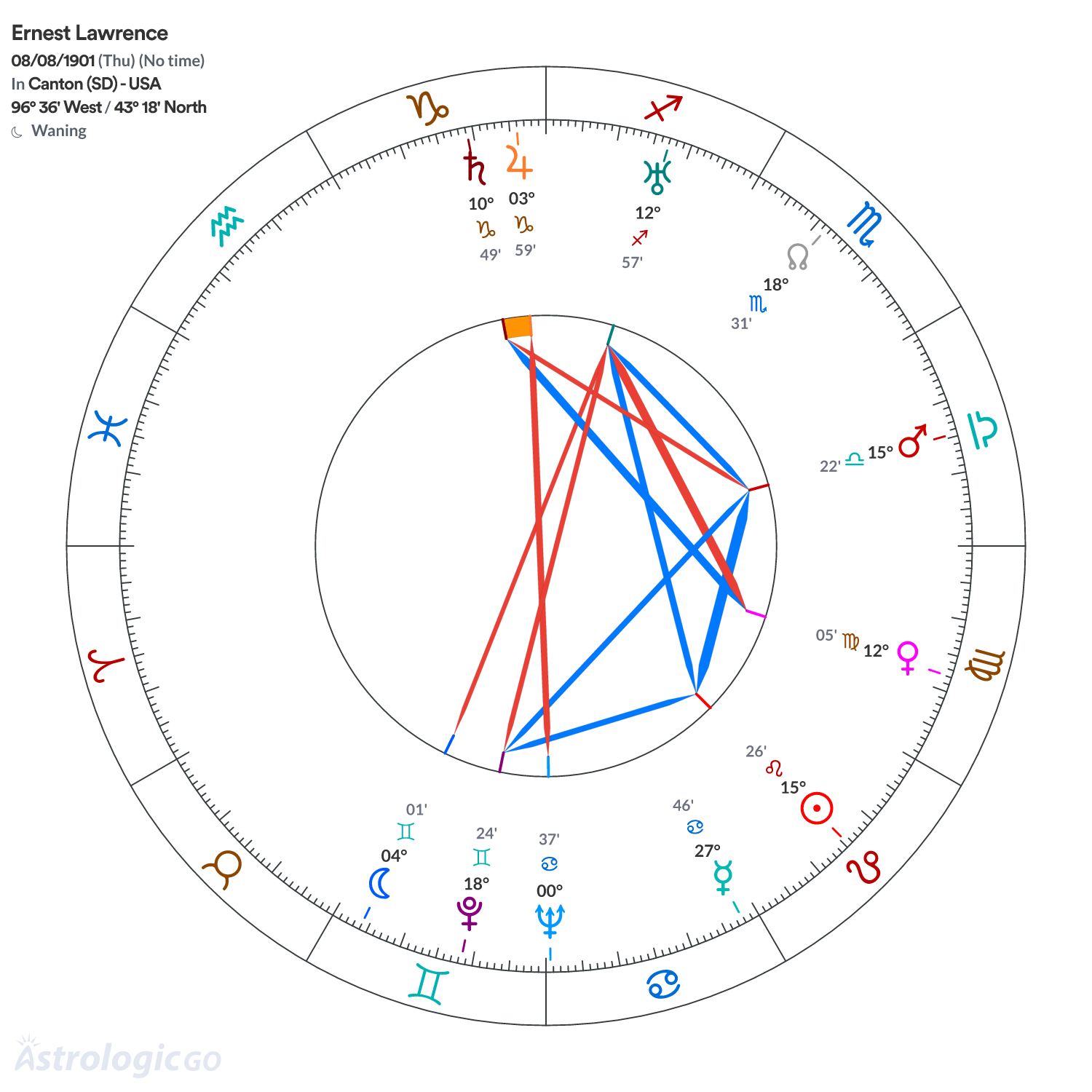
↣ Sun in Leo - 15°27'
↣ Moon in Gemini - 04°01'
↣ Mercury in Cancer - 27°46'
↣ Venus in Virgo - 12°06'
↣ Mars in Libra - 15°22'
↣ Jupiter in Capricorn - 03°59' - retrograde
↣ Saturn in Capricorn - 10°50' - retrograde
↣ Uranus in Sagittarius - 12°58' - retrograde
↣ Neptune in Cancer - 00°37'
↣ Pluto in Gemini - 18°24'
↣ North Node in Scorpio - 18°31' - retrograde
Aspects
↣ Sun and Mars sextile (0°05' separating)
↣ Sun and Uranus trine (2°29' separating)
↣ Sun and Pluto sextile (2°57' applying)
↣ Sun and North Node square (3°04' applying) antiparallel
↣ Moon and Mercury parallel
↣ Moon and Uranus opposition (8°56' applying)
↣ Venus and Saturn trine (1°16' separating)
↣ Venus and Uranus square (0°52' applying)
↣ Mars and Saturn square (4°32' separating)
↣ Mars and Uranus sextile (2°24' separating)
↣ Mars and Pluto trine (3°02' applying)
↣ Jupiter and Saturn conjunction (6°50' separating) parallel
↣ Jupiter and Neptune opposition (3°22' applying)
↣ Saturn and Uranus parallel
↣ Saturn and Neptune antiparallel
↣ Uranus and Neptune antiparallel
↣ Uranus and Pluto opposition (5°26' separating)
Birth data
- Original name
- Ernest Orlando Lawrence
- Chart date
- 08/08/1901
- Chart time
- No time
- Date and time quality
- XX Time not informed what does this mean?
- Data origin
- Astro-Databank
- Location
-
 Canton (SD), USA
 - Latitude and longitude
- 43°18' North · 96°36' West
- Time zone
- 06:00 West
The data used to calculate the charts comes from public sources, as do the descriptive texts. We use sources such as Wikipedia.

About
Ernest Orlando Lawrence was an American physicist whose invention of the cyclotron established his influence on twentieth-century experimental physics. He received the 1939 Nobel Prize in Physics for the development of this type of particle accelerator and went on to build ever larger machines, transforming high-energy research techniques.
As an institutional leader, he founded the Radiation Laboratory in Berkeley — which evolved into the Lawrence Berkeley National Laboratory — and played a key role in creating the Lawrence Livermore National Laboratory. During World War II he contributed to the war effort through the electromagnetic separation of isotopes using so-called calutrons, a process employed on a large scale at Oak Ridge for the Manhattan Project.
After the war, Lawrence became an tireless proponent of “Big Science,” advocating large government-funded programs and major research facilities. His role in building scientific infrastructure and coordinating with public and private funders left a lasting legacy: two national laboratories bear his name and the chemical element with atomic number 103 was named lawrencium in his honor.


