Birth Chart
Ernest Rutherford
Sun Virgo
Moon Aquarius or Pisces
When the birth time is unknown, the chart is calculated for 12:00 noon without using the astrological houses system. Are the planets in the wrong houses?
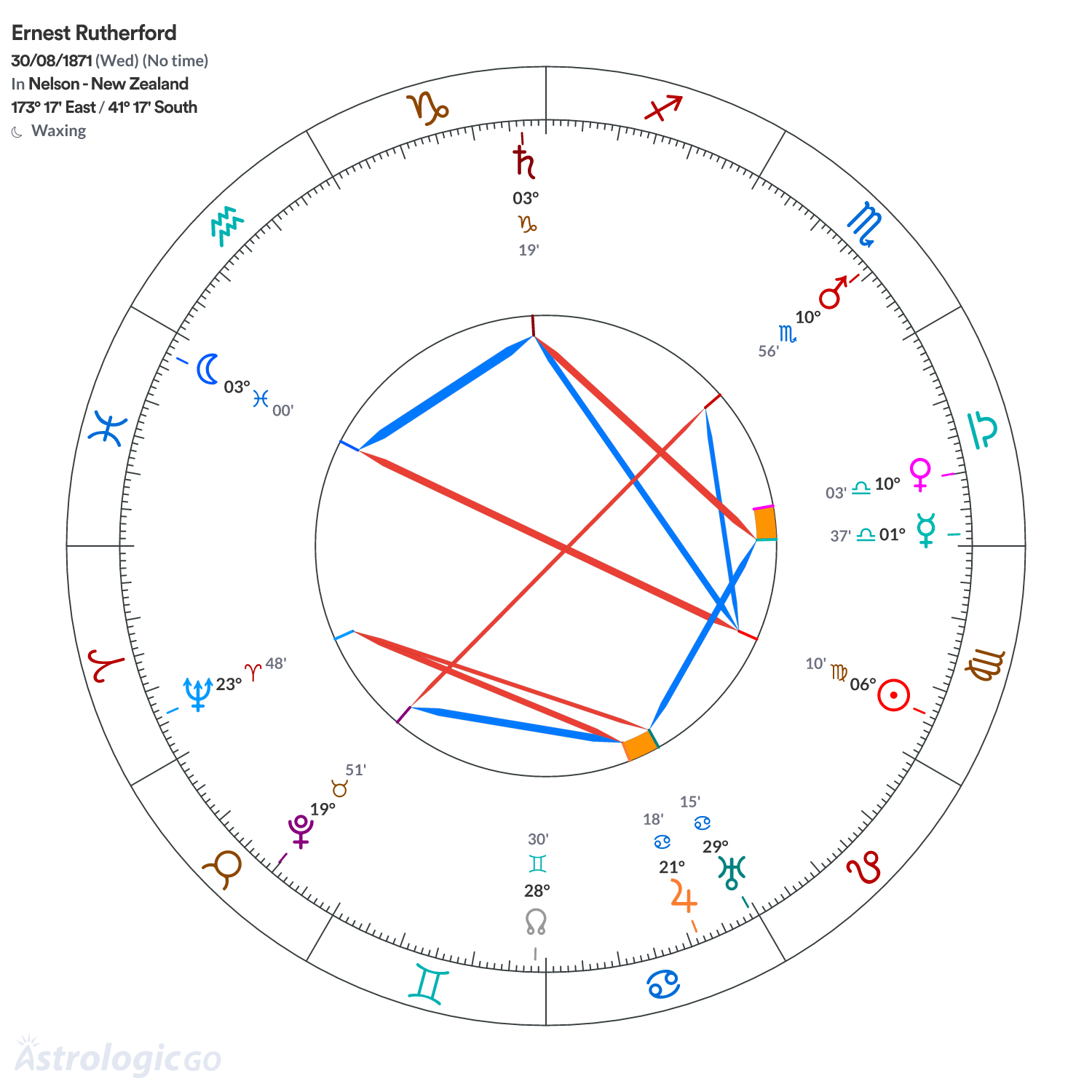
Influences in signs
↣ Sun in Virgo - 06°10'
↣ Moon in Pisces - 03°01'
↣ Mercury in Libra - 01°37'
↣ Venus in Libra - 10°03'
↣ Mars in Scorpio - 10°57'
↣ Jupiter in Cancer - 21°19'
↣ Saturn in Capricorn - 03°20' - retrograde
↣ Uranus in Cancer - 29°15'
↣ Neptune in Aries - 23°48' - retrograde
↣ Pluto in Taurus - 19°52' - retrograde
↣ North Node in Gemini - 28°31' - retrograde
Aspects
↣ Sun and Moon opposition (3°10' applying)
↣ Sun and Venus antiparallel
↣ Sun and Mars sextile (4°46' applying)
↣ Sun and Saturn trine (2°50' separating)
↣ Moon and Mars parallel
↣ Moon and Saturn sextile (0°20' applying)
↣ Moon and North Node trine (4°30' separating)
↣ Mercury and Venus conjunction (8°26' applying)
↣ Mercury and Saturn square (1°43' applying)
↣ Mercury and Uranus sextile (2°23' separating)
↣ Mercury and Pluto antiparallel
↣ Mercury and North Node square (3°07' separating)
↣ Mars and Pluto opposition (8°55' applying)
↣ Jupiter and Saturn antiparallel
↣ Jupiter and Uranus conjunction (7°56' applying)
↣ Jupiter and Neptune square (2°29' applying)
↣ Jupiter and Pluto sextile (1°27' separating)
↣ Saturn and North Node opposition (4°49' separating) antiparallel
↣ Uranus and Neptune square (5°27' separating)
↣ Neptune and North Node sextile (4°42' applying)
Birth data
- Chart date
- 30/08/1871
- Chart time
- No time
- Date and time quality
- XX Time not informed what does this mean?
- Data origin
- Astro-Databank
- Location
-
 Nelson, New Zealand
 - Latitude and longitude
- 41°17' South · 173°17' East
- Time zone
- 11:30 East
The data used to calculate the charts comes from public sources, as do the descriptive texts. We use sources such as Wikipedia.

About
Ernest Rutherford was a New Zealand–born physicist and chemist who became a British citizen, widely regarded as the father of nuclear physics. He won the Nobel Prize in Chemistry in 1908 for his investigations into the disintegration of the elements and the chemistry of radioactive substances, distinguished alpha and beta radiation, and introduced the concept of radioactive half-life.
In Manchester he led research that identified the nature of alpha particles and, in 1911, proposed an atomic model that placed a massive, positively charged nucleus at the atom’s center—an idea later refined by Niels Bohr. Under his direction, the famous gold‑foil experiment demonstrated the existence of the atomic nucleus.
In 1919 he performed the first artificial transmutation of one element into another, converting nitrogen into oxygen, and in 1920 he postulated the existence of the proton as a constituent of nuclei. He directed the Cavendish Laboratory in Cambridge, where he trained and inspired generations of scientists, and served as president of the Royal Society from 1925 to 1930.
His legacy extends beyond physics and chemistry: his methods and discoveries about radioactivity enabled fundamental techniques in geology, archaeology, and paleontology by making possible the dating of rocks and fossils.


