Birth Chart
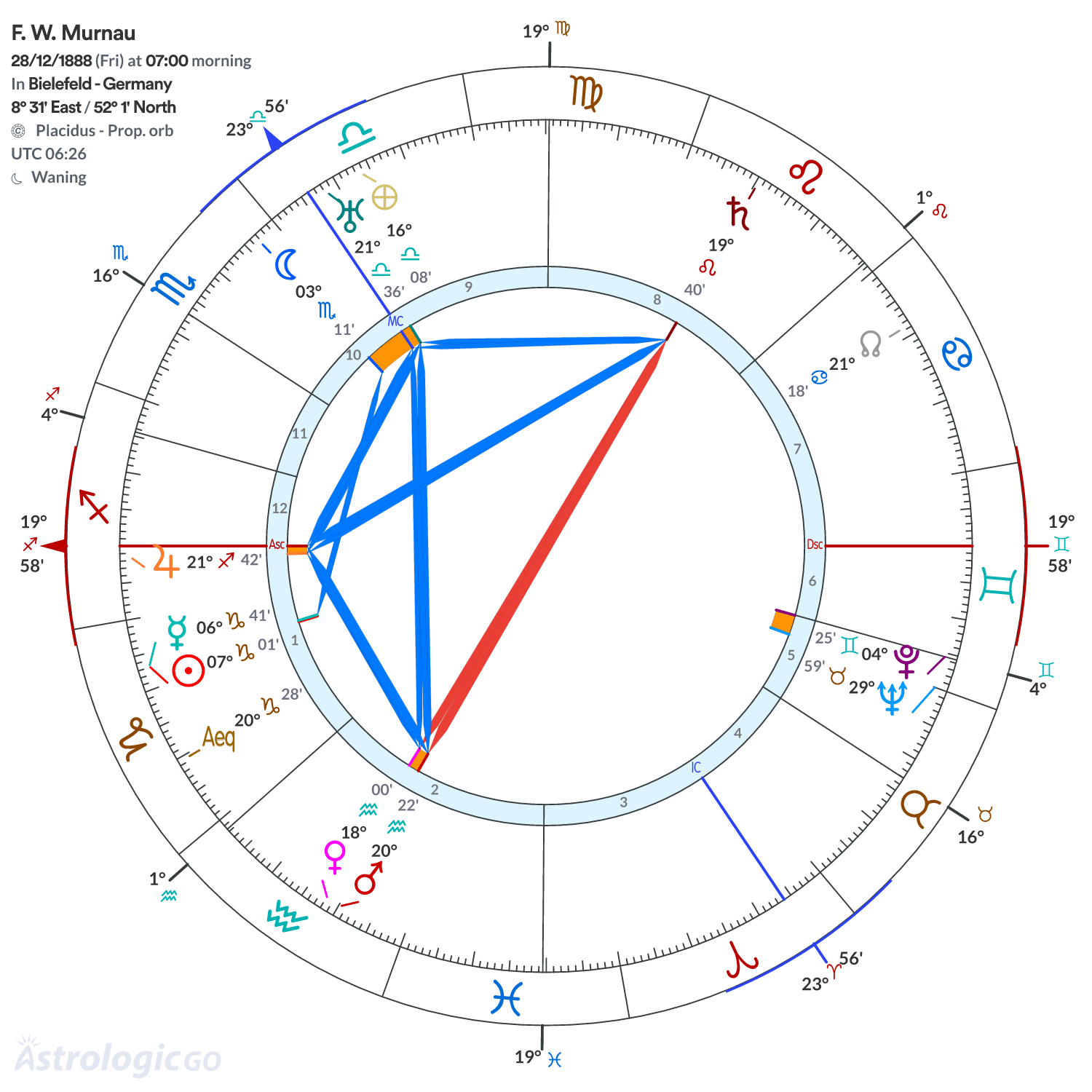
F. W. Murnau
Friedrich Wilhelm Plumpe
Sun Capricorn
Moon Scorpio
Ascendant Sagittarius
Influences in signs
↣ Sun in Capricorn - 07°01' - in house 1
↣ Moon in Scorpio - 03°11' - in house 10
↣ Mercury in Capricorn - 06°42' - in house 1
↣ Venus in Aquarius - 18°01' - in house 2
↣ Mars in Aquarius - 20°23' - in house 2
↣ Jupiter in Sagittarius - 21°43' - in house 1
↣ Saturn in Leo - 19°40' - in house 8 - retrograde
↣ Uranus in Libra - 21°37' - in house 10
↣ Neptune in Taurus - 29°59' - in house 5/6 - retrograde
↣ Pluto in Gemini - 04°25' - in house 6 - retrograde
↣ North Node in Cancer - 21°19' - in house 7/8 - retrograde
↣ Ascendant in Sagittarius - 19°58' - in house 1
↣ Midheaven in Libra - 23°56' - in house 10
↣ Equatorial Ascendant in Capricorn - 20°29'
Influences in houses
↣ Sun in house 1
↣ Moon in house 10
↣ Mercury in house 1
↣ Venus in house 2
↣ Mars in house 2
↣ Jupiter in house 1
↣ Saturn in house 8
↣ Uranus in house 10
↣ Neptune in house 5/6
↣ Pluto in house 6
↣ North Node in house 7/8
↣ Ascendant in house 1
↣ Midheaven in house 10
Aspects
↣ Sun and Moon sextile (3°50' applying)
↣ Sun and Mercury conjunction (0°19' applying)
↣ Sun and Jupiter parallel
↣ Sun and Ascendant parallel
↣ Moon and Mercury sextile (3°30' applying)
↣ Moon and Uranus parallel
↣ Moon and Pluto antiparallel
↣ Moon and Midheaven conjunction (9°15' applying)
↣ Venus and Mars conjunction (2°22' applying)
↣ Venus and Jupiter sextile (3°42' applying)
↣ Venus and Saturn opposition (1°39' applying)
↣ Venus and Uranus trine (3°36' applying)
↣ Venus and Ascendant sextile (1°58' separating)
↣ Venus and Midheaven trine (5°56' separating)
↣ Mars and Jupiter sextile (1°20' applying)
↣ Mars and Saturn opposition (0°43' separating) antiparallel
↣ Mars and Uranus trine (1°14' applying)
↣ Mars and Ascendant sextile (0°24' applying)
↣ Mars and Midheaven trine (3°33' separating)
↣ Jupiter and Saturn trine (2°03' separating)
↣ Jupiter and Uranus sextile (0°06' separating)
↣ Jupiter and Ascendant conjunction (1°44' applying) parallel
↣ Jupiter and Midheaven sextile (2°14' separating)
↣ Saturn and Uranus sextile (1°57' separating)
↣ Saturn and Ascendant trine (0°18' separating)
↣ Saturn and Midheaven sextile (4°16' separating)
↣ Uranus and North Node square (0°18' separating)
↣ Uranus and Equatorial Ascendant square (1°08' applying)
↣ Uranus and Ascendant sextile (1°38' applying)
↣ Uranus and Midheaven conjunction (2°19' separating)
↣ Neptune and Pluto conjunction (4°26' separating)
↣ Pluto and Midheaven antiparallel
↣ North Node and Equatorial Ascendant opposition (0°49' applying)
↣ North Node and Midheaven square (2°38' separating)
Birth data
- Original name
- Friedrich Wilhelm Plumpe
- Chart date
- 28/12/1888
- Chart time
- 07:00
- Date and time quality
- AA Birth record in hand what does this mean?
- Data origin
- Astro-Databank
- Location
-
 Bielefeld, Germany
 - Latitude and longitude
- 52°01' North · 8°31' East
- Time zone
- 00:34 East
The data used to calculate the charts comes from public sources, as do the descriptive texts. We use sources such as Wikipedia.

About
Friedrich Wilhelm Murnau, known as F. W. Murnau, was a German filmmaker central to silent cinema, Expressionism, and the Kammerspiel movement. Trained in philosophy, literature, music and art history and influenced by the theater of Max Reinhardt, he developed a style characterized by inventive framing, camera movements that convey psychological states, and a preference for natural locations over artificial sets.
His filmography includes landmarks such as Nosferatu (1922), which renewed expressionist horror with visual innovations; The Last Laugh (Der letzte Mann, 1924), which anticipated the Kammerspielfilm by privileging dramatic intimacy and camera technique; and Faust (1926). In 1927, having been invited to Hollywood by William Fox, he directed Sunrise (Aurora), a masterpiece praised by critics and honored by the Academy for its artistic quality and cinematography.
Although known for both genius and a contentious temperament, Murnau left a lasting legacy on cinematic language—particularly in visual composition and expressive camera use—shaping generations of subsequent directors. He died young in 1931, leaving a body of work that remains among the most important in silent cinema.


