Birth Chart
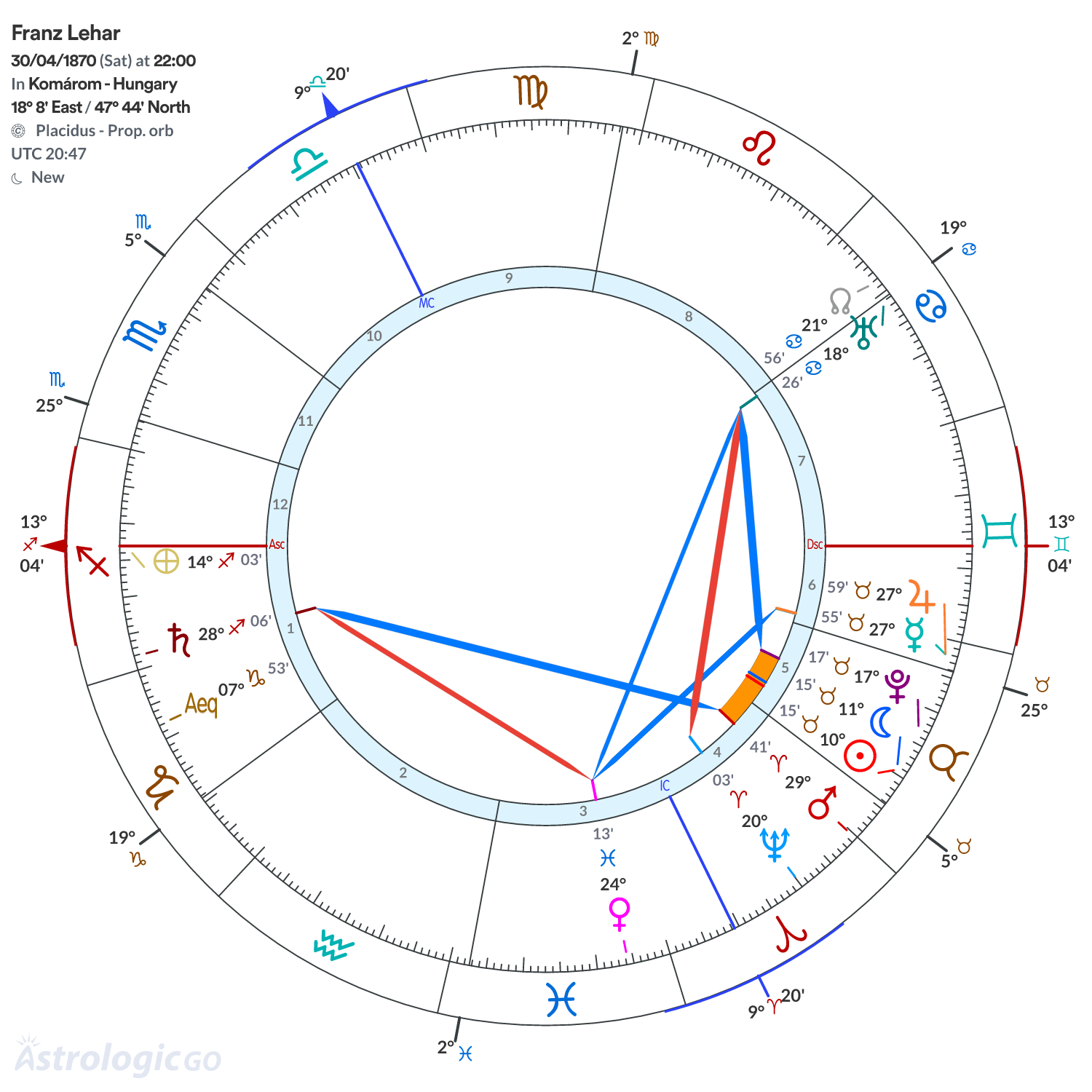
Franz Lehar
Sun Taurus
Moon Taurus
Ascendant Sagittarius
Influences in signs
↣ Sun in Taurus - 10°16' - in house 5
↣ Moon in Taurus - 11°15' - in house 5
↣ Mercury in Taurus - 27°55' - in house 6
↣ Venus in Pisces - 24°14' - in house 3
↣ Mars in Aries - 29°41' - in house 4/5
↣ Jupiter in Taurus - 27°59' - in house 6
↣ Saturn in Sagittarius - 28°06' - in house 1 - retrograde
↣ Uranus in Cancer - 18°26' - in house 8
↣ Neptune in Aries - 20°03' - in house 4
↣ Pluto in Taurus - 17°17' - in house 5
↣ North Node in Cancer - 21°56' - in house 8 - retrograde
↣ Ascendant in Sagittarius - 13°04' - in house 1
↣ Midheaven in Libra - 09°21' - in house 10
↣ Equatorial Ascendant in Capricorn - 07°53'
Influences in houses
↣ Sun in house 5
↣ Moon in house 5
↣ Mercury in house 6
↣ Venus in house 3
↣ Mars in house 4/5
↣ Jupiter in house 6
↣ Saturn in house 1
↣ Uranus in house 8
↣ Neptune in house 4
↣ Pluto in house 5
↣ North Node in house 8
↣ Ascendant in house 1
↣ Midheaven in house 10
Aspects
↣ Sun and Moon conjunction (0°59' separating)
↣ Sun and Mars conjunction (10°34' separating)
↣ Sun and Pluto conjunction (7°01' applying)
↣ Sun and Equatorial Ascendant trine (2°23' applying)
↣ Moon and Mars parallel
↣ Moon and Pluto conjunction (6°02' applying)
↣ Moon and Equatorial Ascendant trine (3°22' applying)
↣ Mercury and Venus sextile (3°42' separating)
↣ Mercury and Jupiter conjunction (0°04' applying)
↣ Mercury and Saturn antiparallel
↣ Mercury and Uranus parallel
↣ Mercury and North Node sextile (5°59' separating) parallel
↣ Mercury and Ascendant antiparallel
↣ Venus and Jupiter sextile (3°46' applying)
↣ Venus and Saturn square (3°52' applying)
↣ Venus and Uranus trine (5°47' separating)
↣ Venus and Pluto antiparallel
↣ Venus and North Node trine (2°18' separating)
↣ Mars and Saturn trine (1°35' separating)
↣ Saturn and Uranus antiparallel
↣ Saturn and North Node antiparallel
↣ Saturn and Equatorial Ascendant conjunction (9°47' separating)
↣ Saturn and Ascendant parallel
↣ Uranus and Neptune square (1°37' separating)
↣ Uranus and Pluto sextile (1°09' separating)
↣ Uranus and North Node conjunction (3°30' applying) parallel
↣ Uranus and Ascendant antiparallel
↣ Neptune and North Node square (1°53' applying)
↣ Pluto and North Node sextile (4°39' applying)
↣ Pluto and Midheaven antiparallel
↣ North Node and Ascendant antiparallel
Birth data
- Chart date
- 30/04/1870
- Chart time
- 22:00
- Date and time quality
- B Biography/autobiography what does this mean?
- Data origin
- Astro-Databank
- Location
-
 Komárom, Hungary
 - Latitude and longitude
- 47°44' North · 18°08' East
- Time zone
- 01:13 East
The data used to calculate the charts comes from public sources, as do the descriptive texts. We use sources such as Wikipedia.

About
Franz Lehár was an Austrian composer of Hungarian origin, celebrated above all for his operettas that helped define the light lyric repertoire of the early twentieth century. Trained at the Prague Conservatory and initially attached to military bands—where he worked as a violinist and conductor—Lehár moved to Vienna and devoted himself to composition, achieving worldwide fame with The Merry Widow (Die lustige Witwe, 1905).
His output includes popular titles such as The Land of Smiles (Il Paese del Sorriso, 1929), as well as widely circulated waltzes and dances like Gold und Silber (Gold and Silver). The success of his operettas secured his financial and cultural position in Vienna, leading him to found a music publishing house and to maintain long-standing relationships with theaters such as the Theater an der Wien and the Politeama in Trieste.
Lehár’s personal life was also entwined with historical events: he married Sophie Meth, of Jewish background, whom he helped protect during World War II with the assistance of others, and he spent his final years in Bad Ischl. His legacy endures in the light operatic tradition and in the repertoire of European musical theatre.
Charts like this one
- Sun Taurus 1,096 charts
- Moon Taurus 1,104 charts
- Ascendant Sagittarius 1,128 charts
- Born on April 30 33 charts


