Birth Chart
Heike Kamerlingh Onnes
Sun Virgo
Moon Taurus
Ascendant Taurus
Influences in signs
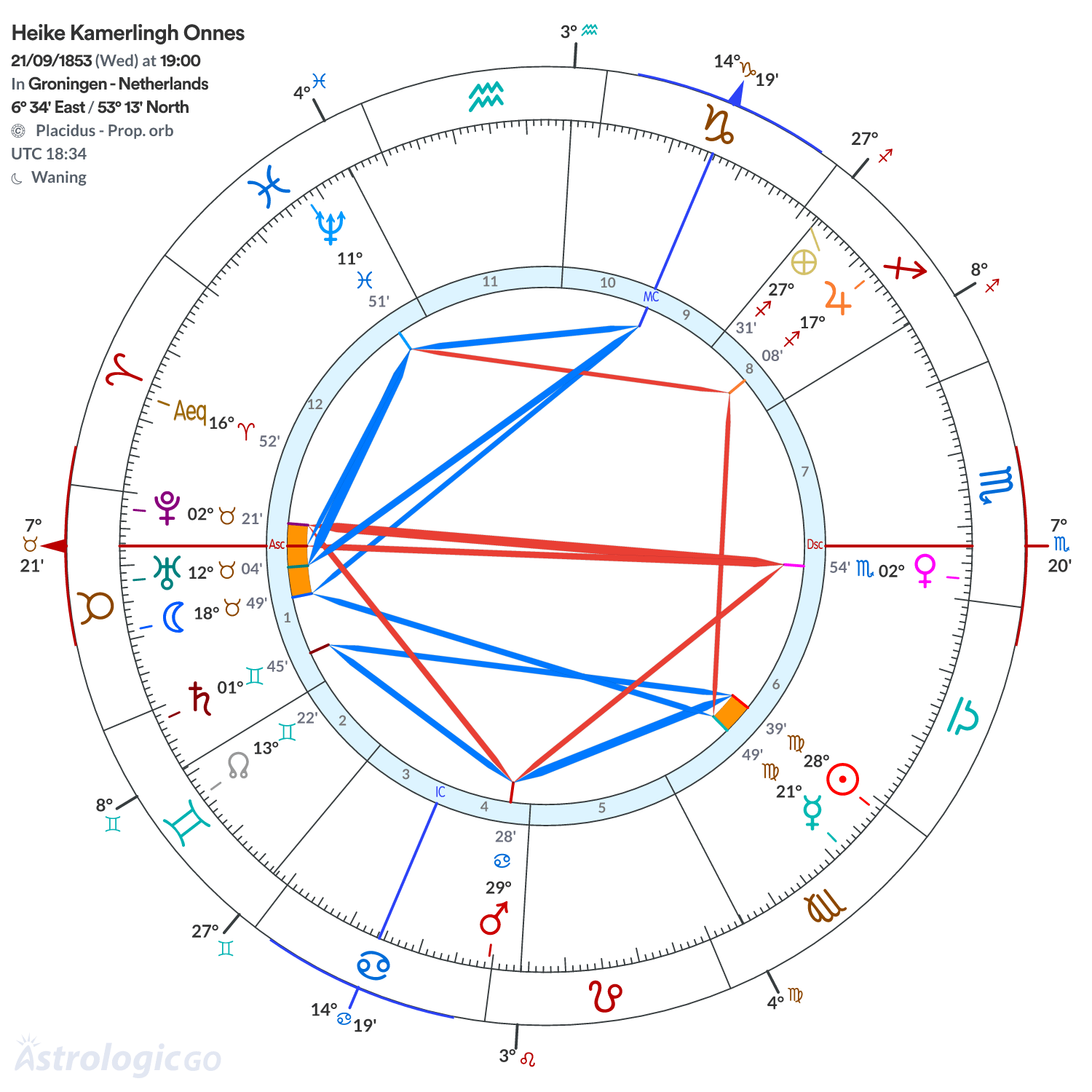
↣ Sun in Virgo - 28°39' - in house 6
↣ Moon in Taurus - 18°50' - in house 1
↣ Mercury in Virgo - 21°50' - in house 6
↣ Venus in Scorpio - 02°54' - in house 7
↣ Mars in Cancer - 29°29' - in house 4/5
↣ Jupiter in Sagittarius - 17°09' - in house 8
↣ Saturn in Gemini - 01°46' - in house 1/2 - retrograde
↣ Uranus in Taurus - 12°04' - in house 1 - retrograde
↣ Neptune in Pisces - 11°52' - in house 12 - retrograde
↣ Pluto in Taurus - 02°21' - in house 1 - retrograde
↣ North Node in Gemini - 13°22' - in house 2 - retrograde
↣ Ascendant in Taurus - 07°21' - in house 1
↣ Midheaven in Capricorn - 14°19' - in house 10
↣ Equatorial Ascendant in Aries - 16°52'
Influences in houses
↣ Sun in house 6
↣ Moon in house 1
↣ Mercury in house 6
↣ Venus in house 7
↣ Mars in house 4/5
↣ Jupiter in house 8
↣ Saturn in house 1/2
↣ Uranus in house 1
↣ Neptune in house 12
↣ Pluto in house 1
↣ North Node in house 2
↣ Ascendant in house 1
↣ Midheaven in house 10
Aspects
↣ Sun and Mercury conjunction (6°49' applying)
↣ Sun and Mars sextile (0°50' applying)
↣ Sun and Saturn trine (3°07' applying)
↣ Sun and Equatorial Ascendant parallel
↣ Moon and Mercury trine (3°00' applying)
↣ Moon and Uranus conjunction (6°45' separating) parallel
↣ Moon and Ascendant conjunction (11°29' applying) parallel
↣ Moon and Midheaven trine (4°30' applying)
↣ Mercury and Jupiter square (4°41' separating)
↣ Venus and Mars square (3°25' separating)
↣ Venus and Pluto opposition (0°33' separating)
↣ Venus and Ascendant opposition (4°27' separating)
↣ Mars and Saturn sextile (2°17' applying)
↣ Mars and Pluto square (2°52' applying)
↣ Jupiter and Neptune square (5°17' separating)
↣ Jupiter and North Node opposition (3°47' separating) antiparallel
↣ Jupiter and Equatorial Ascendant trine (0°16' applying)
↣ Jupiter and Midheaven parallel
↣ Uranus and Neptune sextile (0°13' applying)
↣ Uranus and Ascendant conjunction (4°44' applying)
↣ Uranus and Midheaven trine (2°15' separating)
↣ Neptune and North Node square (1°30' applying)
↣ Neptune and Ascendant sextile (4°31' applying)
↣ Neptune and Midheaven sextile (2°27' separating)
↣ Pluto and Ascendant conjunction (5°00' separating)
↣ North Node and Equatorial Ascendant sextile (3°30' separating)
↣ North Node and Midheaven antiparallel
Birth data
- Chart date
- 21/09/1853
- Chart time
- 19:00
- Date and time quality
- AA Birth record in hand what does this mean?
- Data origin
- Astro-Databank
- Location
-
 Groningen, Netherlands
 - Latitude and longitude
- 53°13' North · 6°34' East
- Time zone
- 00:26 East
The data used to calculate the charts comes from public sources, as do the descriptive texts. We use sources such as Wikipedia.

About
Heike Kamerlingh Onnes was a Dutch physicist known for initiating the era of experimental cryogenics and for discovering superconductivity. A professor of experimental physics at Leiden University from 1882 to 1923, he organized and directed a low-temperature laboratory that became an international reference, today known as the Kamerlingh Onnes Laboratory.
His work on cooling techniques made possible the first liquefaction of helium in 1908, reaching unprecedented thermal conditions. Building on those experimental capabilities, in 1911 he observed that the electrical resistance of mercury vanished abruptly when cooled to about 4.2 K, a phenomenon he called superconductivity.
For his advances in the study of matter at extremely low temperatures and for producing liquid helium, he received the Nobel Prize in Physics in 1913. His scientific leadership and technical publications established methods and equipment that enabled later developments in solid-state physics and technologies based on low temperatures.
Charts like this one
- Sun Virgo 998 charts
- Moon Taurus 1,104 charts
- Ascendant Taurus 707 charts
- Born on September 21 40 charts


