Birth Chart
Hilary Putnam
Hilary Whitehall Putnam
Sun Leo
Moon Taurus
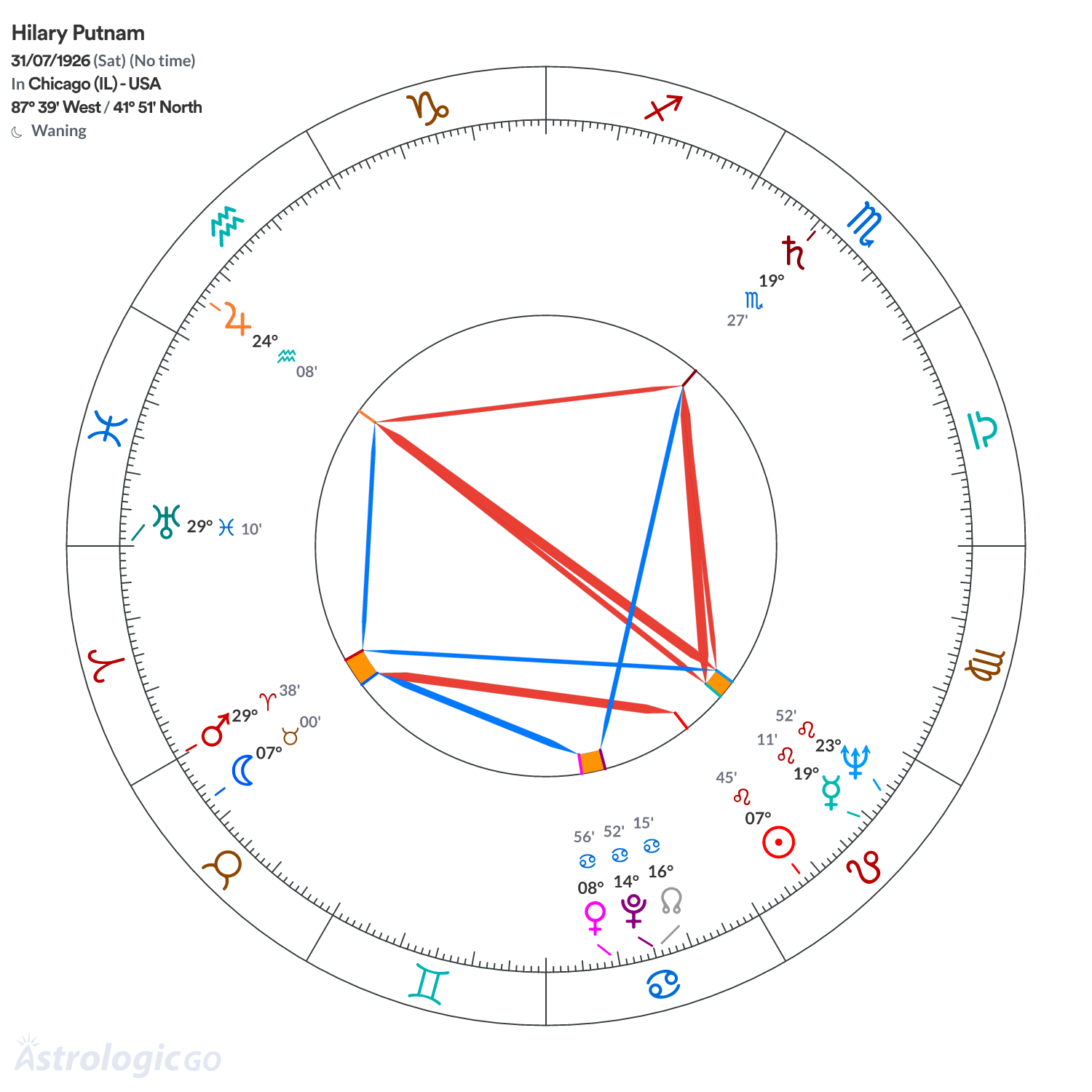
When the birth time is unknown, the chart is calculated for 12:00 noon without using the astrological houses system. Are the planets in the wrong houses?
Influences in signs
↣ Sun in Leo - 07°45'
↣ Moon in Taurus - 07°00'
↣ Mercury in Leo - 19°12' - retrograde
↣ Venus in Cancer - 08°56'
↣ Mars in Aries - 29°39'
↣ Jupiter in Aquarius - 24°08' - retrograde
↣ Saturn in Scorpio - 19°28'
↣ Uranus in Pisces - 29°10' - retrograde
↣ Neptune in Leo - 23°53'
↣ Pluto in Cancer - 14°53'
↣ North Node in Cancer - 16°15' - retrograde
Aspects
↣ Sun and Moon square (0°45' applying)
↣ Moon and Mercury parallel
↣ Moon and Venus sextile (1°56' applying)
↣ Moon and Mars conjunction (7°21' separating) parallel
↣ Mercury and Jupiter opposition (4°56' separating)
↣ Mercury and Saturn square (0°15' separating)
↣ Mercury and Neptune conjunction (4°40' separating)
↣ Venus and Pluto conjunction (5°56' applying)
↣ Venus and North Node conjunction (7°19' applying) parallel
↣ Mars and Jupiter sextile (5°31' separating)
↣ Mars and Neptune trine (5°46' separating)
↣ Jupiter and Saturn square (4°41' applying)
↣ Jupiter and Neptune opposition (0°16' applying) antiparallel
↣ Saturn and Neptune square (4°25' separating)
↣ Saturn and Pluto trine (4°35' applying)
↣ Saturn and North Node trine (3°12' separating)
↣ Pluto and North Node conjunction (1°23' applying)
Birth data
- Original name
- Hilary Whitehall Putnam
- Chart date
- 31/07/1926
- Chart time
- No time
- Date and time quality
- AAX No time - official source what does this mean?
- Data origin
- Astro-Databank
- Location
-
 Chicago (IL), USA
 - Latitude and longitude
- 41°51' North · 87°39' West
- Time zone
- 06:00 West
The data used to calculate the charts comes from public sources, as do the descriptive texts. We use sources such as Wikipedia.

About
Hilary Whitehall Putnam was a leading American philosopher in recent decades whose work profoundly influenced the philosophy of mind, language, and science. A professor and the author of numerous books and articles, he was recognized for combining analytic rigor with historical and social concerns and for not hesitating to revise his own positions in the face of critical arguments.
In the philosophy of mind, Putnam made decisive contributions by criticizing identity theories that equate mental and physical states and by formulating functionalism, defending the idea that mental states can be multiply realized. In the philosophy of language he developed, in dialogue with thinkers such as Saul Kripke, a causal theory of reference applied to natural kind terms and articulated an influential version of semantic externalism, famous for the Twin Earth thought experiment.
Also noted for other thought experiments—such as the brain in a vat and the ant that “draws” Churchill—Putnam used these devices to explore problems of meaning, knowledge, and representation. His commitment to the social responsibility of intellectuals and his progressive stance also shaped his public and academic engagement.
Legacy: his theses and criticisms remain central references in contemporary debates about mind, language, and science, and his works continue to be essential reading in analytic philosophy.


