Birth Chart
James Clerk Maxwell
Sun Gemini
Moon Cancer or Leo
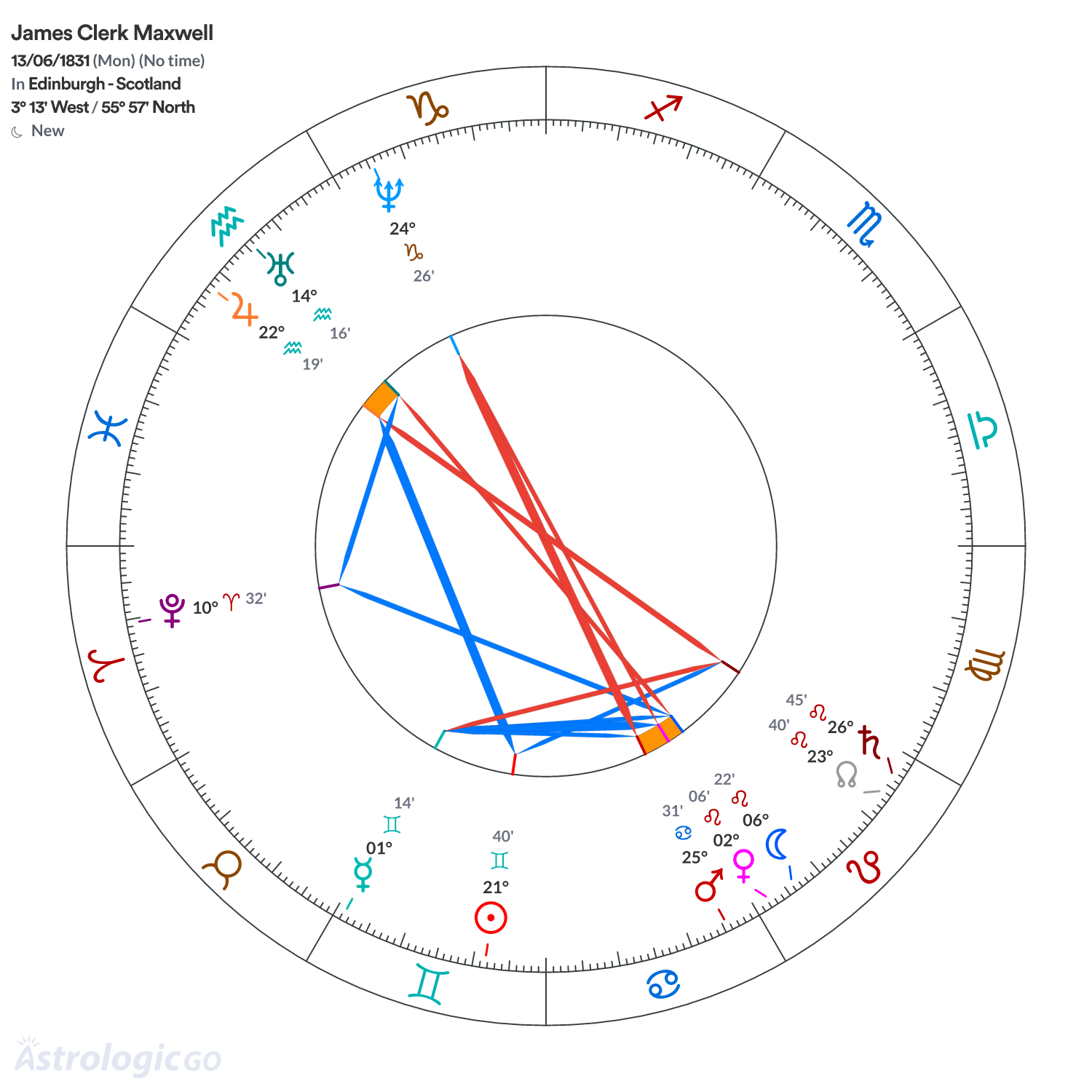
When the birth time is unknown, the chart is calculated for 12:00 noon without using the astrological houses system. Are the planets in the wrong houses?
Influences in signs
↣ Sun in Gemini - 21°40'
↣ Moon in Leo - 06°22'
↣ Mercury in Gemini - 01°14'
↣ Venus in Leo - 02°07'
↣ Mars in Cancer - 25°31'
↣ Jupiter in Aquarius - 22°20' - retrograde
↣ Saturn in Leo - 26°45'
↣ Uranus in Aquarius - 14°16' - retrograde
↣ Neptune in Capricorn - 24°26' - retrograde
↣ Pluto in Aries - 10°32'
↣ North Node in Leo - 23°40' - retrograde
Aspects
↣ Sun and Venus parallel
↣ Sun and Mars parallel
↣ Sun and Jupiter trine (0°39' applying)
↣ Sun and Saturn sextile (5°04' applying)
↣ Sun and North Node sextile (2°00' applying)
↣ Moon and Mercury sextile (5°08' separating) parallel
↣ Moon and Venus conjunction (4°16' separating)
↣ Moon and Mars conjunction (10°51' separating)
↣ Moon and Uranus opposition (7°54' applying) antiparallel
↣ Moon and Pluto trine (4°10' applying)
↣ Mercury and Venus sextile (0°52' separating)
↣ Mercury and Mars sextile (5°43' applying)
↣ Mercury and Saturn square (4°29' separating)
↣ Mercury and Uranus antiparallel
↣ Venus and Mars conjunction (6°36' separating) parallel
↣ Venus and Neptune opposition (7°40' separating)
↣ Mars and Neptune opposition (1°04' separating)
↣ Jupiter and Saturn opposition (4°25' separating) antiparallel
↣ Jupiter and Uranus conjunction (8°03' separating)
↣ Jupiter and North Node opposition (1°21' applying)
↣ Saturn and North Node conjunction (3°05' separating) parallel
↣ Uranus and Pluto sextile (3°44' applying)
Birth data
- Chart date
- 13/06/1831
- Chart time
- No time
- Date and time quality
- XX Time not informed what does this mean?
- Data origin
- Astro-Databank
- Location
-
 Edinburgh, Scotland
 - Latitude and longitude
- 55°57' North · 3°13' West
- Time zone
- 00:13 West
The data used to calculate the charts comes from public sources, as do the descriptive texts. We use sources such as Wikipedia.

About
James Clerk Maxwell was a Scottish physicist and mathematician whose contributions laid the foundations of modern electromagnetism and statistical physics. He is best known for formulating Maxwell's equations, which unified electricity, magnetism and optics and showed that electric and magnetic fields propagate at the speed of light, explaining the electromagnetic nature of light. This theoretical framework prepared the ground for special relativity and influenced later developments in theoretical physics.
Beyond his work in electromagnetism, Maxwell made decisive advances in the kinetic theory of gases, leading to the distribution that now bears his name alongside Boltzmann, and he investigated properties such as the viscosity of gases. He also worked in optics, including pioneering methods for color photography by superposing red, green and blue components, and on problems in astronomy—most notably the stability of Saturn’s rings.
His output alternated between pure mathematics and careful experimentation, with contributions in geometry, elasticity and color perception. A professor at institutions including Aberdeen and King’s College, his work left a lasting legacy in the theoretical and experimental foundations of modern physics.


