Birth Chart
Jan Tinbergen
Sun Aries
Moon Scorpio
Ascendant Sagittarius
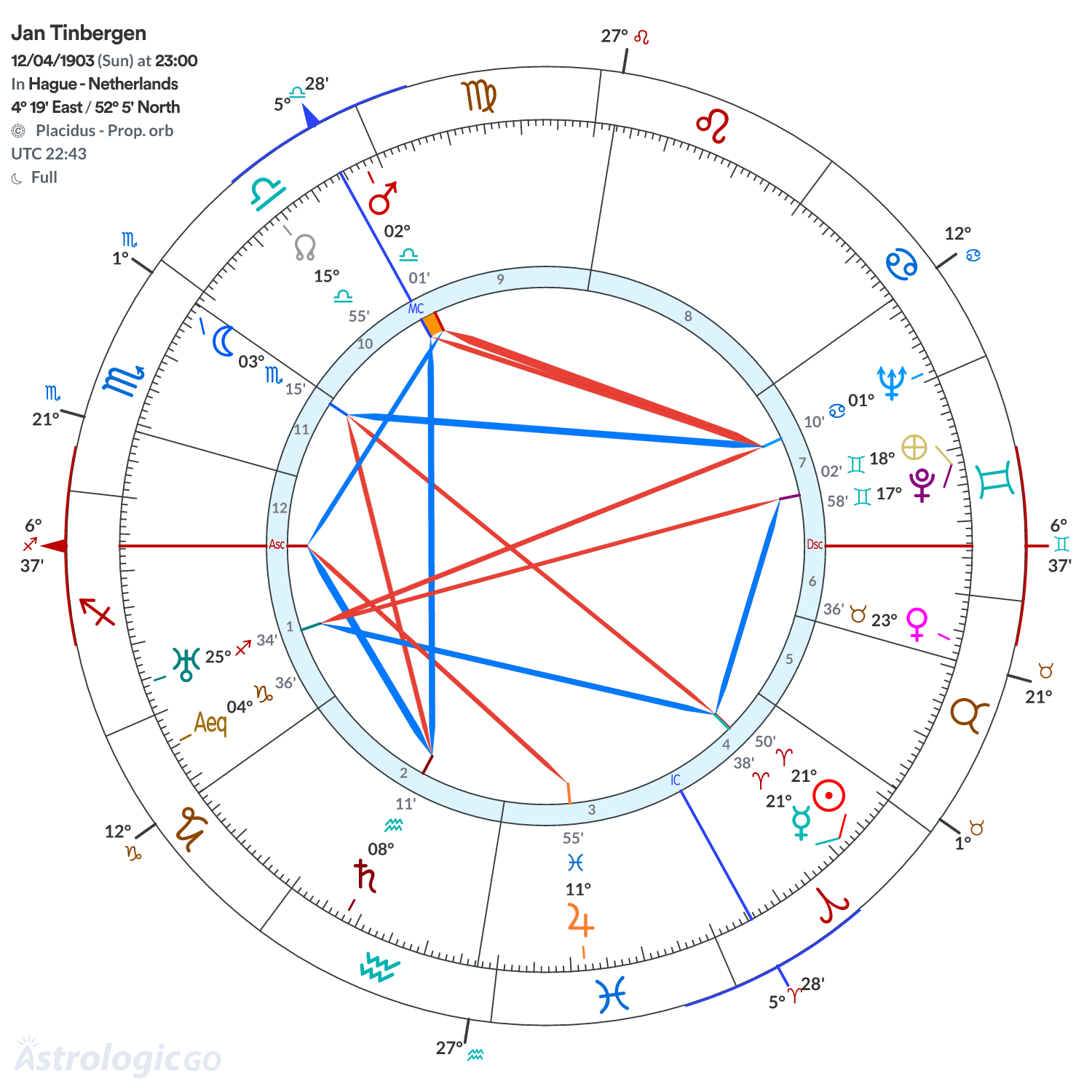
Influences in signs
↣ Sun in Aries - 21°50' - in house 4
↣ Moon in Scorpio - 03°16' - in house 11
↣ Mercury in Aries - 21°39' - in house 4
↣ Venus in Taurus - 23°36' - in house 6
↣ Mars in Libra - 02°02' - in house 10 - retrograde
↣ Jupiter in Pisces - 11°55' - in house 3
↣ Saturn in Aquarius - 08°12' - in house 2
↣ Uranus in Sagittarius - 25°34' - in house 1 - retrograde
↣ Neptune in Cancer - 01°10' - in house 7/8
↣ Pluto in Gemini - 17°58' - in house 7
↣ North Node in Libra - 15°56' - in house 10 - retrograde
↣ Ascendant in Sagittarius - 06°37' - in house 1
↣ Midheaven in Libra - 05°28' - in house 10
↣ Equatorial Ascendant in Capricorn - 04°37'
Influences in houses
↣ Sun in house 4
↣ Moon in house 11
↣ Mercury in house 4
↣ Venus in house 6
↣ Mars in house 10
↣ Jupiter in house 3
↣ Saturn in house 2
↣ Uranus in house 1
↣ Neptune in house 7/8
↣ Pluto in house 7
↣ North Node in house 10
↣ Ascendant in house 1
↣ Midheaven in house 10
Aspects
↣ Sun and Moon opposition (11°25' separating)
↣ Sun and Mercury conjunction (0°12' applying) parallel
↣ Sun and Jupiter antiparallel
↣ Sun and Uranus trine (3°44' applying)
↣ Sun and Pluto sextile (3°52' separating)
↣ Sun and North Node opposition (5°55' separating)
↣ Moon and Saturn square (4°56' applying)
↣ Moon and Neptune trine (2°05' separating)
↣ Moon and Equatorial Ascendant sextile (1°21' separating)
↣ Mercury and Jupiter antiparallel
↣ Mercury and Uranus trine (3°55' applying)
↣ Mercury and Pluto sextile (3°41' separating)
↣ Mercury and North Node opposition (5°43' separating)
↣ Venus and Saturn antiparallel
↣ Mars and Neptune square (0°52' applying)
↣ Mars and Equatorial Ascendant square (2°35' separating)
↣ Mars and Ascendant sextile (4°36' separating)
↣ Mars and Midheaven conjunction (3°26' separating) antiparallel
↣ Jupiter and Ascendant square (5°18' applying)
↣ Saturn and Ascendant sextile (1°34' applying)
↣ Saturn and Midheaven trine (2°44' applying)
↣ Uranus and Neptune opposition (5°36' separating)
↣ Uranus and Pluto opposition (7°36' applying)
↣ Uranus and Equatorial Ascendant conjunction (9°02' separating)
↣ Neptune and Equatorial Ascendant opposition (3°26' separating)
↣ Neptune and Ascendant antiparallel
↣ Neptune and Midheaven square (4°18' separating)
↣ Pluto and North Node trine (2°03' separating)
Birth data
- Chart date
- 12/04/1903
- Chart time
- 23:00
- Date and time quality
- AA Birth record cited what does this mean?
- Data origin
- Astro-Databank
- Location
-
 Hague, Netherlands
 - Latitude and longitude
- 52°05' North · 4°19' East
- Time zone
- 00:17 East
The data used to calculate the charts comes from public sources, as do the descriptive texts. We use sources such as Wikipedia.

About
Jan Tinbergen was a prominent twentieth-century Dutch economist, recognized as one of the founders of econometrics and awarded the first Prize in Economic Sciences in Memory of Alfred Nobel in 1969, which he shared with Ragnar Frisch. His central work was the development and application of dynamic models to analyze economic processes, including the construction of the first national macroeconomic model, first applied to the Netherlands and later adapted for the United States and the United Kingdom.
Tinbergen left lasting theoretical contributions, such as Tinbergen’s Rule, which distinguishes between policy goals and instruments and states that the number of instruments must be at least equal to the number of goals for policy to be effective. This framework influenced the formulation of macroeconomic policy and remains underlying contemporary practices, such as the conduct of monetary policy by central banks.
Beyond academic research, Tinbergen played a significant institutional role: in 1945 he founded the Bureau for Economic Policy Analysis (CPB) and served as its first director, and he also participated in initiatives such as Economists for Peace and Security. His legacy includes influential debates with figures like Keynes and Friedman and a bibliography covering business cycle studies, economic policy, and development.
Charts like this one
- Sun Aries 1,113 charts
- Moon Scorpio 1,132 charts
- Ascendant Sagittarius 1,128 charts
- Born on April 12 42 charts


