Birth Chart
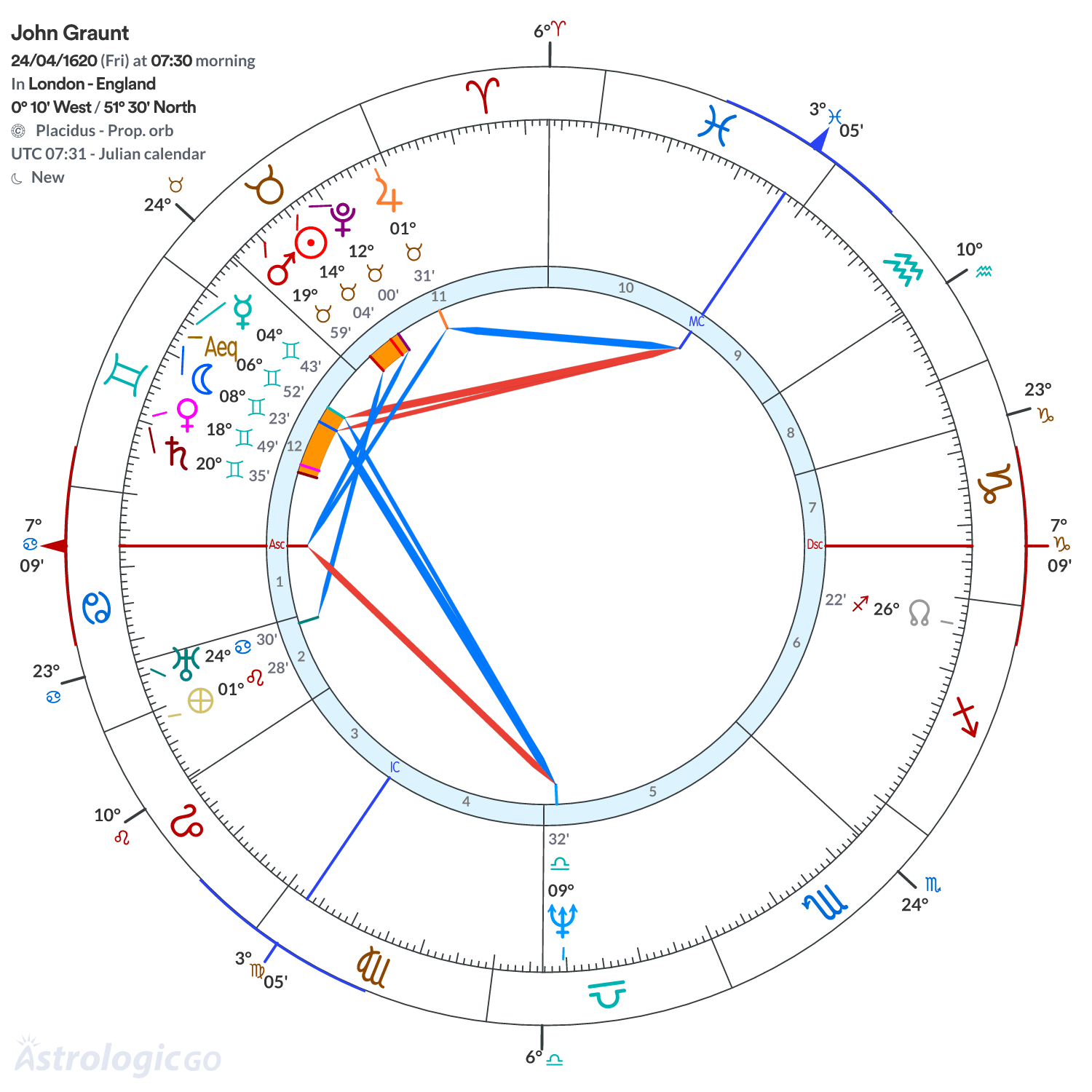
John Graunt
Sun Taurus
Moon Gemini
Ascendant Cancer
Influences in signs
↣ Sun in Taurus - 14°05' - in house 11/12
↣ Moon in Gemini - 08°23' - in house 12
↣ Mercury in Gemini - 04°43' - in house 12
↣ Venus in Gemini - 18°49' - in house 12
↣ Mars in Taurus - 19°59' - in house 12
↣ Jupiter in Taurus - 01°32' - in house 11
↣ Saturn in Gemini - 20°36' - in house 12
↣ Uranus in Cancer - 24°31' - in house 2
↣ Neptune in Libra - 09°32' - in house 5 - retrograde
↣ Pluto in Taurus - 12°00' - in house 11/12
↣ North Node in Sagittarius - 26°23' - in house 7 - retrograde
↣ Ascendant in Cancer - 07°10' - in house 1
↣ Midheaven in Pisces - 03°05' - in house 10
↣ Equatorial Ascendant in Gemini - 06°53'
Influences in houses
↣ Sun in house 11/12
↣ Moon in house 12
↣ Mercury in house 12
↣ Venus in house 12
↣ Mars in house 12
↣ Jupiter in house 11
↣ Saturn in house 12
↣ Uranus in house 2
↣ Neptune in house 5
↣ Pluto in house 11/12
↣ North Node in house 7
↣ Ascendant in house 1
↣ Midheaven in house 10
Aspects
↣ Sun and Mars conjunction (5°55' applying)
↣ Sun and Pluto conjunction (2°05' separating)
↣ Moon and Mercury conjunction (3°40' separating) parallel
↣ Moon and Venus conjunction (10°26' applying) parallel
↣ Moon and Saturn parallel
↣ Moon and Neptune trine (1°09' applying)
↣ Moon and North Node antiparallel
↣ Moon and Equatorial Ascendant conjunction (1°31' applying)
↣ Moon and Ascendant parallel
↣ Moon and Midheaven square (5°18' applying)
↣ Mercury and Neptune trine (4°49' applying)
↣ Mercury and North Node antiparallel
↣ Mercury and Equatorial Ascendant conjunction (2°09' separating)
↣ Mercury and Ascendant parallel
↣ Mercury and Midheaven square (1°38' applying)
↣ Venus and Saturn conjunction (1°47' applying)
↣ Venus and North Node opposition (7°34' applying)
↣ Mars and Uranus sextile (4°31' applying)
↣ Mars and Pluto conjunction (8°00' separating)
↣ Jupiter and North Node trine (5°09' separating)
↣ Jupiter and Ascendant sextile (5°38' separating)
↣ Jupiter and Midheaven sextile (1°33' separating) antiparallel
↣ Saturn and Uranus parallel
↣ Saturn and North Node opposition (5°47' applying)
↣ Neptune and Equatorial Ascendant trine (2°40' applying)
↣ Neptune and Ascendant square (2°23' applying)
↣ Pluto and Ascendant sextile (4°50' applying)
↣ North Node and Ascendant antiparallel
Birth data
- Chart date
- 24/04/1620 Julian
- Chart time
- 07:30
- Date and time quality
- B Biography/autobiography what does this mean?
- Data origin
- Astro-Databank
- Location
-
 London, England
 - Latitude and longitude
- 51°30' North · 0°10' West
- Time zone
- 00:01 West
The data used to calculate the charts comes from public sources, as do the descriptive texts. We use sources such as Wikipedia.

About
John Graunt was a 17th-century London merchant whose systematic analysis of the “Bills of Mortality” made him a pioneer of demography and of statistics applied to populations. In 1662 he published Natural and Political Observations upon the Bills of Mortality, a pioneering work that compiled burials and causes of death from London parishes and introduced rudimentary methods for life tables and for estimating birth rates, death rates, and population size.
Graunt did more than organize raw data: he also questioned its reliability, criticizing the classification of causes of death and discussing biases in the records—an early instance of methodological scrutiny in epidemiology. His collaboration and friendship with William Petty brought him into the intellectual circles of the day, culminating in his election to the Royal Society in 1662.
Although he suffered financial setback after the Great Fire of London and personal difficulties related to his religious conversion, Graunt’s legacy endures: his tables are sometimes the only source for certain periods and continue to be used as references in historical studies of mortality and demography.
Charts like this one
- Sun Taurus 1,096 charts
- Moon Gemini 1,036 charts
- Ascendant Cancer 1,126 charts
- Born on April 24 39 charts


