Birth Chart
John Polanyi
John Charles Polanyi
Sun Aquarius
Moon Cancer
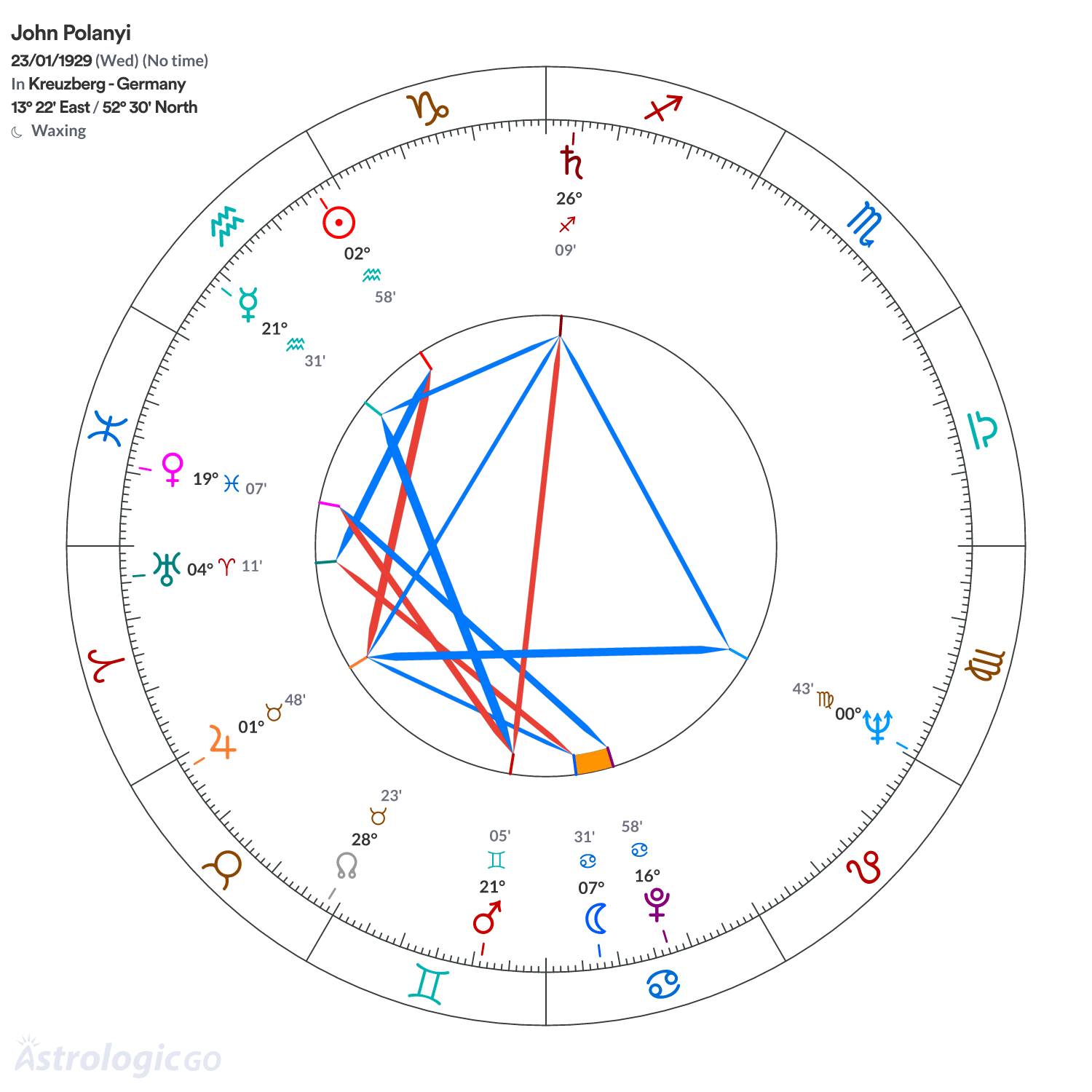
When the birth time is unknown, the chart is calculated for 12:00 noon without using the astrological houses system. Are the planets in the wrong houses?
Influences in signs
↣ Sun in Aquarius - 02°59'
↣ Moon in Cancer - 07°31'
↣ Mercury in Aquarius - 21°32'
↣ Venus in Pisces - 19°08'
↣ Mars in Gemini - 21°05' - retrograde
↣ Jupiter in Taurus - 01°49'
↣ Saturn in Sagittarius - 26°10'
↣ Uranus in Aries - 04°11'
↣ Neptune in Virgo - 00°43' - retrograde
↣ Pluto in Cancer - 16°59' - retrograde
↣ North Node in Taurus - 28°24' - retrograde
Aspects
↣ Sun and Jupiter square (1°10' separating)
↣ Sun and Uranus sextile (1°13' applying)
↣ Sun and North Node trine (4°35' separating) antiparallel
↣ Moon and Mars parallel
↣ Moon and Jupiter sextile (5°43' separating)
↣ Moon and Uranus square (3°19' separating)
↣ Moon and Pluto conjunction (9°28' applying)
↣ Mercury and Mars trine (0°26' separating)
↣ Mercury and Saturn sextile (4°38' applying)
↣ Venus and Mars square (1°58' applying)
↣ Venus and Pluto trine (2°09' separating)
↣ Mars and Saturn opposition (5°04' separating)
↣ Jupiter and Saturn trine (5°39' applying)
↣ Jupiter and Neptune trine (1°05' separating) parallel
↣ Saturn and Neptune trine (4°33' applying)
↣ Saturn and Pluto antiparallel
↣ Uranus and North Node sextile (5°48' separating)
↣ Neptune and North Node square (2°19' separating)
Birth data
- Original name
- John Charles Polanyi
- Chart date
- 23/01/1929
- Chart time
- No time
- Date and time quality
- XX Time not informed what does this mean?
- Data origin
- Astro-Databank
- Location
-
 Kreuzberg, Germany
 - Latitude and longitude
- 52°30' North · 13°22' East
- Time zone
- 01:00 East
The data used to calculate the charts comes from public sources, as do the descriptive texts. We use sources such as Wikipedia.

About
John Charles Polanyi is a chemist of German origin based in Canada, internationally recognized for his contributions to physical chemistry and the dynamics of chemical reactions. His academic career developed mainly at the University of Toronto, where he held positions from 1956 onward and attained the title of University Professor; his pioneering research on transition states and energy in chemical reactions earned him the Nobel Prize in Chemistry in 1986.
Over several decades, Polanyi investigated the microscopic mechanisms that govern how and why reactions occur, including studies on vibrational excitation, chemiluminescence and molecular dynamics at surfaces — work that has influenced fields such as catalysis and nanotechnology. Among other distinctions, he received the Wolf Prize and numerous academic honors and honorary degrees.
Beyond his scientific work, Polanyi has been active in public policy, particularly on issues related to nuclear arms control and support for basic science. A founder of the Pugwash group in Canada, he has long participated in debates on peace, scientific ethics and research policy.


