Birth Chart
King of England George I
Georg Ludwig
Sun Gemini
Moon Gemini
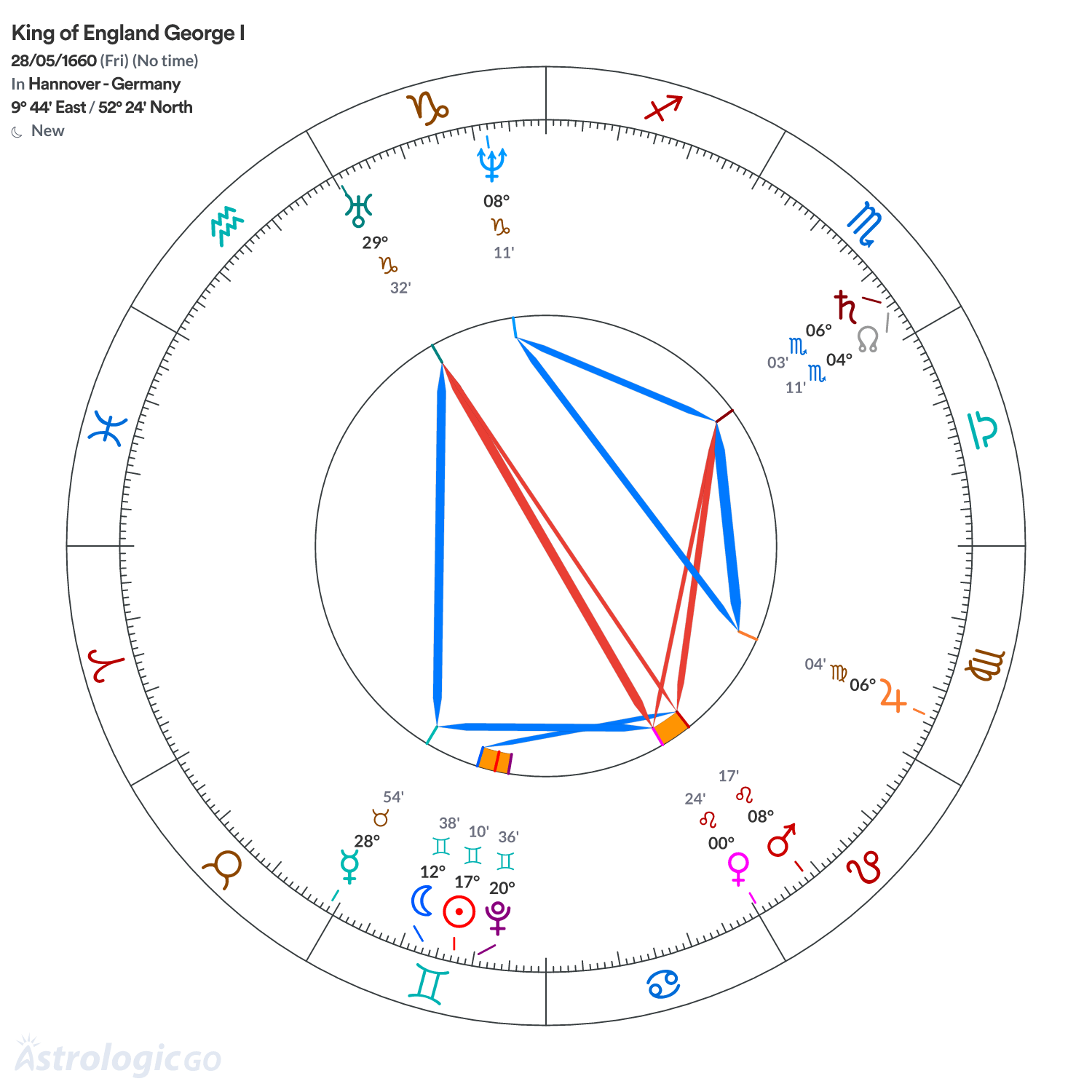
When the birth time is unknown, the chart is calculated for 12:00 noon without using the astrological houses system. Are the planets in the wrong houses?
Influences in signs
↣ Sun in Gemini - 17°11'
↣ Moon in Gemini - 12°38'
↣ Mercury in Taurus - 28°55'
↣ Venus in Leo - 00°25'
↣ Mars in Leo - 08°17'
↣ Jupiter in Virgo - 06°04'
↣ Saturn in Scorpio - 06°03' - retrograde
↣ Uranus in Capricorn - 29°32' - retrograde
↣ Neptune in Capricorn - 08°11' - retrograde
↣ Pluto in Gemini - 20°37'
↣ North Node in Scorpio - 04°11' - retrograde
Aspects
↣ Sun and Moon conjunction (4°32' applying)
↣ Sun and Venus parallel
↣ Sun and Neptune antiparallel
↣ Sun and Pluto conjunction (3°26' applying)
↣ Moon and Mars sextile (4°21' separating) parallel
↣ Moon and Pluto conjunction (7°58' applying)
↣ Mercury and Venus sextile (1°30' separating)
↣ Mercury and Uranus trine (0°38' applying)
↣ Mercury and Pluto parallel
↣ Venus and Mars conjunction (7°53' applying)
↣ Venus and Saturn square (5°39' applying)
↣ Venus and Uranus opposition (0°52' separating)
↣ Venus and Neptune antiparallel
↣ Venus and North Node square (3°47' applying)
↣ Mars and Saturn square (2°14' separating)
↣ Mars and Uranus opposition (8°45' separating)
↣ Mars and North Node square (4°06' separating)
↣ Jupiter and Saturn sextile (0°01' separating) antiparallel
↣ Jupiter and Neptune trine (2°07' applying)
↣ Jupiter and North Node sextile (1°53' separating)
↣ Saturn and Neptune sextile (2°08' separating)
↣ Saturn and North Node conjunction (1°52' separating)
↣ Uranus and North Node square (4°39' applying)
↣ Neptune and North Node sextile (4°00' separating)
Birth data
- Original name
- Georg Ludwig
- Chart date
- 28/05/1660 Julian
- Chart time
- No time
- Date and time quality
- XX Time not informed what does this mean?
- Data origin
- Astro-Databank
- Location
-
 Hannover, Germany
 - Latitude and longitude
- 52°24' North · 9°44' East
- Time zone
- 00:39 East
The data used to calculate the charts comes from public sources, as do the descriptive texts. We use sources such as Wikipedia.

About
George I (Georg Ludwig) was the first British monarch from the House of Hanover; his accession in 1714 marked the dynastic transfer that prioritized Protestant succession in Great Britain. Born in the Hanover region, he held offices and territories within the Holy Roman Empire, was confirmed as Elector of Hanover in 1708, and expanded his domains through the European conflicts of the era.
His personal life was marked by a marriage of convenience to Sophia Dorothea of Celle that ended in scandal and resulted in her long imprisonment; at the same time he maintained a stable relationship with Melusine von der Schulenburg, by whom he had children and who played a public role at court. As sovereign of Britain, he faced Jacobite attempts to depose him and, though often governing from afar, oversaw the beginning of the transfer of royal power to a cabinet government.
During his reign the office of prime minister as a de facto power consolidated, with Robert Walpole taking effective political control toward the end of George’s life. George I died in 1727 while traveling to Hanover; his reign influenced the configuration of the modern British state and the continued political prominence of Hanoverians on the British throne.


