Birth Chart
Kitty Wells
Muriel Deason
Sun Virgo
Moon Libra or Scorpio
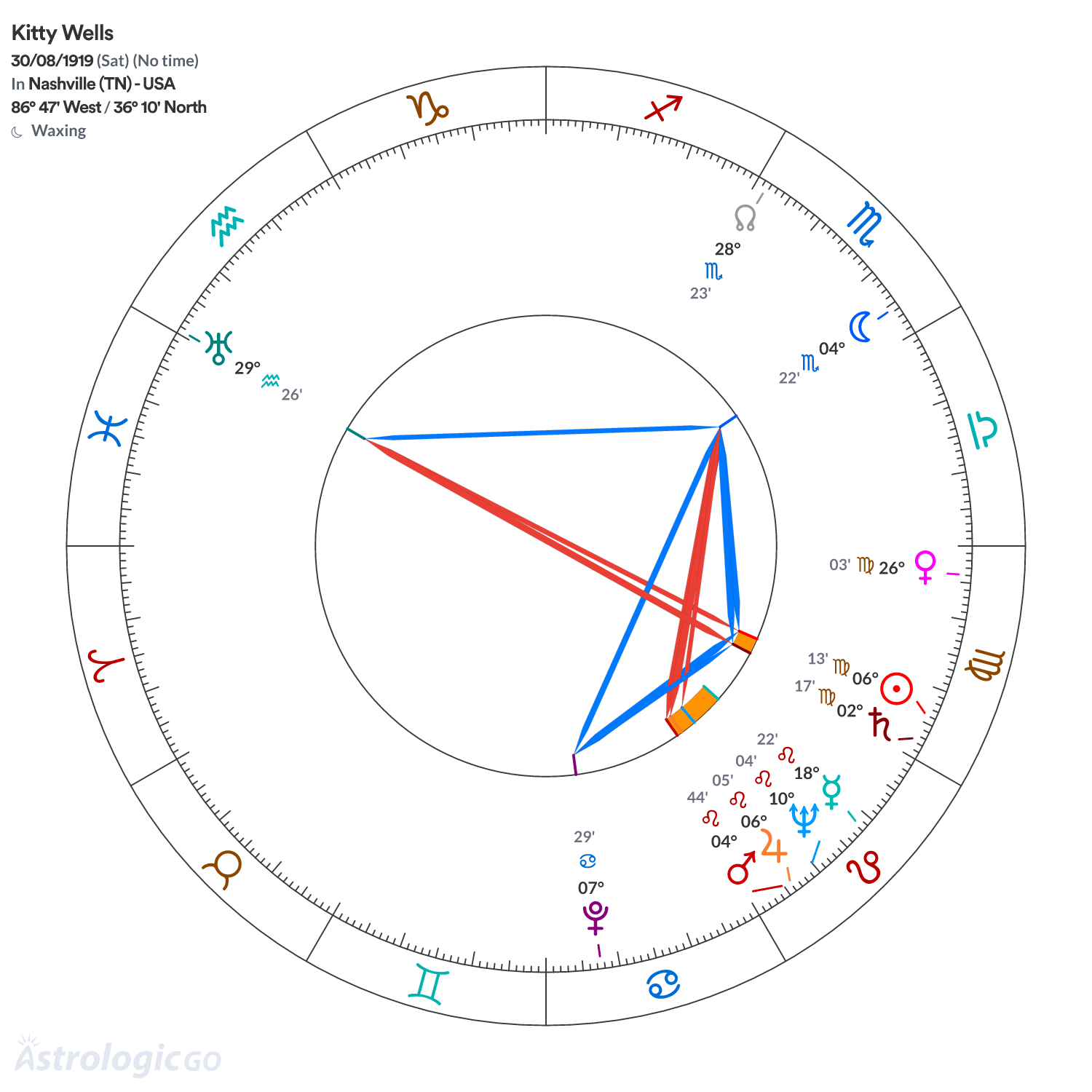
When the birth time is unknown, the chart is calculated for 12:00 noon without using the astrological houses system. Are the planets in the wrong houses?
Influences in signs
↣ Sun in Virgo - 06°13'
↣ Moon in Scorpio - 04°22'
↣ Mercury in Leo - 18°23'
↣ Venus in Virgo - 26°04' - retrograde
↣ Mars in Leo - 04°44'
↣ Jupiter in Leo - 06°05'
↣ Saturn in Virgo - 02°17'
↣ Uranus in Aquarius - 29°27' - retrograde
↣ Neptune in Leo - 10°04'
↣ Pluto in Cancer - 07°29'
↣ North Node in Scorpio - 28°23' - retrograde
Aspects
↣ Sun and Moon sextile (1°51' applying)
↣ Sun and Saturn conjunction (3°56' separating)
↣ Sun and Uranus opposition (6°46' separating)
↣ Sun and Pluto sextile (1°16' applying)
↣ Moon and Mercury antiparallel
↣ Moon and Mars square (0°23' applying)
↣ Moon and Jupiter square (1°43' applying)
↣ Moon and Saturn sextile (2°05' separating)
↣ Moon and Uranus trine (4°55' separating)
↣ Moon and Neptune square (5°42' applying)
↣ Moon and Pluto trine (3°07' applying)
↣ Mercury and Neptune conjunction (8°18' separating)
↣ Venus and North Node sextile (2°20' separating)
↣ Mars and Jupiter conjunction (1°21' applying) parallel
↣ Mars and Neptune conjunction (5°20' applying)
↣ Mars and Pluto parallel
↣ Mars and North Node antiparallel
↣ Jupiter and Neptune conjunction (3°59' applying)
↣ Jupiter and Pluto parallel
↣ Jupiter and North Node antiparallel
↣ Saturn and Uranus opposition (2°50' separating) antiparallel
↣ Saturn and Pluto sextile (5°12' applying)
↣ Saturn and North Node square (3°54' separating)
↣ Uranus and North Node square (1°04' separating)
↣ Pluto and North Node antiparallel
Birth data
- Original name
- Muriel Deason
- Chart date
- 30/08/1919
- Chart time
- No time
- Date and time quality
- XX Time not informed what does this mean?
- Data origin
- Astro-Databank
- Location
-
 Nashville (TN), USA
 - Latitude and longitude
- 36°10' North · 86°47' West
- Time zone
- 05:00 West
The data used to calculate the charts comes from public sources, as do the descriptive texts. We use sources such as Wikipedia.

About
Kitty Wells, stage name of Muriel Deason, was an American singer whose country career gained wide attention beginning in the 1950s. Her greatest achievement was the 1952 hit “It Wasn't God Who Made Honky Tonk Angels,” which made her the first woman to reach the top of the country charts in the United States and also led to entries on the pop charts. The song, a pointed response to lyrics that blamed women for infidelities, faced censorship but sold hundreds of thousands of copies and established her presence in the music world.
Throughout the following decade Wells kept a steady string of hits and established herself as a pioneering voice for female performers in the genre, winning consecutive awards as best female singer and gaining visibility on country radio and television. Her partnership with Red Foley produced another number-one and numerous recordings that broadened her reach.
Institutional recognition came with her induction into the Country Music Hall of Fame in 1976 and the Grammy Lifetime Achievement Award, both underscoring her enduring influence. Known as the “Queen of Country Music,” Wells left a legacy of artistic empowerment for later generations of country singers.


