Birth Chart
Macdonald Carey
Edward Macdonald Carey
Sun Pisces
Moon Gemini
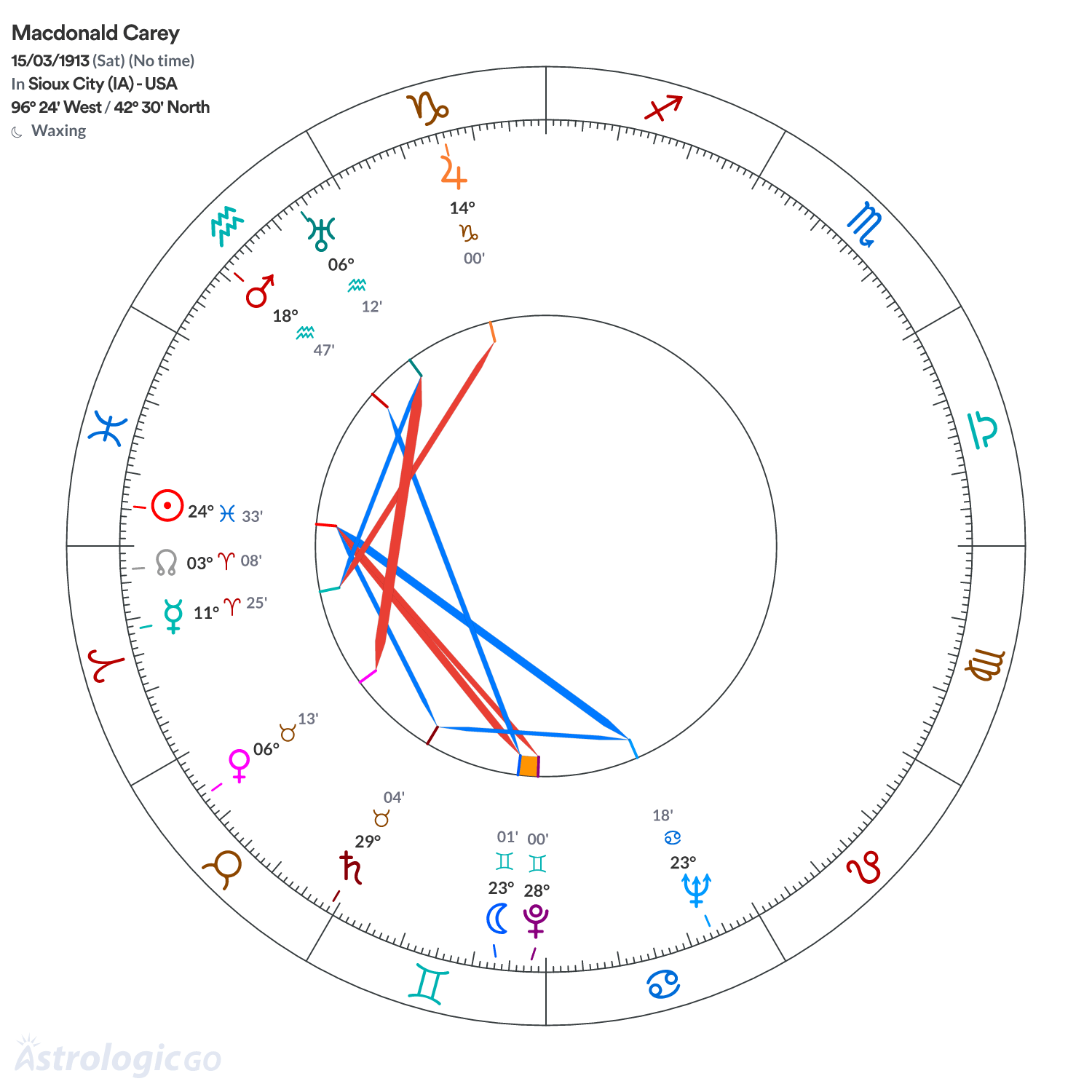
When the birth time is unknown, the chart is calculated for 12:00 noon without using the astrological houses system. Are the planets in the wrong houses?
Influences in signs
↣ Sun in Pisces - 24°34'
↣ Moon in Gemini - 23°01'
↣ Mercury in Aries - 11°25'
↣ Venus in Taurus - 06°14'
↣ Mars in Aquarius - 18°47'
↣ Jupiter in Capricorn - 14°01'
↣ Saturn in Taurus - 29°04'
↣ Uranus in Aquarius - 06°13'
↣ Neptune in Cancer - 23°19' - retrograde
↣ Pluto in Gemini - 28°01'
↣ North Node in Aries - 03°09'
Aspects
↣ Sun and Moon square (1°33' applying)
↣ Sun and Saturn sextile (4°31' applying)
↣ Sun and Neptune trine (1°15' separating)
↣ Sun and Pluto square (3°27' applying)
↣ Sun and North Node conjunction (8°35' applying) antiparallel
↣ Moon and Mars trine (4°14' separating)
↣ Moon and Pluto conjunction (4°59' applying)
↣ Mercury and Jupiter square (2°36' applying)
↣ Mercury and Uranus sextile (5°12' separating)
↣ Mercury and North Node conjunction (8°16' separating)
↣ Venus and Saturn parallel
↣ Venus and Uranus square (0°01' separating) antiparallel
↣ Venus and Pluto parallel
↣ Saturn and Neptune sextile (5°45' separating)
↣ Saturn and Pluto parallel
↣ Saturn and North Node sextile (4°05' applying)
↣ Uranus and North Node sextile (3°04' separating)
↣ Pluto and North Node square (5°09' separating)
Birth data
- Original name
- Edward Macdonald Carey
- Chart date
- 15/03/1913
- Chart time
- No time
- Date and time quality
- XX Time not informed what does this mean?
- Data origin
- Astro-Databank
- Location
-
 Sioux City (IA), USA
 - Latitude and longitude
- 42°30' North · 96°24' West
- Time zone
- 06:00 West
The data used to calculate the charts comes from public sources, as do the descriptive texts. We use sources such as Wikipedia.

About
Macdonald Carey was an American actor whose career moved between film and television, becoming best known as a steady presence on the soap opera Days of Our Lives, where he played the patriarch Dr. Tom Horton for nearly three decades. His daily presence on the NBC program made him one of the most recognizable faces of American televised drama from the postwar era to the end of the 20th century.
Before establishing himself on television, Carey worked extensively in B-movies from the 1940s through the 1960s, building a varied filmography that includes appearances in titles such as Shadow of a Doubt (1943), The Great Gatsby (1949) and John Paul Jones (1959). He performed across genres—from westerns to thrillers and historical drama—showing versatility as both a supporting actor and a leading man in popular productions.
Beyond his professional longevity, Carey remained relevant by working in both film and TV at a time when crossing between media was still uncommon for actors of his stature. His legacy is tied both to the creation of emblematic television characters and to a substantial contribution to mid‑century commercial cinema in the United States.


