Birth Chart
Madeleine Albright
Marie Jana Korbelová
Sun Taurus
Moon Cancer or Leo
When the birth time is unknown, the chart is calculated for 12:00 noon without using the astrological houses system. Are the planets in the wrong houses?
Influences in signs
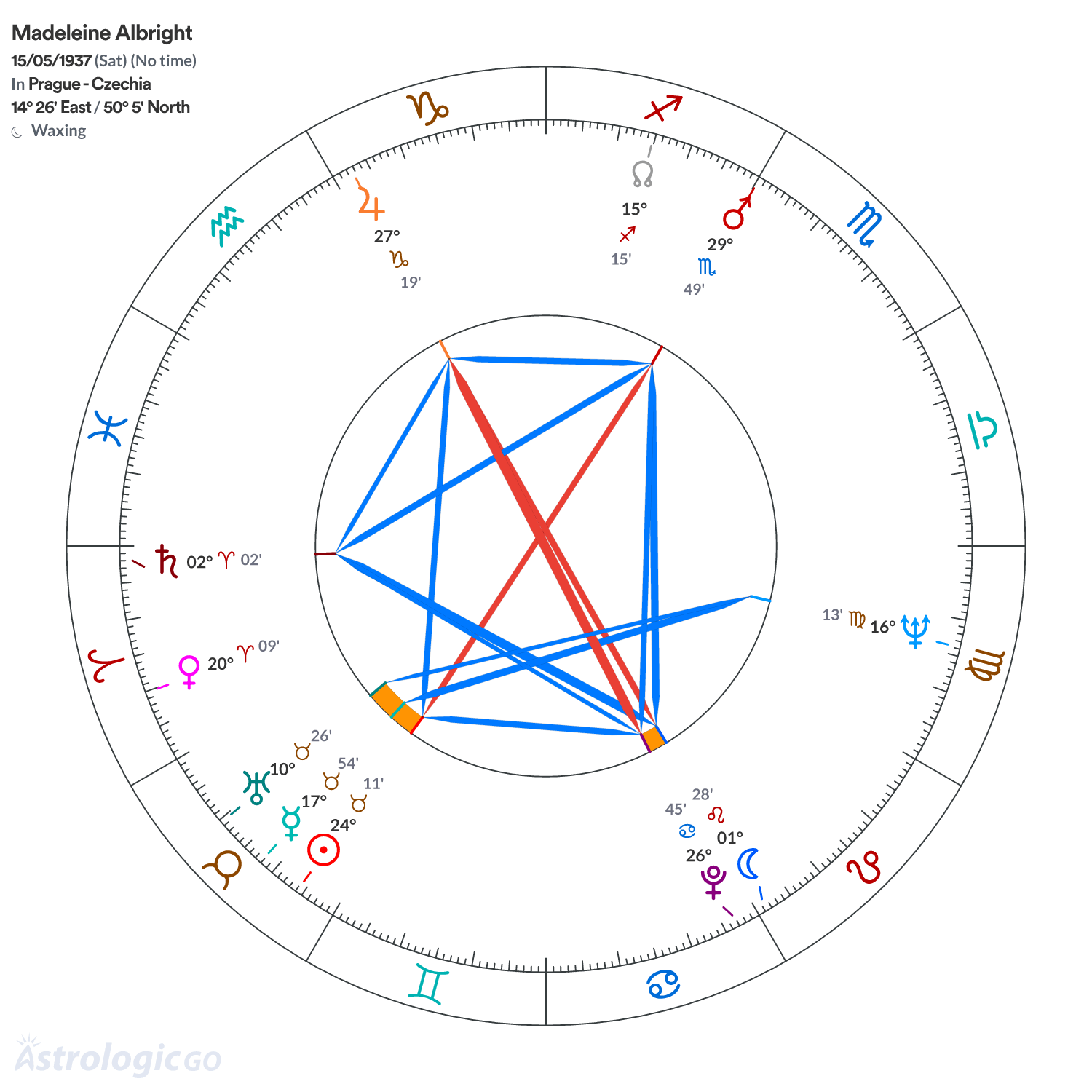
↣ Sun in Taurus - 24°11'
↣ Moon in Leo - 01°28'
↣ Mercury in Taurus - 17°55' - retrograde
↣ Venus in Aries - 20°10'
↣ Mars in Scorpio - 29°50' - retrograde
↣ Jupiter in Capricorn - 27°19'
↣ Saturn in Aries - 02°02'
↣ Uranus in Taurus - 10°26'
↣ Neptune in Virgo - 16°13' - retrograde
↣ Pluto in Cancer - 26°46'
↣ North Node in Sagittarius - 15°16'
Aspects
↣ Sun and Mercury conjunction (6°17' separating)
↣ Sun and Mars opposition (5°39' applying)
↣ Sun and Jupiter trine (3°08' applying)
↣ Sun and Pluto sextile (2°35' applying)
↣ Moon and Mercury parallel
↣ Moon and Mars trine (1°38' separating)
↣ Moon and Jupiter opposition (4°09' separating)
↣ Moon and Saturn trine (0°34' applying)
↣ Moon and Pluto conjunction (4°42' separating)
↣ Mercury and Uranus conjunction (7°28' applying)
↣ Mercury and Neptune trine (1°42' applying)
↣ Venus and North Node trine (4°54' separating)
↣ Mars and Jupiter sextile (2°31' applying) parallel
↣ Mars and Saturn trine (2°13' separating)
↣ Mars and Pluto trine (3°04' applying)
↣ Jupiter and Saturn sextile (4°43' separating)
↣ Jupiter and Pluto opposition (0°33' applying)
↣ Saturn and Pluto trine (5°17' separating)
↣ Uranus and Neptune trine (5°46' applying)
↣ Neptune and North Node square (0°57' applying)
↣ Pluto and North Node antiparallel
Birth data
- Original name
- Marie Jana Korbelová
- Chart date
- 15/05/1937
- Chart time
- No time
- Date and time quality
- XX Time not informed what does this mean?
- Data origin
- Astro-Databank
- Location
-
 Prague, Czechia
 - Latitude and longitude
- 50°05' North · 14°26' East
- Time zone
- 01:00 East
The data used to calculate the charts comes from public sources, as do the descriptive texts. We use sources such as Wikipedia.

About
Madeleine Korbel Albright was a diplomat and a central figure in American foreign policy, remembered as the first woman to serve as United States Secretary of State (1997–2001). Trained and holding a doctorate in political science, she had a long public career as an adviser on the National Security Council, as U.S. Ambassador to the United Nations (1993–1997), and later as the head of diplomacy in the Bill Clinton administration.
At the UN, she was noted for her role in international crises, including her forceful stance regarding the Rwandan massacre and the campaign that prevented Boutros Boutros‑Ghali’s reappointment as secretary‑general. As Secretary of State, she led initiatives in multilateral diplomacy and the defense of U.S. interests in a post–Cold War context marked by humanitarian interventions and challenges to the international order.
After leaving government, she maintained academic and business activities: she taught at Georgetown University, chaired a global affairs consultancy, and served on boards such as the Council on Foreign Relations. She received the Presidential Medal of Freedom in 2012 and left a legacy as a female reference in diplomacy and in the formulation of U.S. foreign policy.


