Birth Chart
Martha Gellhorn
Martha Ellis Gellhorn
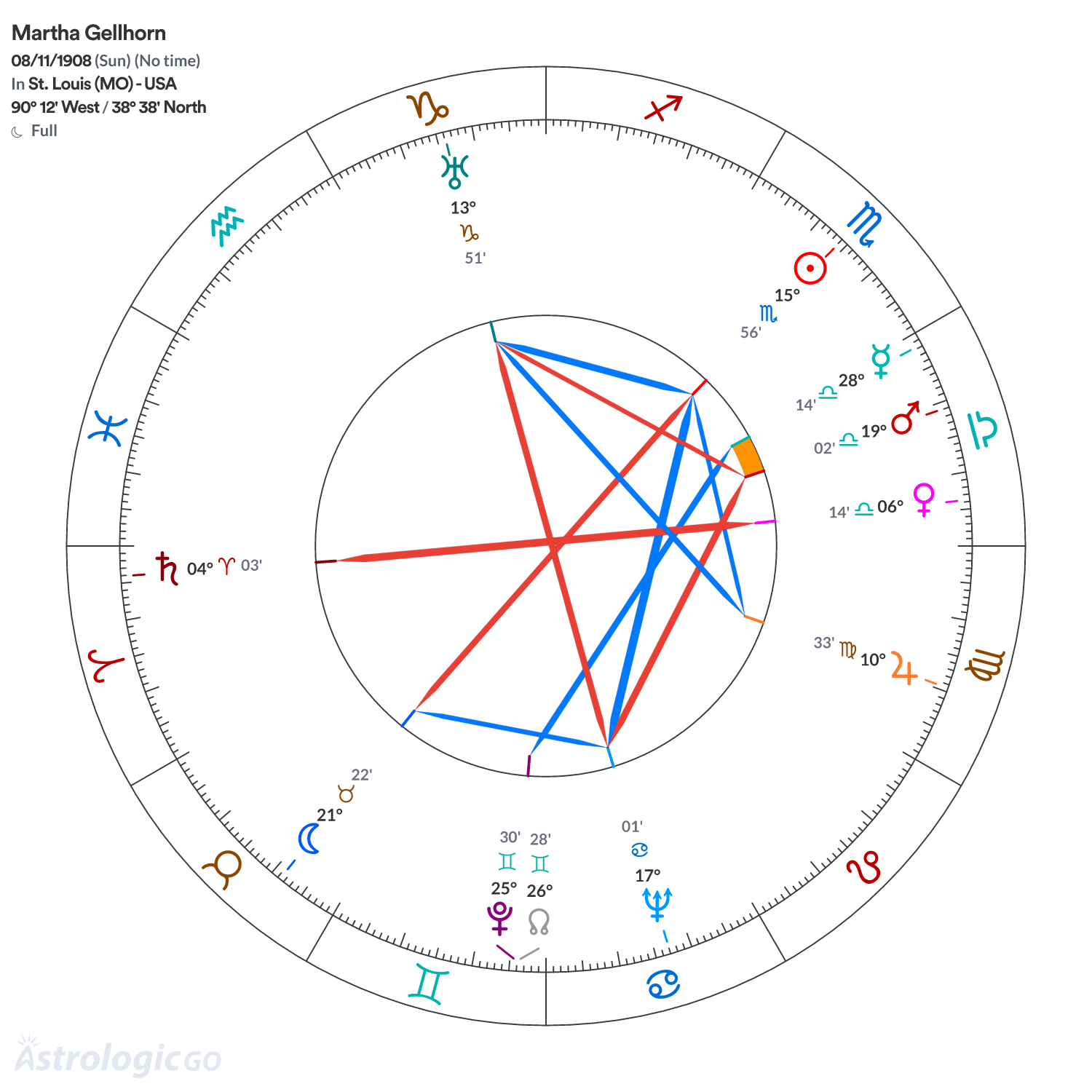
Sun Scorpio
Moon Taurus
When the birth time is unknown, the chart is calculated for 12:00 noon without using the astrological houses system. Are the planets in the wrong houses?
Influences in signs
↣ Sun in Scorpio - 15°57'
↣ Moon in Taurus - 21°22'
↣ Mercury in Libra - 28°14'
↣ Venus in Libra - 06°14'
↣ Mars in Libra - 19°02'
↣ Jupiter in Virgo - 10°33'
↣ Saturn in Aries - 04°04' - retrograde
↣ Uranus in Capricorn - 13°52'
↣ Neptune in Cancer - 17°01' - retrograde
↣ Pluto in Gemini - 25°31' - retrograde
↣ North Node in Gemini - 26°29' - retrograde
Aspects
↣ Sun and Moon opposition (5°25' separating) antiparallel
↣ Sun and Jupiter sextile (5°24' separating)
↣ Sun and Uranus sextile (2°05' separating)
↣ Sun and Neptune trine (1°04' applying)
↣ Sun and Pluto antiparallel
↣ Moon and Neptune sextile (4°21' separating)
↣ Moon and Pluto parallel
↣ Mercury and Mars conjunction (9°12' applying)
↣ Mercury and Jupiter antiparallel
↣ Mercury and Pluto trine (2°43' separating)
↣ Mercury and North Node trine (1°46' separating)
↣ Venus and Saturn opposition (2°11' separating) parallel
↣ Mars and Uranus square (5°11' separating)
↣ Mars and Neptune square (2°01' separating)
↣ Jupiter and Uranus trine (3°19' applying)
↣ Uranus and Neptune opposition (3°09' applying)
↣ Uranus and North Node antiparallel
↣ Pluto and North Node conjunction (0°58' applying)
Birth data
- Original name
- Martha Ellis Gellhorn
- Chart date
- 08/11/1908
- Chart time
- No time
- Date and time quality
- XX Time not informed what does this mean?
- Data origin
- Astro-Databank
- Location
-
 St. Louis (MO), USA
 - Latitude and longitude
- 38°38' North · 90°12' West
- Time zone
- 06:00 West
The data used to calculate the charts comes from public sources, as do the descriptive texts. We use sources such as Wikipedia.

About
Martha Gellhorn was an American writer and journalist whose six‑decade career established her as one of the most important war correspondents of the twentieth century. She specialized in reporting from conflicts and crises, covering everything from the rise of Nazism and the Spanish Civil War to World War II landings, fronts in Asia and the liberation of concentration camps. Her work combined on‑the‑ground reporting, humanitarian testimony and literary narrative.
Before focusing full time on international journalism, Gellhorn worked on social investigations in the United States during the Great Depression, collaborating with government initiatives and documentary practitioners such as Dorothea Lange; those experiences produced the short‑story collection The Trouble I’ve Seen. During her career she also became known for exposing harassment and for breaking gender conventions in the correspondent’s trade.
Noted for going where few reporters—especially women—could gain access, Gellhorn took part in the Normandy landings and was among the first journalists to report from Dachau after its liberation. Her journalistic and literary work left a legacy in the way it combined empirical investigation, human sensitivity and an ethical commitment to bearing witness to war and injustice.