Birth Chart
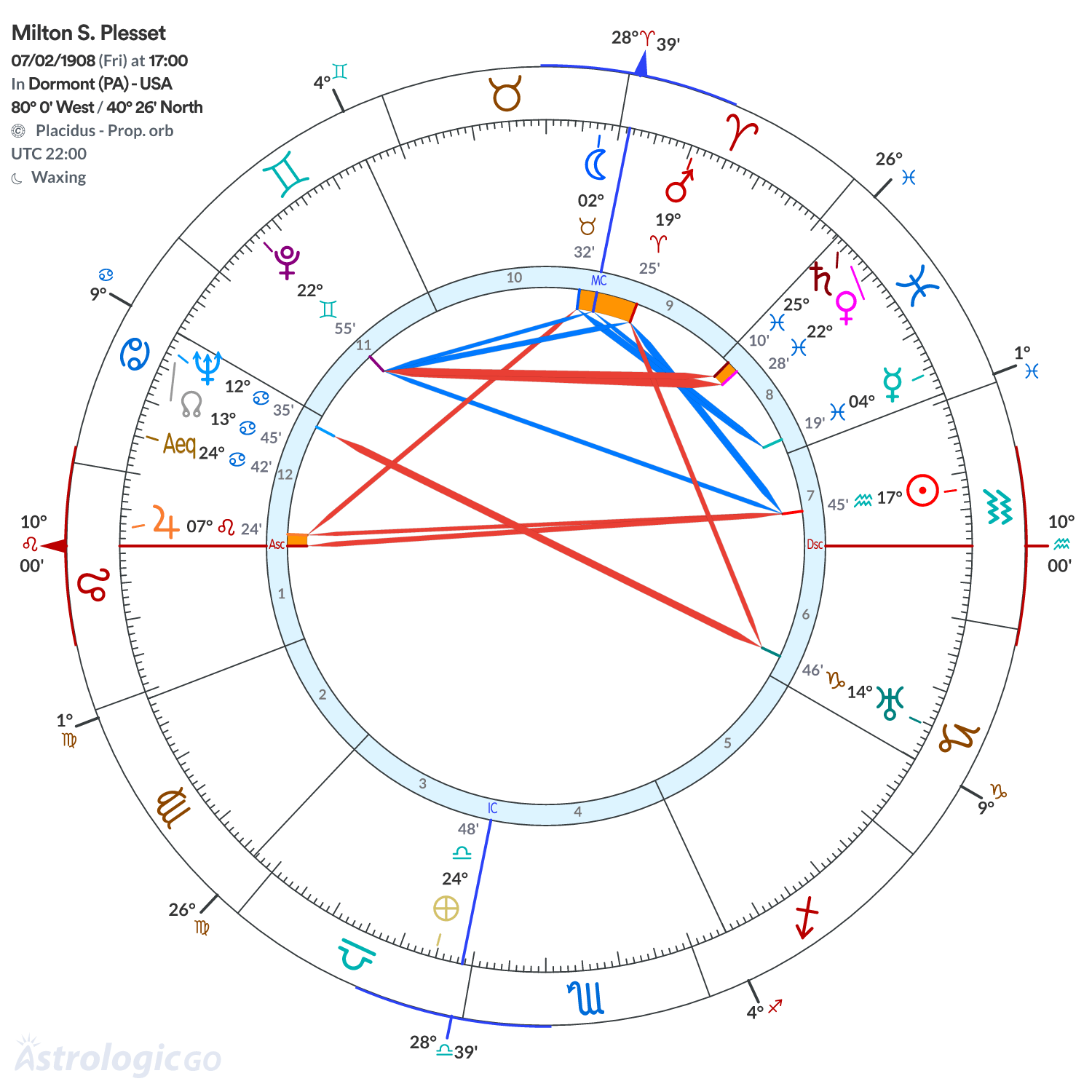
Milton S. Plesset
Milton Spinoza Plesset
Sun Aquarius
Moon Taurus
Ascendant Leo
Influences in signs
↣ Sun in Aquarius - 17°45' - in house 7
↣ Moon in Taurus - 02°33' - in house 10
↣ Mercury in Pisces - 04°19' - in house 8
↣ Venus in Pisces - 22°28' - in house 9
↣ Mars in Aries - 19°26' - in house 10
↣ Jupiter in Leo - 07°25' - in house 1 - retrograde
↣ Saturn in Pisces - 25°11' - in house 9
↣ Uranus in Capricorn - 14°47' - in house 6
↣ Neptune in Cancer - 12°36' - in house 12 - retrograde
↣ Pluto in Gemini - 22°55' - in house 11 - retrograde
↣ North Node in Cancer - 13°46' - in house 12 - retrograde
↣ Ascendant in Leo - 10°01' - in house 1
↣ Midheaven in Aries - 28°40' - in house 10
↣ Equatorial Ascendant in Cancer - 24°42'
Influences in houses
↣ Sun in house 7
↣ Moon in house 10
↣ Mercury in house 8
↣ Venus in house 9
↣ Mars in house 10
↣ Jupiter in house 1
↣ Saturn in house 9
↣ Uranus in house 6
↣ Neptune in house 12
↣ Pluto in house 11
↣ North Node in house 12
↣ Ascendant in house 1
↣ Midheaven in house 10
Aspects
↣ Sun and Mars sextile (1°40' applying)
↣ Sun and Jupiter opposition (10°21' separating)
↣ Sun and Pluto trine (5°10' applying) antiparallel
↣ Sun and Ascendant opposition (7°45' applying)
↣ Moon and Mercury sextile (1°46' applying)
↣ Moon and Mars parallel
↣ Moon and Jupiter square (4°52' applying)
↣ Moon and Midheaven conjunction (3°54' applying)
↣ Mercury and Midheaven sextile (5°40' applying) antiparallel
↣ Venus and Saturn conjunction (2°42' applying) parallel
↣ Venus and Pluto square (0°27' applying)
↣ Venus and Equatorial Ascendant trine (2°14' separating)
↣ Mars and Uranus square (4°39' separating)
↣ Mars and Pluto sextile (3°29' applying)
↣ Mars and North Node square (5°40' separating)
↣ Mars and Equatorial Ascendant square (5°16' separating)
↣ Mars and Midheaven conjunction (9°14' separating)
↣ Jupiter and Ascendant conjunction (2°36' separating)
↣ Saturn and Pluto square (2°16' separating)
↣ Saturn and Equatorial Ascendant trine (0°29' applying)
↣ Uranus and Neptune opposition (2°11' separating) antiparallel
↣ Uranus and North Node opposition (1°02' separating) antiparallel
↣ Uranus and Equatorial Ascendant opposition (9°55' separating)
↣ Neptune and North Node conjunction (1°09' applying) parallel
↣ Pluto and Midheaven sextile (5°44' separating)
Birth data
- Original name
- Milton Spinoza Plesset
- Chart date
- 07/02/1908
- Chart time
- 17:00
- Date and time quality
- AA Birth record in hand what does this mean?
- Data origin
- Astro-Databank
- Location
-
 Dormont (PA), USA
 - Latitude and longitude
- 40°26' North · 80°00' West
- Time zone
- 05:00 West
The data used to calculate the charts comes from public sources, as do the descriptive texts. We use sources such as Wikipedia.

About
Milton Spinoza Plesset was an American applied physicist whose career focused on fluid mechanics and nuclear engineering. He is known for fundamental contributions to the study of multiphase flows, bubble dynamics, and reactor safety, work that led to his election to the National Academy of Engineering in 1979 and to the ASME Fluids Engineering Award in 1986.
Plesset gave his name to the Rayleigh–Plesset equation, used to describe the dynamics of a spherical bubble in a liquid, and is coauthor with Christian Møller of the perturbative theory known as Møller–Plesset. His academic training includes an undergraduate degree from the University of Pittsburgh, a doctorate from Yale, and a long association with Caltech, where he worked with figures such as Robert Oppenheimer and taught until becoming a full professor in 1951.
During World War II and the postwar period he also worked in the aerospace industry (Douglas Aircraft) and maintained collaborations with researchers such as John A. Wheeler. His technical legacy continues to influence cavitation theory, perturbative methods, and practical engineering applications involving bubbles, vibration, and nuclear system safety.
Charts like this one
- Sun Aquarius 1,031 charts
- Moon Taurus 1,104 charts
- Ascendant Leo 1,228 charts
- Born on February 7 25 charts


