Birth Chart
Neil Sedaka
Sun Pisces
Moon Sagittarius or Capricorn
When the birth time is unknown, the chart is calculated for 12:00 noon without using the astrological houses system. Are the planets in the wrong houses?
Influences in signs
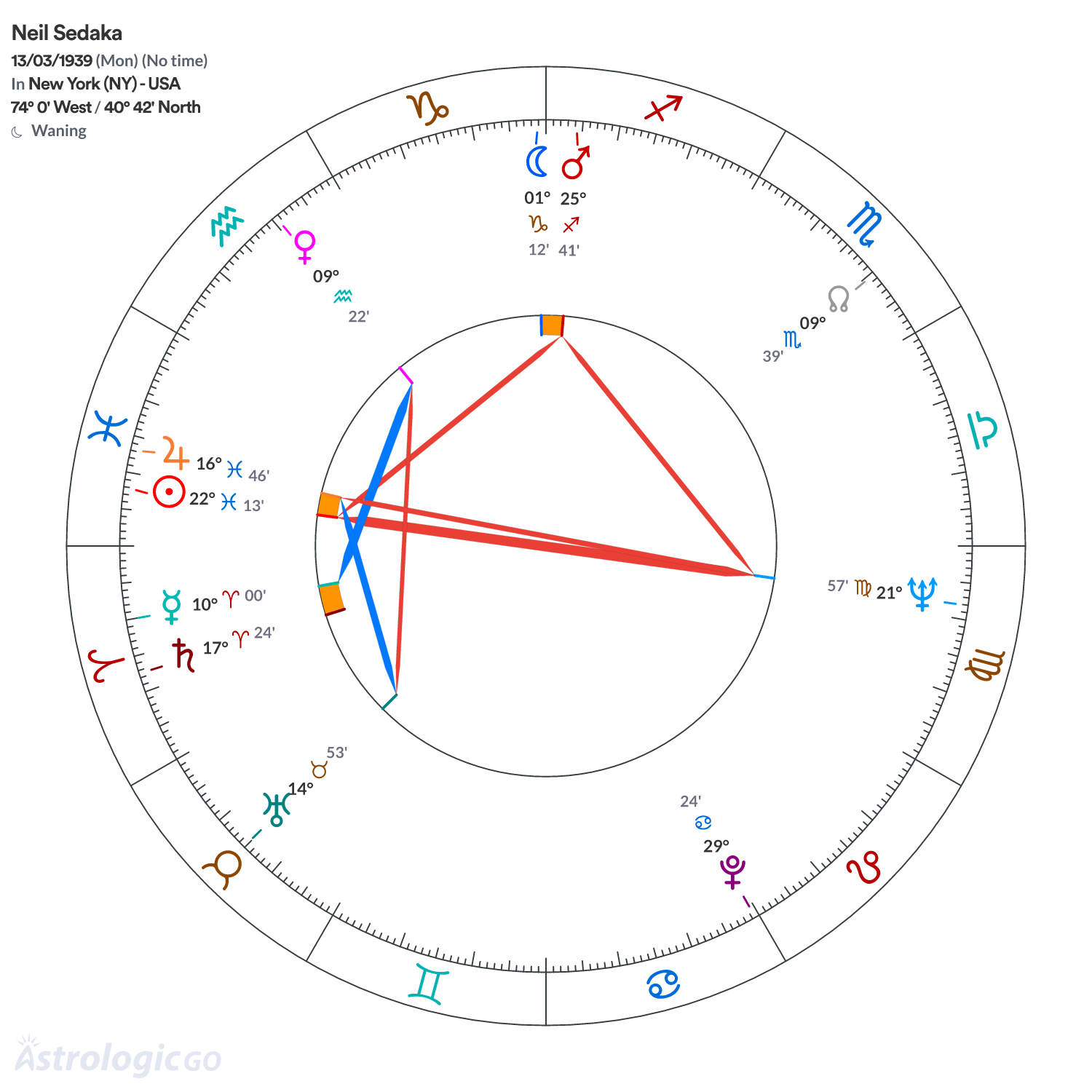
↣ Sun in Pisces - 22°14'
↣ Moon in Capricorn - 01°13'
↣ Mercury in Aries - 10°00'
↣ Venus in Aquarius - 09°22'
↣ Mars in Sagittarius - 25°42'
↣ Jupiter in Pisces - 16°46'
↣ Saturn in Aries - 17°25'
↣ Uranus in Taurus - 14°53'
↣ Neptune in Virgo - 21°58' - retrograde
↣ Pluto in Cancer - 29°25' - retrograde
↣ North Node in Scorpio - 09°39' - retrograde
Aspects
↣ Sun and Mars square (3°28' applying)
↣ Sun and Jupiter conjunction (5°27' separating)
↣ Sun and Neptune opposition (0°16' separating) antiparallel
↣ Moon and Mars conjunction (5°31' separating)
↣ Mercury and Venus sextile (0°38' separating)
↣ Mercury and Jupiter antiparallel
↣ Mercury and Saturn conjunction (7°25' applying) parallel
↣ Venus and Uranus square (5°31' applying)
↣ Venus and North Node square (0°17' applying)
↣ Mars and Neptune square (3°45' separating)
↣ Mars and Pluto antiparallel
↣ Jupiter and Uranus sextile (1°53' separating)
↣ Jupiter and Neptune opposition (5°11' applying)
↣ Saturn and Neptune parallel
↣ Uranus and North Node opposition (5°15' separating)
Birth data
- Chart date
- 13/03/1939
- Chart time
- No time
- Date and time quality
- XX Time not informed what does this mean?
- Data origin
- Astro-Databank
- Location
-
 New York (NY), USA
 - Latitude and longitude
- 40°42' North · 74°00' West
- Time zone
- 05:00 West
The data used to calculate the charts comes from public sources, as do the descriptive texts. We use sources such as Wikipedia.

About
Neil Sedaka was an American singer, pianist and songwriter whose career spanned several decades, from the late 1950s into the 21st century. Musically trained on a scholarship at the Juilliard School and shaped by the milieu of the Brill Building, Sedaka became a central figure in melodic pop, known for his tenor voice and for songs that became landmarks of the pre‑Beatles era, such as “Oh! Carol,” “Calendar Girl” and “Breakin’ Up Is Hard to Do.”
In partnership with lyricist Howard Greenfield, Sedaka not only recorded his own hits but also wrote for other artists, contributing to the repertoire of prominent pop names of the time. His output includes solo albums, compilations and live recordings, as well as collaborations and versions in other languages, including an adaptation of “Ring Ring” for the English‑language market.
Recognized for accessible melodies and distinctive piano arrangements, Sedaka worked across decades while maintaining commercial and artistic relevance, with reissues, compilations and projects that revisited his work. He died on February 27, 2026, leaving a legacy as a prolific songwriter and a representative performer of post‑war American pop.


