Birth Chart
Nicéphore Niépce
Joseph Niépce
Sun Pisces
Moon Virgo
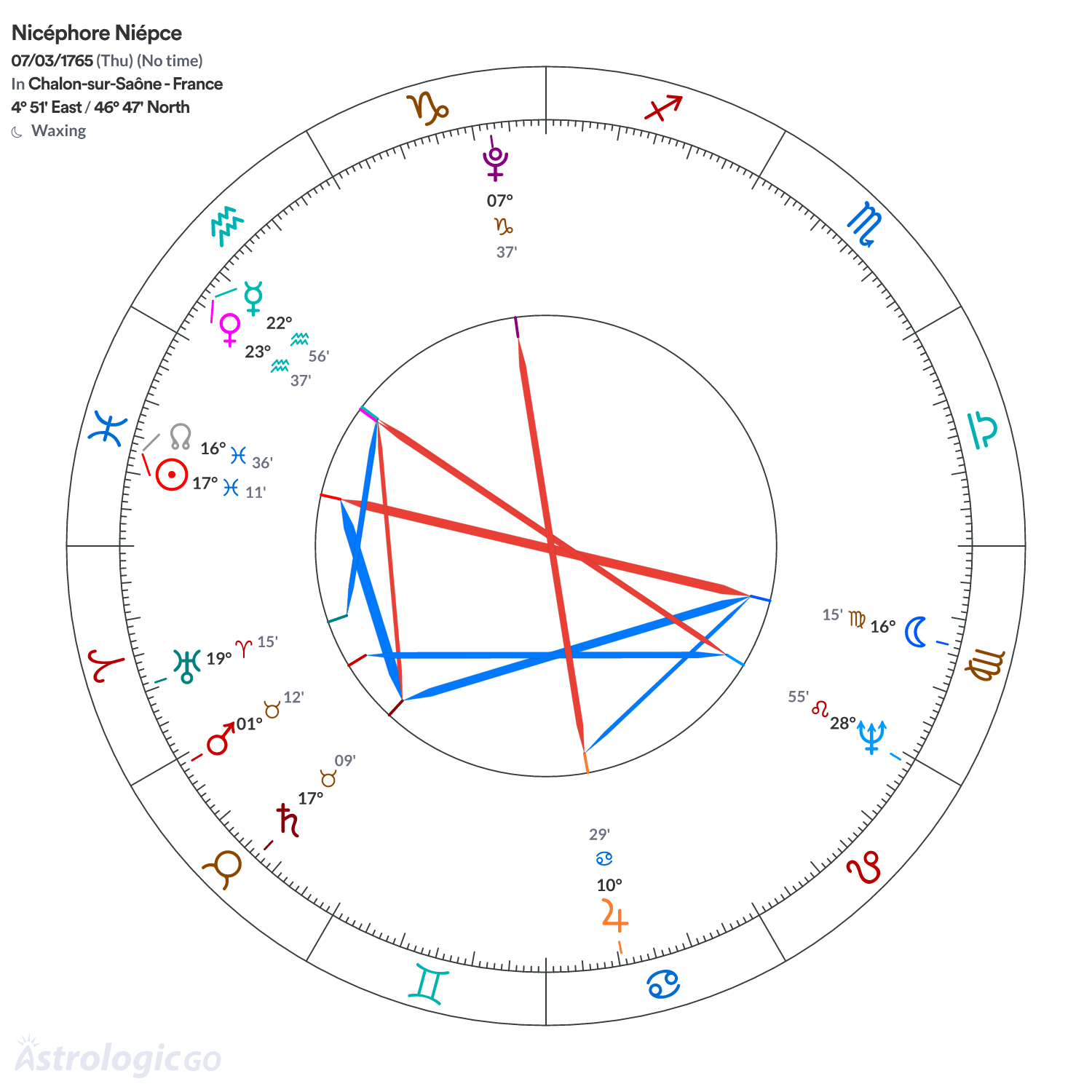
When the birth time is unknown, the chart is calculated for 12:00 noon without using the astrological houses system. Are the planets in the wrong houses?
Influences in signs
↣ Sun in Pisces - 17°12'
↣ Moon in Virgo - 16°15'
↣ Mercury in Aquarius - 22°56'
↣ Venus in Aquarius - 23°38'
↣ Mars in Taurus - 01°13'
↣ Jupiter in Cancer - 10°29'
↣ Saturn in Taurus - 17°10'
↣ Uranus in Aries - 19°15'
↣ Neptune in Leo - 28°56' - retrograde
↣ Pluto in Capricorn - 07°38'
↣ North Node in Pisces - 16°36'
Aspects
↣ Sun and Moon opposition (0°57' applying) antiparallel
↣ Sun and Saturn sextile (0°02' separating)
↣ Sun and North Node conjunction (0°36' separating) parallel
↣ Moon and Jupiter sextile (5°45' separating)
↣ Moon and Saturn trine (0°55' applying)
↣ Moon and North Node opposition (0°21' applying) antiparallel
↣ Mercury and Venus conjunction (0°42' applying) parallel
↣ Mercury and Saturn square (5°46' separating) antiparallel
↣ Mercury and Uranus sextile (3°42' separating)
↣ Mercury and Neptune opposition (6°00' applying)
↣ Venus and Saturn antiparallel
↣ Venus and Uranus sextile (4°23' separating)
↣ Venus and Neptune opposition (5°18' applying)
↣ Mars and Neptune trine (2°17' separating) parallel
↣ Jupiter and Pluto opposition (2°52' applying)
↣ Saturn and North Node sextile (0°34' separating)
Birth data
- Original name
- Joseph Niépce
- Chart date
- 07/03/1765
- Chart time
- No time
- Date and time quality
- XX Time not informed what does this mean?
- Data origin
- Astro-Databank
- Location
-
 Chalon-sur-Saône, France
 - Latitude and longitude
- 46°47' North · 4°51' East
- Time zone
- 00:19 East
The data used to calculate the charts comes from public sources, as do the descriptive texts. We use sources such as Wikipedia.

About
Nicéphore Niépce was a French inventor essential to the emergence of photography who also worked in other fields of engineering. He is best remembered for creating heliography, a technique that used Bitumen of Judea dissolved in lavender oil to fix images, and for producing the oldest known photograph of a real scene, made with a rudimentary camera in the 1820s. His process demonstrated the feasibility of capturing and preserving luminous images and was a direct predecessor of later photographic developments.
Besides his photographic research, Niépce collaborated with his brother Claude on notable mechanical inventions: the Pyréolophore, one of the first internal combustion engines actually built, which was even applied to a boat on the Saône River, and improvements to hydraulic machines. These initiatives show his experimental spirit and interest in practical technological applications.
Niépce’s career included military service and public administration before he devoted himself entirely to research. Although his technical pioneering is acknowledged, he ended his last years in financial difficulty; nevertheless his technical and cultural legacy endures, with objects from his collection preserved in museums and photographic awards bearing his name.


