Birth Chart
Otto Stern
Sun Aquarius
Moon Aries or Taurus
When the birth time is unknown, the chart is calculated for 12:00 noon without using the astrological houses system. Are the planets in the wrong houses?
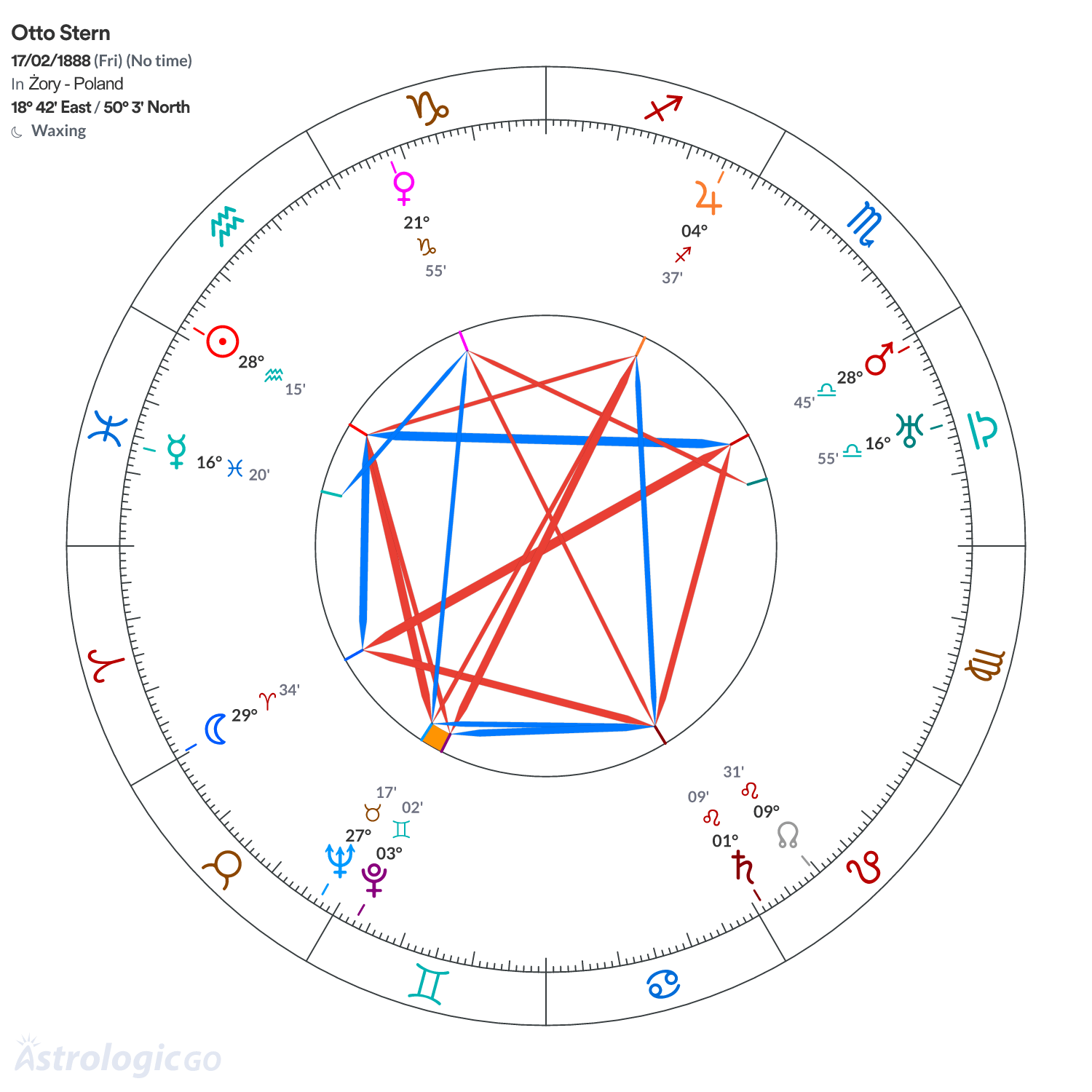
Influences in signs
↣ Sun in Aquarius - 28°16'
↣ Moon in Aries - 29°34'
↣ Mercury in Pisces - 16°20'
↣ Venus in Capricorn - 21°56'
↣ Mars in Libra - 28°46'
↣ Jupiter in Sagittarius - 04°38'
↣ Saturn in Leo - 01°10' - retrograde
↣ Uranus in Libra - 16°56' - retrograde
↣ Neptune in Taurus - 27°18'
↣ Pluto in Gemini - 03°02'
↣ North Node in Leo - 09°32' - retrograde
Aspects
↣ Sun and Moon sextile (1°18' separating)
↣ Sun and Mars trine (0°30' applying)
↣ Sun and Jupiter square (6°22' applying)
↣ Sun and Neptune square (0°57' separating)
↣ Sun and Pluto square (4°47' applying)
↣ Moon and Mars opposition (0°48' separating)
↣ Moon and Saturn square (1°35' applying)
↣ Moon and Uranus antiparallel
↣ Mercury and Venus sextile (5°36' separating)
↣ Venus and Jupiter parallel
↣ Venus and Saturn opposition (9°13' applying) antiparallel
↣ Venus and Uranus square (5°00' separating)
↣ Venus and Neptune trine (5°22' applying)
↣ Mars and Saturn square (2°24' applying)
↣ Mars and Pluto antiparallel
↣ Jupiter and Saturn trine (3°28' separating) antiparallel
↣ Jupiter and Neptune opposition (7°20' separating)
↣ Jupiter and Pluto opposition (1°35' separating)
↣ Jupiter and North Node trine (4°54' applying)
↣ Saturn and Neptune sextile (3°51' applying)
↣ Saturn and Pluto sextile (1°53' separating)
↣ Saturn and North Node conjunction (8°22' separating)
↣ Neptune and Pluto conjunction (5°45' applying)
↣ Neptune and North Node parallel
Birth data
- Chart date
- 17/02/1888
- Chart time
- No time
- Date and time quality
- XX Time not informed what does this mean?
- Data origin
- Astro-Databank
- Location
-
 Żory, Poland
 - Latitude and longitude
- 50°03' North · 18°42' East
- Time zone
- 01:15 East
The data used to calculate the charts comes from public sources, as do the descriptive texts. We use sources such as Wikipedia.

About
A physicist of German origin, Otto Stern became known as a pioneer of experimental atomic and molecular physics. Trained in physical chemistry, he moved early between theory and the laboratory and developed molecular beam techniques that made it possible to isolate particles and measure their properties with precision, paving the way for new experimental protocols.
Together with Walther Gerlach he devised the famous experiment that demonstrated the quantization of atomic angular momentum, a central result for quantum mechanics. In Hamburg he led a large research group, mentoring generations of scientists and promoting investigations into matter diffraction, magnetic moments, and the interaction between particles and fields.
By measuring the magnetic moments of the proton and deuteron, and contributing to the development of molecular beam epitaxy, Stern consolidated a body of work that earned him the Nobel Prize in Physics. Bridging theory and technique, his legacy lies in founding modern experimental atomic physics and shaping methods for preparing and characterizing particles in well‑defined states.


