Birth Chart
Pat Riley
Sun Pisces
Moon Gemini or Cancer
When the birth time is unknown, the chart is calculated for 12:00 noon without using the astrological houses system. Are the planets in the wrong houses?
Influences in signs
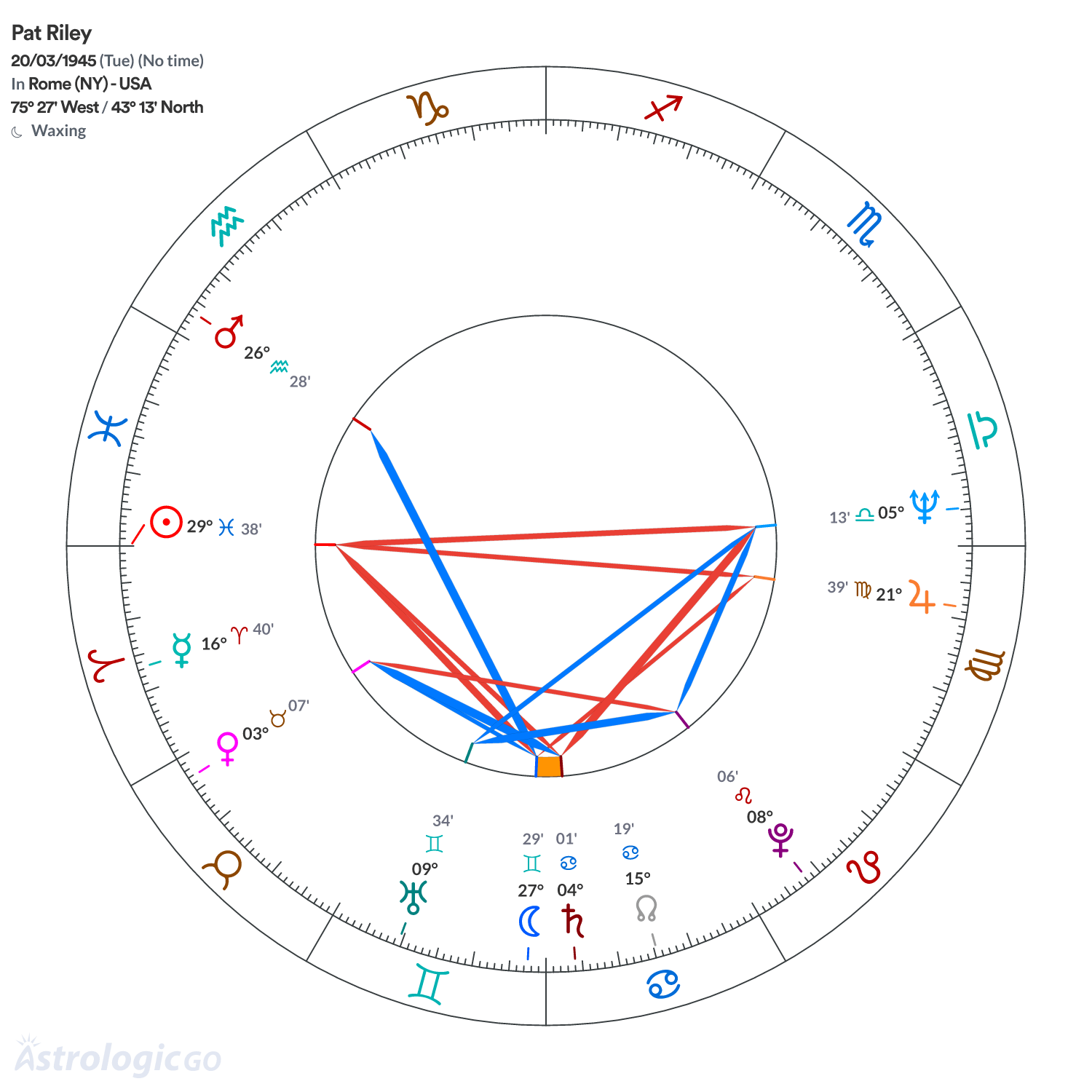
↣ Sun in Pisces - 29°38'
↣ Moon in Gemini - 27°29'
↣ Mercury in Aries - 16°41'
↣ Venus in Taurus - 03°07'
↣ Mars in Aquarius - 26°29'
↣ Jupiter in Virgo - 21°39' - retrograde
↣ Saturn in Cancer - 04°02'
↣ Uranus in Gemini - 09°34'
↣ Neptune in Libra - 05°13' - retrograde
↣ Pluto in Leo - 08°07' - retrograde
↣ North Node in Cancer - 15°19' - retrograde
Aspects
↣ Sun and Moon square (2°09' applying)
↣ Sun and Jupiter opposition (7°59' separating)
↣ Sun and Saturn square (4°23' applying)
↣ Sun and Neptune opposition (5°35' applying) parallel
↣ Moon and Venus sextile (5°37' applying)
↣ Moon and Mars trine (1°01' separating)
↣ Moon and Jupiter square (5°50' separating)
↣ Moon and Saturn conjunction (6°32' applying) parallel
↣ Moon and Uranus parallel
↣ Moon and North Node parallel
↣ Mercury and North Node square (1°21' separating)
↣ Venus and Saturn sextile (0°55' applying)
↣ Venus and Pluto square (5°00' applying)
↣ Saturn and Uranus parallel
↣ Saturn and Neptune square (1°11' applying)
↣ Saturn and North Node parallel
↣ Uranus and Neptune trine (4°21' separating)
↣ Uranus and Pluto sextile (1°27' separating)
↣ Uranus and North Node parallel
↣ Neptune and Pluto sextile (2°54' separating)
Birth data
- Chart date
- 20/03/1945
- Chart time
- No time
- Date and time quality
- XX Time not informed what does this mean?
- Data origin
- Astro-Databank
- Location
-
 Rome (NY), USA
 - Latitude and longitude
- 43°13' North · 75°27' West
- Time zone
- 04:00 West
The data used to calculate the charts comes from public sources, as do the descriptive texts. We use sources such as Wikipedia.

About
Pat Riley is an American basketball executive and coach whose name is associated with the Los Angeles Lakers’ golden era and the Miami Heat’s success. As a coach he won five NBA championships — four with the Lakers in the 1980s and one with the Heat in 2006 — and helped define the “Showtime” style, combining fast offense with defensive discipline. His career also includes a championship as a player in 1972 and executive titles with the Heat in 2006, 2012, and 2013, making him the first American figure to win championships as a player, assistant, coach, and executive.
A versatile collegiate athlete, Riley played in the NBA in the 1960s and 1970s and was a member of the Los Angeles Lakers’ 1972 championship team. He later moved into broadcasting and soon took on coaching responsibilities, becoming an icon for his style and for imposing a culture of winning built on discipline, physical conditioning, and emphasis on rebounding.
His influence extends beyond championships: Riley helped shape team identity and management practices across the league, influencing generations of coaches and executives. At the Miami Heat, his executive leadership established a long-term competitive project and left a lasting legacy in NBA history.


