Birth Chart
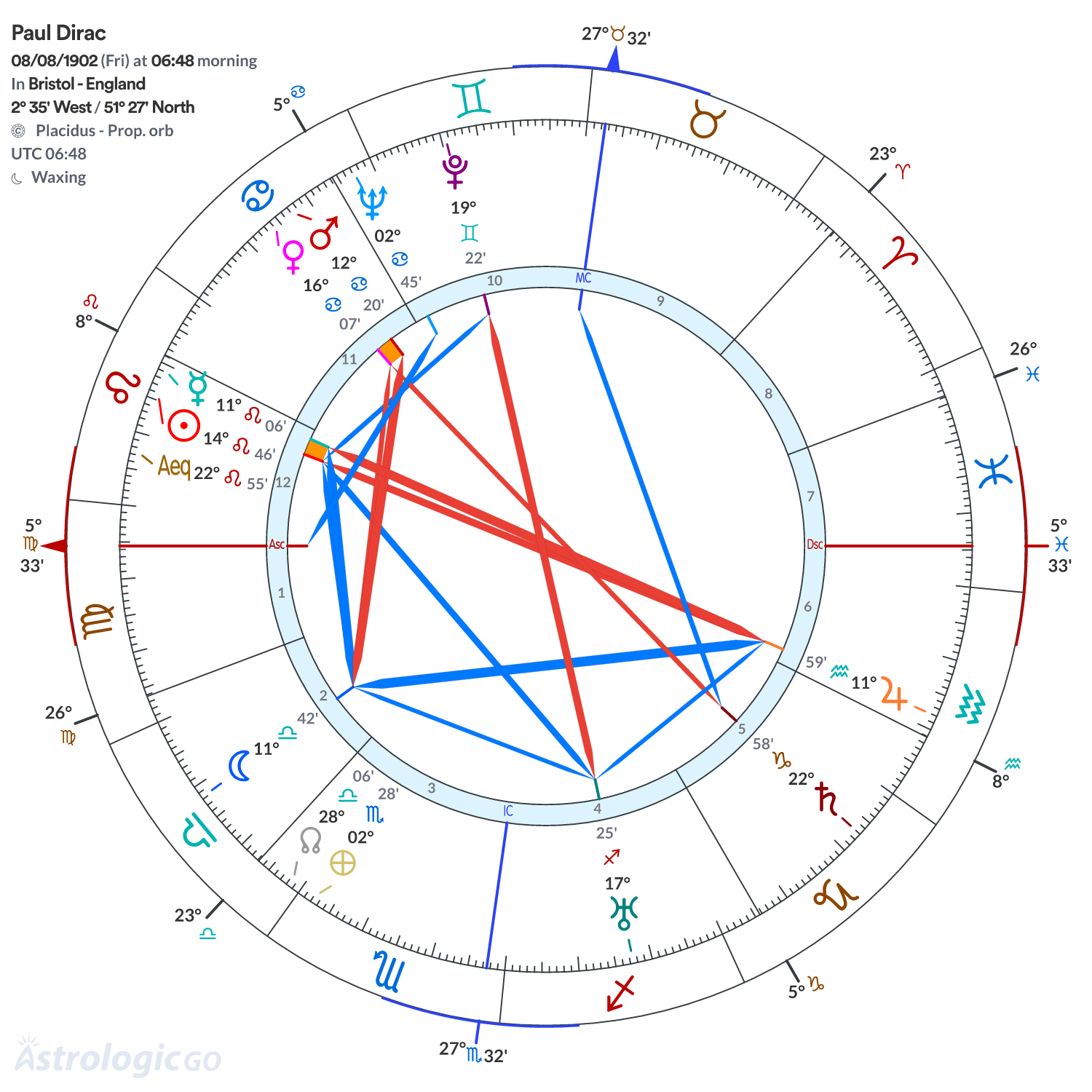
Paul Dirac
Sun Leo
Moon Libra
Ascendant Virgo
Influences in signs
↣ Sun in Leo - 14°47' - in house 12
↣ Moon in Libra - 11°43' - in house 2
↣ Mercury in Leo - 11°07' - in house 12
↣ Venus in Cancer - 16°08' - in house 11
↣ Mars in Cancer - 12°21' - in house 11
↣ Jupiter in Aquarius - 11°59' - in house 6 - retrograde
↣ Saturn in Capricorn - 22°59' - in house 5 - retrograde
↣ Uranus in Sagittarius - 17°25' - in house 4 - retrograde
↣ Neptune in Cancer - 02°46' - in house 11
↣ Pluto in Gemini - 19°22' - in house 10
↣ North Node in Libra - 28°07' - in house 3 - retrograde
↣ Ascendant in Virgo - 05°33' - in house 1
↣ Midheaven in Taurus - 27°32' - in house 10
↣ Equatorial Ascendant in Leo - 22°55'
Influences in houses
↣ Sun in house 12
↣ Moon in house 2
↣ Mercury in house 12
↣ Venus in house 11
↣ Mars in house 11
↣ Jupiter in house 6
↣ Saturn in house 5
↣ Uranus in house 4
↣ Neptune in house 11
↣ Pluto in house 10
↣ North Node in house 3
↣ Ascendant in house 1
↣ Midheaven in house 10
Aspects
↣ Sun and Moon sextile (3°04' applying)
↣ Sun and Mercury conjunction (3°40' applying)
↣ Sun and Jupiter opposition (2°47' separating)
↣ Sun and Uranus trine (2°39' applying)
↣ Sun and Pluto sextile (4°36' applying)
↣ Sun and Equatorial Ascendant conjunction (8°08' separating)
↣ Moon and Mercury sextile (0°35' separating)
↣ Moon and Venus square (4°26' applying)
↣ Moon and Mars square (0°39' applying)
↣ Moon and Jupiter trine (0°17' applying)
↣ Moon and Uranus sextile (5°43' applying)
↣ Mercury and Jupiter opposition (0°52' applying) antiparallel
↣ Mercury and Midheaven parallel
↣ Venus and Mars conjunction (3°47' separating)
↣ Venus and Saturn opposition (6°51' applying) antiparallel
↣ Venus and Uranus antiparallel
↣ Venus and Neptune parallel
↣ Mars and Uranus antiparallel
↣ Jupiter and Uranus sextile (5°26' separating)
↣ Saturn and Neptune antiparallel
↣ Saturn and North Node square (5°08' separating)
↣ Saturn and Midheaven trine (4°33' separating)
↣ Uranus and Neptune antiparallel
↣ Uranus and Pluto opposition (1°57' separating)
↣ Uranus and Equatorial Ascendant trine (5°30' separating)
↣ Neptune and North Node trine (4°39' separating)
↣ Neptune and Ascendant sextile (2°47' separating)
↣ Pluto and Equatorial Ascendant sextile (3°33' separating)
↣ North Node and Equatorial Ascendant sextile (5°12' applying)
Birth data
- Chart date
- 08/08/1902
- Chart time
- 06:48
- Date and time quality
- C Rectified from approximate time what does this mean?
- Data origin
- Astro-Databank
- Location
-
 Bristol, England
 - Latitude and longitude
- 51°27' North · 2°35' West
- Time zone
- 00:00
The data used to calculate the charts comes from public sources, as do the descriptive texts. We use sources such as Wikipedia.

About
Paul Adrien Maurice Dirac was an English theoretical physicist, recognized as one of the founders of quantum mechanics and quantum electrodynamics. Lucasian Professor of Mathematics at Cambridge and later a faculty member at universities in the United States, Dirac became known for formulating the equation that bears his name, which describes fermions and led to the prediction of antimatter—a prediction confirmed by the discovery of the positron in 1932. His book The Principles of Quantum Mechanics became a lasting reference by unifying the matrix and wave approaches and by introducing mathematical tools such as the delta function and bracket notation.
Dirac’s work also directly influenced the development of quantum electrodynamics, including concepts such as vacuum polarization, and paved the way for later generations of theorists. He received the Nobel Prize in Physics in 1933, sharing the honor with Erwin Schrödinger, and was awarded distinctions including the Royal Medal and the Copley Medal.
Known for an austere personality and little interest in interpretive debates about quantum theory, Dirac left a deep technical and conceptual legacy: his equations and methods are pillars of particle physics and quantum field theory, with lasting impact on semiconductors, Fermi–Dirac statistics, and the modeling of elementary matter.


