Birth Chart
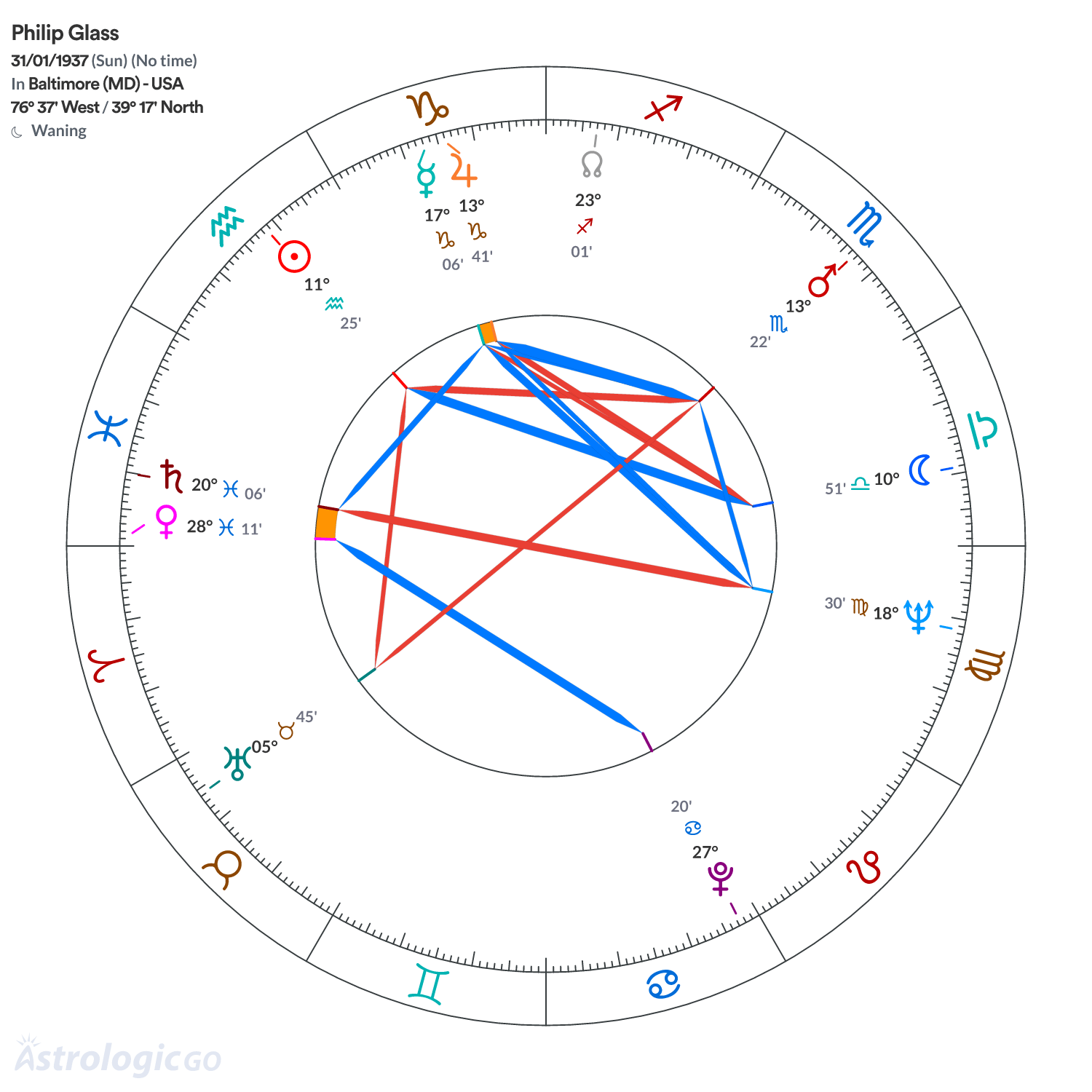
Philip Glass
Sun Aquarius
Moon Libra
When the birth time is unknown, the chart is calculated for 12:00 noon without using the astrological houses system. Are the planets in the wrong houses?
Influences in signs
↣ Sun in Aquarius - 11°26'
↣ Moon in Libra - 10°52'
↣ Mercury in Capricorn - 17°07'
↣ Venus in Pisces - 28°12'
↣ Mars in Scorpio - 13°22'
↣ Jupiter in Capricorn - 13°41'
↣ Saturn in Pisces - 20°07'
↣ Uranus in Taurus - 05°46'
↣ Neptune in Virgo - 18°31' - retrograde
↣ Pluto in Cancer - 27°20' - retrograde
↣ North Node in Sagittarius - 23°02' - retrograde
Aspects
↣ Sun and Moon trine (0°34' applying)
↣ Sun and Mars square (1°56' applying)
↣ Sun and Uranus square (5°40' separating)
↣ Moon and Mercury square (6°15' applying)
↣ Moon and Jupiter square (2°50' applying)
↣ Mercury and Mars sextile (3°44' separating)
↣ Mercury and Jupiter conjunction (3°25' separating)
↣ Mercury and Saturn sextile (3°00' applying)
↣ Mercury and Neptune trine (1°24' applying)
↣ Venus and Saturn conjunction (8°06' separating)
↣ Venus and Pluto trine (0°51' separating)
↣ Venus and North Node square (5°10' separating)
↣ Mars and Jupiter sextile (0°20' applying)
↣ Mars and Uranus opposition (7°36' separating)
↣ Mars and Neptune sextile (5°09' applying)
↣ Jupiter and Neptune trine (4°49' applying)
↣ Jupiter and Pluto antiparallel
↣ Jupiter and North Node parallel
↣ Saturn and Neptune opposition (1°36' separating) antiparallel
↣ Saturn and North Node square (2°55' applying)
↣ Neptune and North Node square (4°31' applying)
↣ Pluto and North Node antiparallel
Birth data
- Chart date
- 31/01/1937
- Chart time
- No time
- Date and time quality
- XX Time not informed what does this mean?
- Data origin
- Astro-Databank
- Location
-
 Baltimore (MD), USA
 - Latitude and longitude
- 39°17' North · 76°37' West
- Time zone
- 05:00 West
The data used to calculate the charts comes from public sources, as do the descriptive texts. We use sources such as Wikipedia.

About
Philip Glass is an American composer regarded as one of the most influential figures in late 20th-century music. Often associated with the minimalist movement — a label he does not fully embrace — he has built a career defined by a prolific output that includes operas, symphonies, concertos and film scores.
His best-known operas include Einstein on the Beach, Akhnaten and Satyagraha, the latter inspired by Gandhi and structured around mantras. In film music, Glass became notable for Koyaanisqatsi, whose score influenced generations of film composers, and he wrote music for films such as Mishima, Kundun and The Hours, earning Academy Award nominations.
Glass’s music also intersects with rock and electronic music; he collaborated with Ravi Shankar and influenced artists such as Brian Eno, and worked with names from alternative rock at his Looking Glass studio. His legacy combines formal experimentation, a repetitive musical language and a wide presence in contemporary repertoire, continuing to influence composers and popular musicians.


