Birth Chart
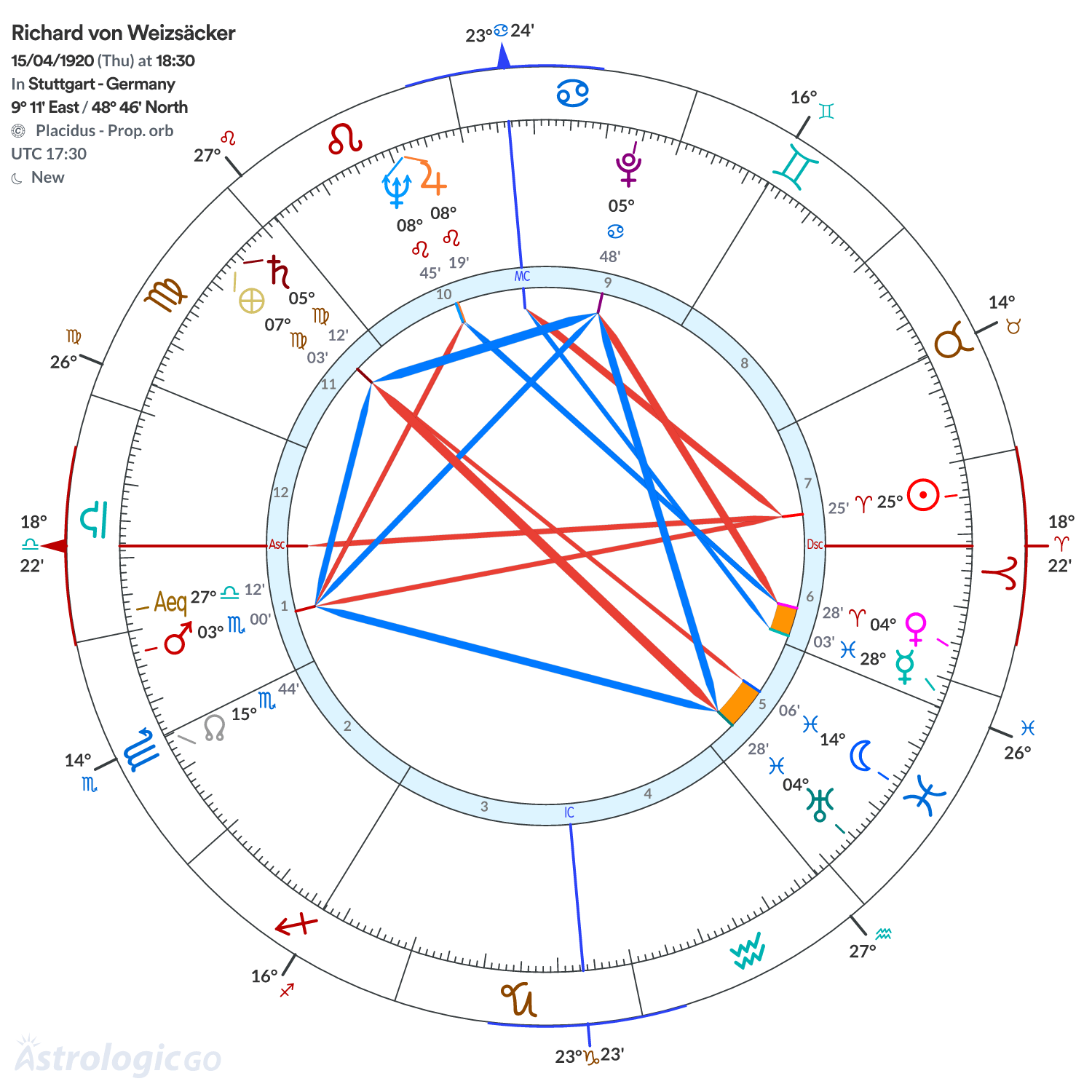
Richard von Weizsäcker
Sun Aries
Moon Pisces
Ascendant Libra
Influences in signs
↣ Sun in Aries - 25°26' - in house 7
↣ Moon in Pisces - 14°06' - in house 5
↣ Mercury in Pisces - 28°03' - in house 6
↣ Venus in Aries - 04°28' - in house 6
↣ Mars in Scorpio - 03°00' - in house 1 - retrograde
↣ Jupiter in Leo - 08°19' - in house 10
↣ Saturn in Virgo - 05°13' - in house 11 - retrograde
↣ Uranus in Pisces - 04°29' - in house 5
↣ Neptune in Leo - 08°45' - in house 10 - retrograde
↣ Pluto in Cancer - 05°49' - in house 9
↣ North Node in Scorpio - 15°44' - in house 2 - retrograde
↣ Ascendant in Libra - 18°23' - in house 1
↣ Midheaven in Cancer - 23°24' - in house 10
↣ Equatorial Ascendant in Libra - 27°13'
Influences in houses
↣ Sun in house 7
↣ Moon in house 5
↣ Mercury in house 6
↣ Venus in house 6
↣ Mars in house 1
↣ Jupiter in house 10
↣ Saturn in house 11
↣ Uranus in house 5
↣ Neptune in house 10
↣ Pluto in house 9
↣ North Node in house 2
↣ Ascendant in house 1
↣ Midheaven in house 10
Aspects
↣ Sun and Mars opposition (7°34' applying) antiparallel
↣ Sun and Uranus antiparallel
↣ Sun and Equatorial Ascendant opposition (1°46' separating)
↣ Sun and Ascendant opposition (7°03' applying)
↣ Sun and Midheaven square (2°02' applying)
↣ Moon and Mercury parallel
↣ Moon and Saturn opposition (8°54' separating)
↣ Moon and Uranus conjunction (9°38' separating)
↣ Moon and North Node trine (1°38' applying)
↣ Mercury and Venus conjunction (6°25' separating)
↣ Mercury and Midheaven trine (4°39' applying)
↣ Venus and Jupiter trine (3°51' applying)
↣ Venus and Neptune trine (4°17' applying)
↣ Venus and Pluto square (1°20' applying)
↣ Venus and Equatorial Ascendant parallel
↣ Mars and Jupiter square (5°19' separating)
↣ Mars and Saturn sextile (2°12' separating) antiparallel
↣ Mars and Uranus trine (1°28' separating) parallel
↣ Mars and Neptune square (5°45' separating)
↣ Mars and Pluto trine (2°48' separating)
↣ Mars and Equatorial Ascendant conjunction (5°48' applying)
↣ Jupiter and Neptune conjunction (0°26' applying) parallel
↣ Jupiter and Pluto parallel
↣ Saturn and Uranus opposition (0°44' applying) antiparallel
↣ Saturn and Pluto sextile (0°36' separating)
↣ Uranus and Pluto trine (1°20' applying)
Birth data
- Chart date
- 15/04/1920
- Chart time
- 18:30
- Date and time quality
- A Memory what does this mean?
- Data origin
- Astro-Databank
- Location
-
 Stuttgart, Germany
 - Latitude and longitude
- 48°46' North · 9°11' East
- Time zone
- 01:00 East
The data used to calculate the charts comes from public sources, as do the descriptive texts. We use sources such as Wikipedia.

About
Richard von Weizsäcker was one of the most prominent political figures in postwar Germany. A member of the Christian Democratic Union (CDU), he built a career in parliament and local government before becoming Federal President in 1984, a post he held for two terms until 1994. Earlier he served as mayor of West Berlin and as deputy leader of the CDU parliamentary group in the Bundestag.
His largely symbolic presidency was notable for its conciliatory role and for shaping historical memory: his 8 May 1985 speech on the 40th anniversary of the end of World War II—when he called that day “the day of liberation” for Germany—became famous and cemented his moral and political reputation. In 1990 he played an important role in the reunification process, becoming the first president of a unified Germany.
Trained in philosophy, history and law, with periods of study at Oxford, Grenoble and Göttingen, Weizsäcker also belonged to a family influential in science and diplomacy. His public career is remembered for institutional balance, an emphasis on critical examination of the past, and the moderate tone that characterized the German presidency in the last decades of the twentieth century.
Charts like this one
- Sun Aries 1,113 charts
- Moon Pisces 1,134 charts
- Ascendant Libra 1,245 charts
- Born on April 15 46 charts


