Birth Chart
Sinclair Lewis
Harry Sinclair Lewis
Sun Aquarius
Moon Scorpio or Sagittarius
When the birth time is unknown, the chart is calculated for 12:00 noon without using the astrological houses system. Are the planets in the wrong houses?
Influences in signs
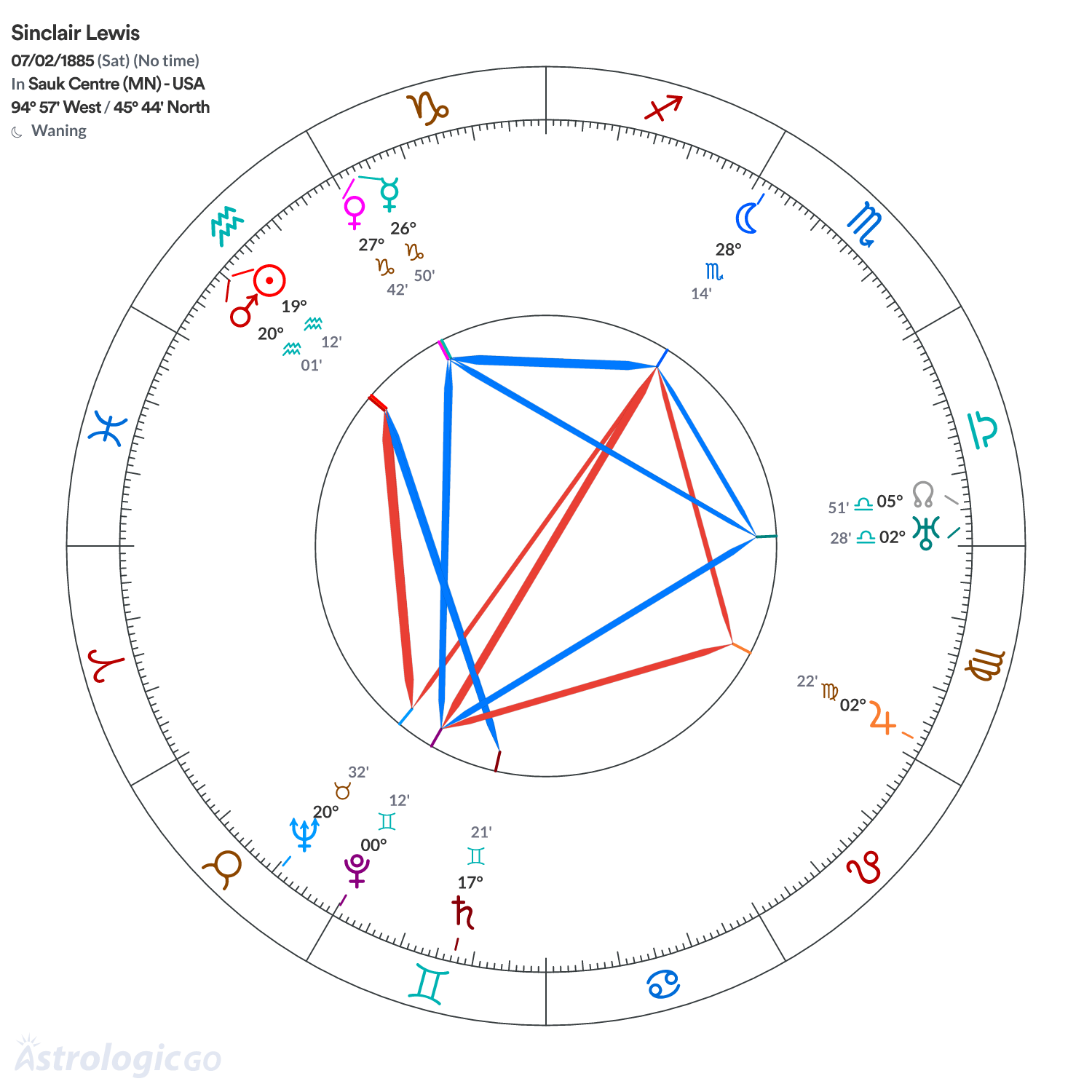
↣ Sun in Aquarius - 19°13'
↣ Moon in Scorpio - 28°14'
↣ Mercury in Capricorn - 26°50'
↣ Venus in Capricorn - 27°43'
↣ Mars in Aquarius - 20°02'
↣ Jupiter in Virgo - 02°23' - retrograde
↣ Saturn in Gemini - 17°22' - retrograde
↣ Uranus in Libra - 02°29' - retrograde
↣ Neptune in Taurus - 20°33'
↣ Pluto in Gemini - 00°12' - retrograde
↣ North Node in Libra - 05°52' - retrograde
Aspects
↣ Sun and Moon parallel
↣ Sun and Mars conjunction (0°50' applying) parallel
↣ Sun and Saturn trine (1°50' separating)
↣ Sun and Neptune square (1°21' applying) antiparallel
↣ Moon and Mercury sextile (1°24' separating)
↣ Moon and Venus sextile (0°32' separating)
↣ Moon and Mars parallel
↣ Moon and Jupiter square (4°08' applying)
↣ Moon and Uranus sextile (4°14' applying)
↣ Moon and Neptune opposition (7°42' separating) antiparallel
↣ Moon and Pluto opposition (1°57' applying)
↣ Mercury and Venus conjunction (0°52' applying) parallel
↣ Mercury and Saturn antiparallel
↣ Mercury and Uranus trine (5°38' applying)
↣ Mercury and Pluto trine (3°21' applying)
↣ Venus and Saturn antiparallel
↣ Venus and Uranus trine (4°46' applying)
↣ Venus and Pluto trine (2°29' applying)
↣ Mars and Saturn trine (2°40' separating)
↣ Mars and Neptune square (0°31' applying) antiparallel
↣ Jupiter and Pluto square (2°11' applying)
↣ Uranus and Pluto trine (2°17' applying)
↣ Uranus and North Node conjunction (3°23' separating)
↣ Pluto and North Node trine (5°40' applying)
Birth data
- Original name
- Harry Sinclair Lewis
- Chart date
- 07/02/1885
- Chart time
- No time
- Date and time quality
- XX Time not informed what does this mean?
- Data origin
- Astro-Databank
- Location
-
 Sauk Centre (MN), USA
 - Latitude and longitude
- 45°44' North · 94°57' West
- Time zone
- 06:20 West
The data used to calculate the charts comes from public sources, as do the descriptive texts. We use sources such as Wikipedia.

About
Sinclair Lewis was an American novelist and playwright whose work had wide impact in the 1920s–1940s. He became the first U.S. writer to receive the Nobel Prize in Literature (1930), an honor that highlighted his literary critique of American materialism and capitalism in the interwar period. His novels blend social satire and realism, probing the hypocrisy of small towns and the tensions of modern life.
His career included popular successes and cultural influence: Main Street (1920) established his reputation by depicting the mediocrity and resistance to change of provincial life, selling millions of copies; later, It Can’t Happen Here (1935) drew renewed attention as a dystopia about the rise of authoritarianism. Lewis was also noted for creating complex working‑class female characters.
Although his critical standing declined after the war, his works returned to public attention for their political and social relevance, shaping debates about culture, power, and American identity. His legacy remains tied to committed satirical fiction and the analysis of twentieth‑century American society.


