Birth Chart
Wild Bill Hickok
James Butler Hickok
Sun Gemini
Moon Pisces
When the birth time is unknown, the chart is calculated for 12:00 noon without using the astrological houses system. Are the planets in the wrong houses?
Influences in signs
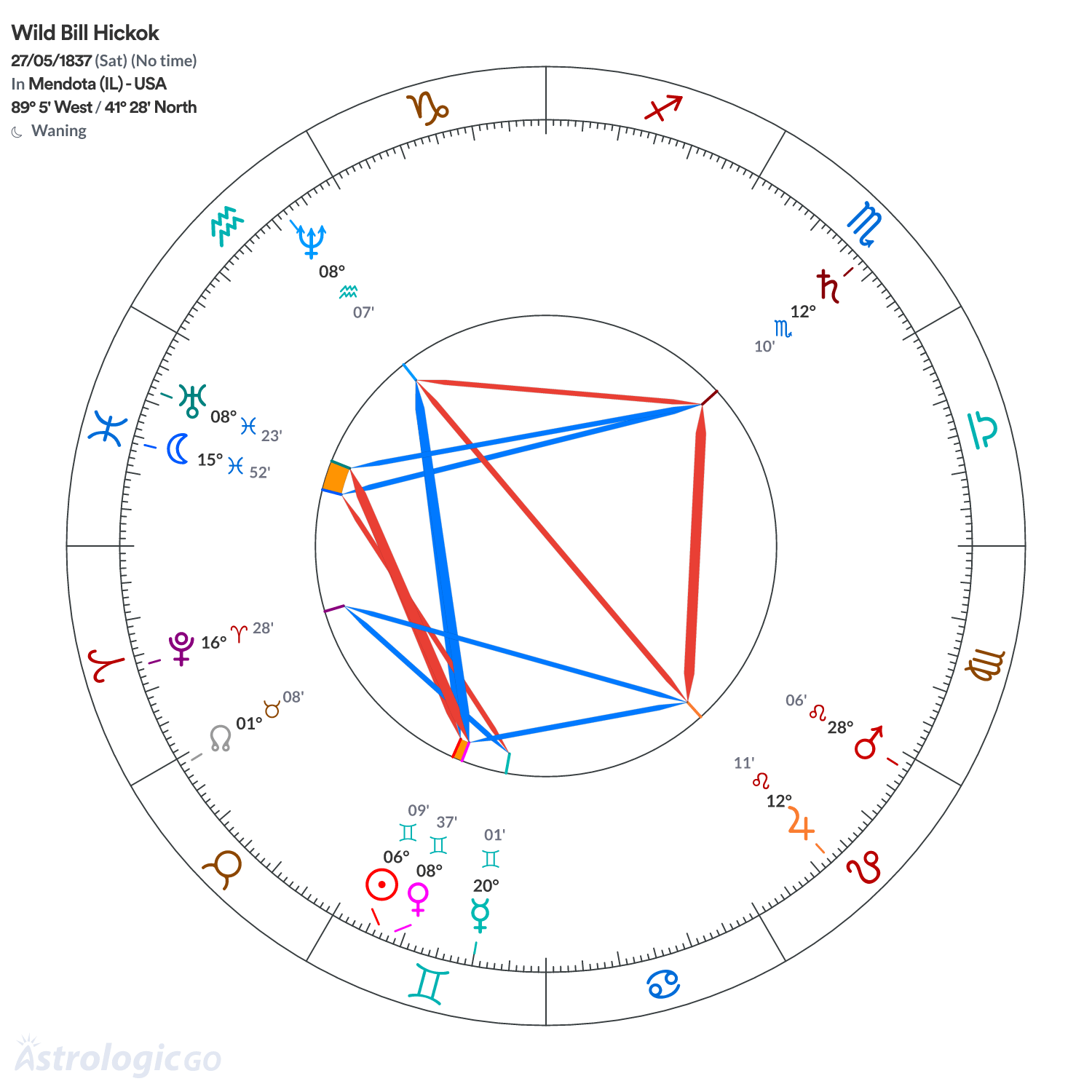
↣ Sun in Gemini - 06°10'
↣ Moon in Pisces - 15°53'
↣ Mercury in Gemini - 20°02' - retrograde
↣ Venus in Gemini - 08°38'
↣ Mars in Leo - 28°07'
↣ Jupiter in Leo - 12°11'
↣ Saturn in Scorpio - 12°11' - retrograde
↣ Uranus in Pisces - 08°23'
↣ Neptune in Aquarius - 08°08' - retrograde
↣ Pluto in Aries - 16°28'
↣ North Node in Taurus - 01°08'
Aspects
↣ Sun and Venus conjunction (2°28' separating) parallel
↣ Sun and Uranus square (2°14' applying)
↣ Sun and Neptune trine (1°59' applying)
↣ Moon and Mercury square (4°09' applying)
↣ Moon and Saturn trine (3°42' separating)
↣ Moon and Uranus conjunction (7°30' separating) parallel
↣ Moon and Pluto parallel
↣ Mercury and Pluto sextile (3°34' applying)
↣ Venus and Jupiter sextile (3°34' applying)
↣ Venus and Uranus square (0°15' separating)
↣ Venus and Neptune trine (0°30' separating)
↣ Mars and Saturn antiparallel
↣ Mars and North Node trine (3°01' applying)
↣ Jupiter and Saturn square (0°00' separating)
↣ Jupiter and Neptune opposition (4°03' separating) antiparallel
↣ Jupiter and Pluto trine (4°17' applying)
↣ Saturn and Uranus trine (3°48' applying)
↣ Saturn and Neptune square (4°03' applying)
↣ Uranus and Pluto parallel
Birth data
- Original name
- James Butler Hickok
- Chart date
- 27/05/1837
- Chart time
- No time
- Date and time quality
- XX Time not informed what does this mean?
- Data origin
- Astro-Databank
- Location
-
 Mendota (IL), USA
 - Latitude and longitude
- 41°28' North · 89°05' West
- Time zone
- 05:56 West
The data used to calculate the charts comes from public sources, as do the descriptive texts. We use sources such as Wikipedia.

About
James Butler “Wild Bill” Hickok was an emblematic figure of the American Old West whose life combined service as a soldier, stagecoach driver, professional gambler and lawman. He served in the Union Army during the Civil War and, afterward, became notable as a sheriff and marshal in towns in Kansas and Nebraska, where he took part in armed confrontations that helped build his reputation.
His reputation as a gunman dates to his youth and to incidents such as the fatal shooting at Rock Creek Station and the duel with Davis Tutt, events widely reported by the sensationalist press of the time. He also worked as an Army scout and joined the buffalo-hunting party that included Buffalo Bill Cody.
Hickok’s public career blended real deeds and myth: he became a figure in shows and popular culture and the subject of legends such as the “Dead Man’s Hand,” linked to the poker game in which he was killed in Deadwood. His violent death and the media exploitation that followed secured his legacy as an icon of the American West.