Birth Chart
William (1770) Clark
Sun Leo
Moon Sagittarius
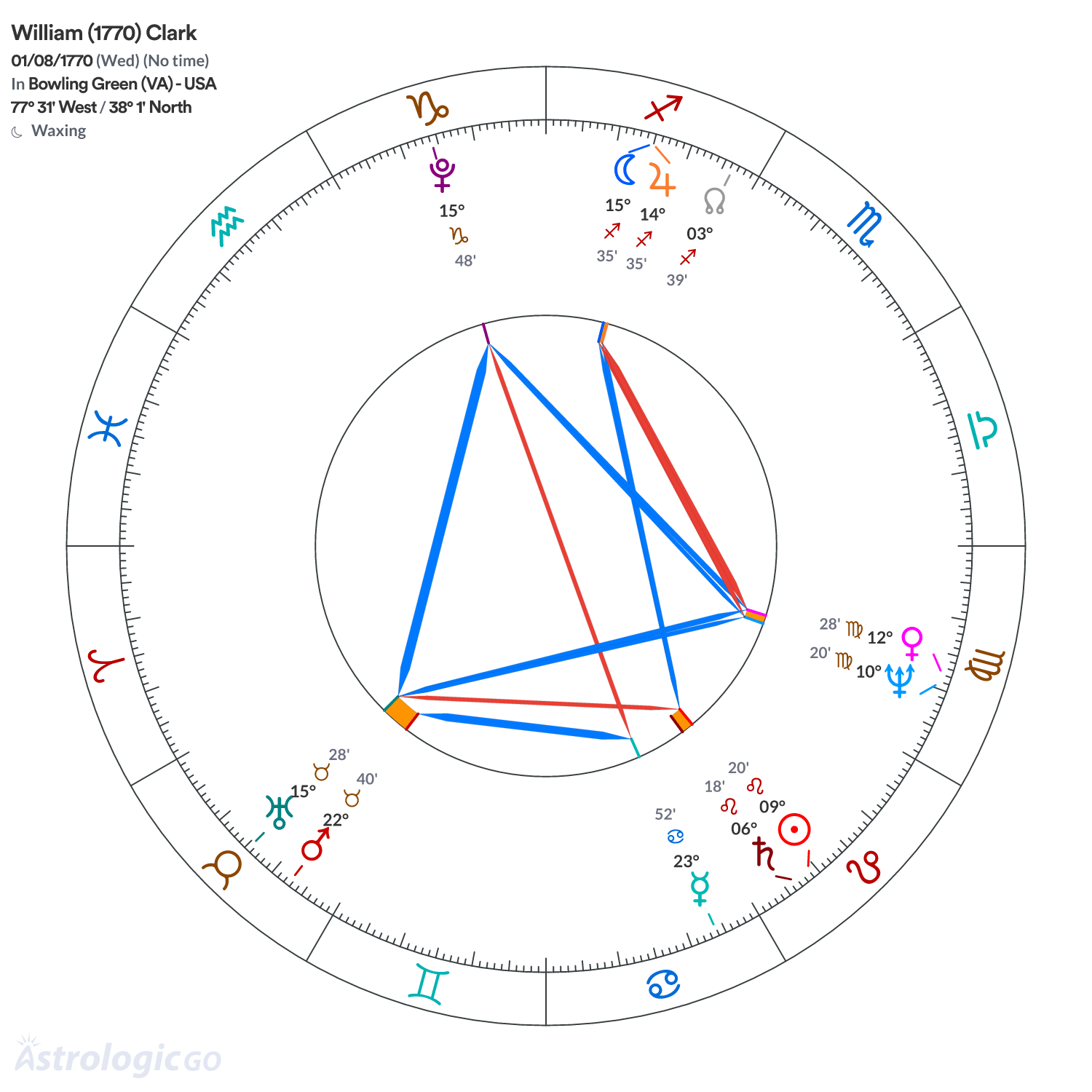
When the birth time is unknown, the chart is calculated for 12:00 noon without using the astrological houses system. Are the planets in the wrong houses?
Influences in signs
↣ Sun in Leo - 09°20'
↣ Moon in Sagittarius - 15°35'
↣ Mercury in Cancer - 23°52'
↣ Venus in Virgo - 12°29'
↣ Mars in Taurus - 22°41'
↣ Jupiter in Sagittarius - 14°36' - retrograde
↣ Saturn in Leo - 06°19'
↣ Uranus in Taurus - 15°29'
↣ Neptune in Virgo - 10°20'
↣ Pluto in Capricorn - 15°48' - retrograde
↣ North Node in Sagittarius - 03°39' - retrograde
Aspects
↣ Sun and Moon trine (6°14' separating)
↣ Sun and Mars parallel
↣ Sun and Jupiter trine (5°15' applying)
↣ Sun and Saturn conjunction (3°02' separating) parallel
↣ Sun and Uranus square (6°08' applying)
↣ Sun and North Node trine (5°42' separating)
↣ Moon and Mercury antiparallel
↣ Moon and Venus square (3°06' separating)
↣ Moon and Jupiter conjunction (0°59' separating) parallel
↣ Moon and Neptune square (5°15' separating)
↣ Moon and Pluto parallel
↣ Moon and North Node parallel
↣ Mercury and Mars sextile (1°11' separating)
↣ Mercury and Jupiter antiparallel
↣ Mercury and Pluto opposition (8°04' separating) antiparallel
↣ Mercury and North Node antiparallel
↣ Venus and Jupiter square (2°07' applying)
↣ Venus and Uranus trine (3°00' applying)
↣ Venus and Neptune conjunction (2°08' separating) parallel
↣ Venus and Pluto trine (3°19' applying)
↣ Mars and Uranus conjunction (7°12' separating)
↣ Jupiter and Neptune square (4°15' applying)
↣ Jupiter and Pluto parallel
↣ Saturn and North Node trine (2°40' separating)
↣ Uranus and Neptune trine (5°08' applying)
↣ Uranus and Pluto trine (0°19' applying)
↣ Neptune and Pluto trine (5°27' applying)
Birth data
- Chart date
- 01/08/1770
- Chart time
- No time
- Date and time quality
- XX Time not informed what does this mean?
- Data origin
- Astro-Databank
- Location
-
 Bowling Green (VA), USA
 - Latitude and longitude
- 38°01' North · 77°31' West
- Time zone
- 05:10 West
The data used to calculate the charts comes from public sources, as do the descriptive texts. We use sources such as Wikipedia.

About
William Clark was a central figure in early 19th-century American expansion. Trained as a military officer, he became famous for co-commanding the Lewis and Clark Expedition (1804–1806), a government-sponsored venture to explore the newly acquired Louisiana, map routes to the Pacific, and consolidate U.S. claims in the Northwest. On the expedition he was noted for his cartographic work, management of supplies, and his role in relations with Indigenous peoples.
After the journey, Clark held important public offices in the territory that became Missouri: brigadier general of the militia, Indian agent and later Superintendent of Indian Affairs, and finally territorial governor. In these roles he combined diplomatic practices — recognition of languages, treaties, and some humanitarian concern — with removal policies and “civilization” programs that furthered American expansion and interests.
A landowner and slaveholder, Clark lived in St. Louis and remained a local authority until his death. His legacy is ambiguous: he is remembered both for his contributions to the exploration and mapping of the West and for his involvement in policies that disrupted Indigenous societies and for his status as a slaveholder.


