Birth Chart
William Inge
William Motter Inge
Sun Taurus
Moon Aries
Ascendant Virgo
Influences in signs
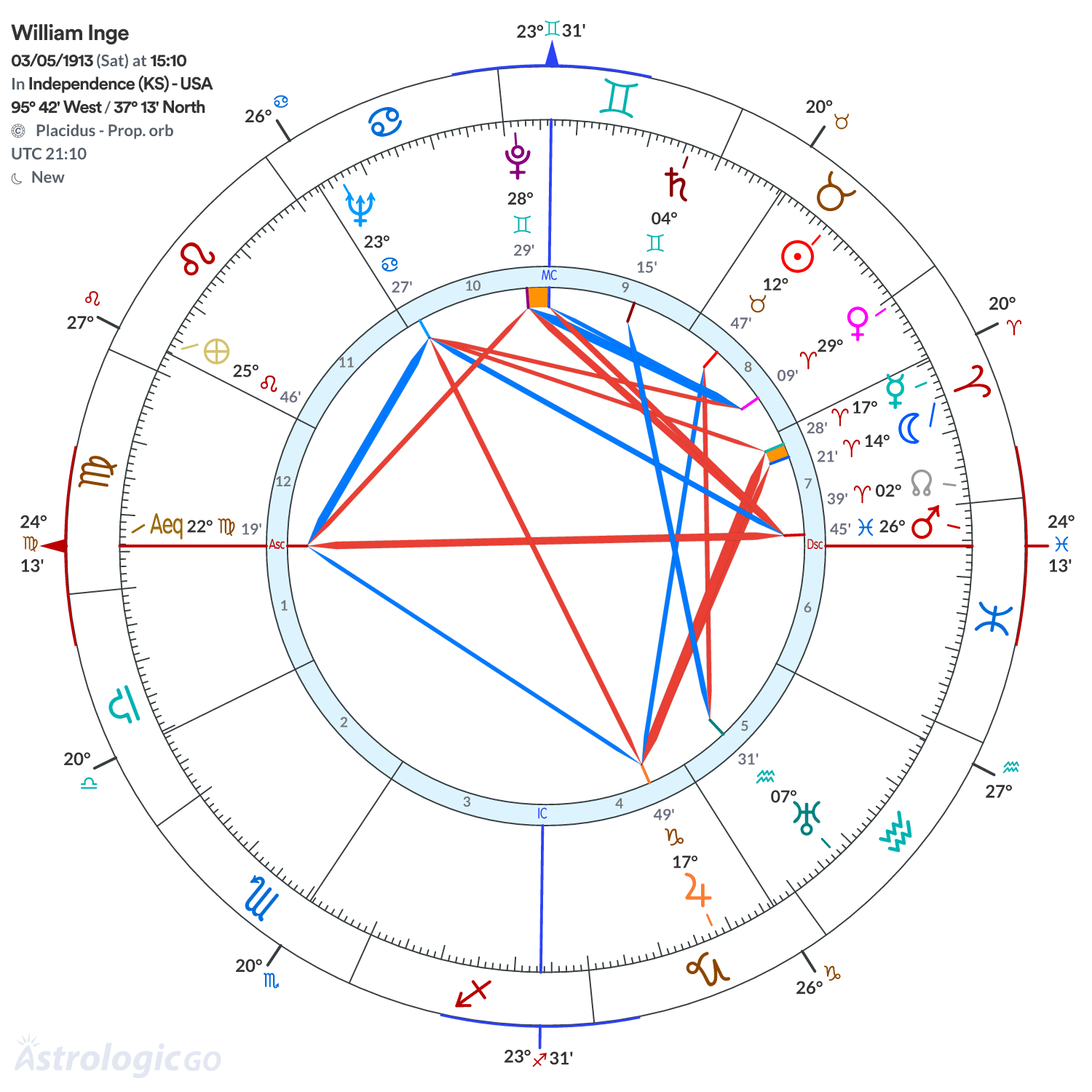
↣ Sun in Taurus - 12°48' - in house 8/9
↣ Moon in Aries - 14°22' - in house 7/8
↣ Mercury in Aries - 17°28' - in house 8
↣ Venus in Aries - 29°10' - in house 8 - retrograde
↣ Mars in Pisces - 26°45' - in house 7
↣ Jupiter in Capricorn - 17°50' - in house 4/5
↣ Saturn in Gemini - 04°15' - in house 9
↣ Uranus in Aquarius - 07°31' - in house 5
↣ Neptune in Cancer - 23°28' - in house 11
↣ Pluto in Gemini - 28°29' - in house 10
↣ North Node in Aries - 02°40' - in house 7 - retrograde
↣ Ascendant in Virgo - 24°14' - in house 1
↣ Midheaven in Gemini - 23°32' - in house 10
↣ Equatorial Ascendant in Virgo - 22°20'
Influences in houses
↣ Sun in house 8/9
↣ Moon in house 7/8
↣ Mercury in house 8
↣ Venus in house 8
↣ Mars in house 7
↣ Jupiter in house 4/5
↣ Saturn in house 9
↣ Uranus in house 5
↣ Neptune in house 11
↣ Pluto in house 10
↣ North Node in house 7
↣ Ascendant in house 1
↣ Midheaven in house 10
Aspects
↣ Sun and Venus parallel
↣ Sun and Jupiter trine (5°02' applying)
↣ Sun and Uranus square (5°17' separating)
↣ Moon and Mercury conjunction (3°07' applying)
↣ Moon and Jupiter square (3°29' applying)
↣ Mercury and Jupiter square (0°22' applying)
↣ Mercury and Neptune square (5°59' applying)
↣ Venus and Neptune square (5°42' applying)
↣ Venus and Pluto sextile (0°40' applying)
↣ Venus and Midheaven sextile (5°38' applying)
↣ Mars and Neptune trine (3°18' separating)
↣ Mars and Pluto square (1°45' applying)
↣ Mars and North Node conjunction (5°55' applying)
↣ Mars and Equatorial Ascendant opposition (4°25' applying)
↣ Mars and Ascendant opposition (2°31' applying) antiparallel
↣ Mars and Midheaven square (3°13' applying)
↣ Jupiter and Neptune opposition (5°37' separating)
↣ Jupiter and Equatorial Ascendant trine (4°30' separating)
↣ Jupiter and Ascendant trine (6°23' separating)
↣ Saturn and Uranus trine (3°16' applying) antiparallel
↣ Saturn and North Node sextile (1°35' separating)
↣ Uranus and North Node sextile (4°51' separating)
↣ Neptune and Equatorial Ascendant sextile (1°08' applying)
↣ Neptune and Ascendant sextile (0°46' separating)
↣ Pluto and North Node square (4°10' applying)
↣ Pluto and Equatorial Ascendant square (6°10' applying)
↣ Pluto and Ascendant square (4°16' applying)
↣ Pluto and Midheaven conjunction (4°58' applying)
↣ North Node and Ascendant opposition (8°26' applying)
Birth data
- Original name
- William Motter Inge
- Chart date
- 03/05/1913
- Chart time
- 15:10
- Date and time quality
- AA Birth record cited what does this mean?
- Data origin
- Astro-Databank
- Location
-
 Independence (KS), USA
 - Latitude and longitude
- 37°13' North · 95°42' West
- Time zone
- 06:00 West
The data used to calculate the charts comes from public sources, as do the descriptive texts. We use sources such as Wikipedia.

About
William Motter Inge was an American playwright and novelist whose work centers on solitary protagonists and fraught sexual and emotional relationships, typically set in the American Midwest. Known as the “Playwright of the Midwest,” he sensitively depicted life in small towns and his characters’ everyday frustrations.
In the early 1950s he achieved major success on Broadway: Come Back, Little Sheba established his reputation and, in 1953, Picnic earned him the Pulitzer Prize for Drama; several of his plays were adapted for film, including Bus Stop and The Dark at the Top of the Stairs. He also wrote the screenplay for Splendor in the Grass (1961), which won him recognition in the film industry.
A teacher and critic before devoting himself to the theater, Inge held academic posts at institutions such as Washington University and Stephens College. His work frequently explores themes of loneliness, broken families and unexpected violence, and it had a noticeable influence on mid‑20th-century American theater, leaving a legacy in portrayals of the rural American heartland and in realist drama of the twentieth century.
Charts like this one
- Sun Taurus 1,096 charts
- Moon Aries 1,094 charts
- Ascendant Virgo 1,239 charts
- Born on May 3 46 charts