Birth Chart
Artur Schnabel
Sun Aries
Moon Aries
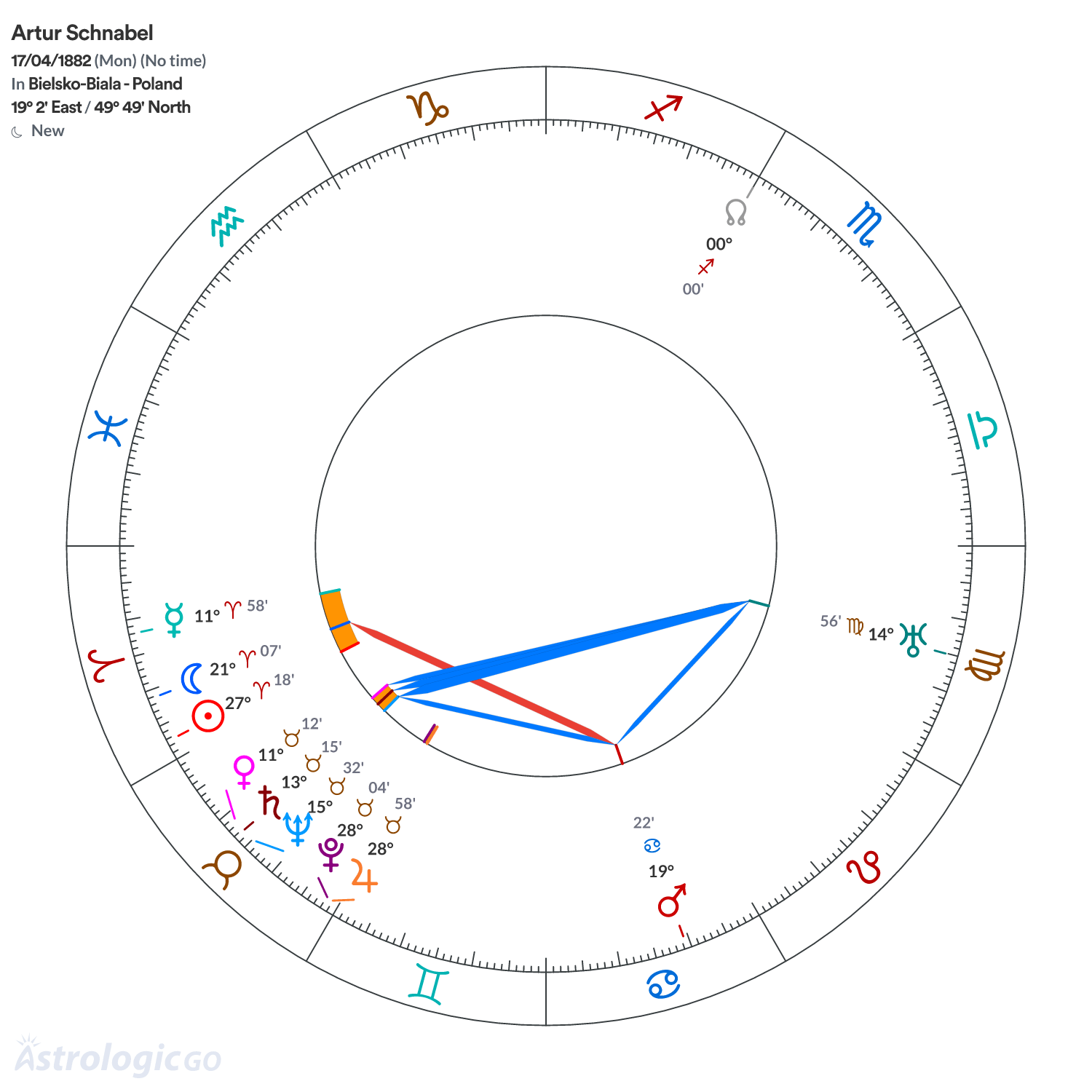
When the birth time is unknown, the chart is calculated for 12:00 noon without using the astrological houses system. Are the planets in the wrong houses?
Influences in signs
↣ Sun in Aries - 27°18'
↣ Moon in Aries - 21°08'
↣ Mercury in Aries - 11°58'
↣ Venus in Taurus - 11°12'
↣ Mars in Cancer - 19°22'
↣ Jupiter in Taurus - 28°59'
↣ Saturn in Taurus - 13°15'
↣ Uranus in Virgo - 14°56' - retrograde
↣ Neptune in Taurus - 15°32'
↣ Pluto in Taurus - 28°05'
↣ North Node in Sagittarius - 00°00' - retrograde
Aspects
↣ Sun and Moon conjunction (6°10' applying) parallel
↣ Moon and Mercury conjunction (9°10' separating)
↣ Moon and Mars square (1°46' separating)
↣ Venus and Saturn conjunction (2°03' applying) parallel
↣ Venus and Uranus trine (3°44' applying)
↣ Venus and Neptune conjunction (4°20' applying) parallel
↣ Mars and Uranus sextile (4°26' separating)
↣ Mars and Neptune sextile (3°50' separating)
↣ Jupiter and Pluto conjunction (0°54' separating)
↣ Jupiter and North Node opposition (1°01' applying) antiparallel
↣ Saturn and Uranus trine (1°41' applying)
↣ Saturn and Neptune conjunction (2°17' applying)
↣ Uranus and Neptune trine (0°36' separating)
↣ Uranus and Pluto parallel
↣ Pluto and North Node opposition (1°55' applying)
Birth data
- Chart date
- 17/04/1882
- Chart time
- No time
- Date and time quality
- XX Time not informed what does this mean?
- Data origin
- Astro-Databank
- Location
-
 Bielsko-Biala, Poland
 - Latitude and longitude
- 49°49' North · 19°02' East
- Time zone
- 01:16 East
The data used to calculate the charts comes from public sources, as do the descriptive texts. We use sources such as Wikipedia.

About
Artur Schnabel was an Austrian-born classical pianist, composer, and teacher, known for his intellectual and deeply felt approach to the Austro-German repertoire. He became one of the 20th century’s most respected figures by privileging musical expression over sheer technical display, bringing particular vitality and spirituality to the works of Beethoven and Schubert.
His career included prominent work as a soloist and chamber musician, collaborating with leading performers and conductors and founding chamber ensembles that shaped European musical life. As a teacher, his lessons and master classes in Berlin and later in the United States trained generations of pianists and established his pedagogical influence.
Among his most significant achievements is the historic complete recording of Beethoven’s piano sonatas, made between 1932 and 1935, notable for its historical importance and preserved in internationally significant collections. Persecuted by the Nazi regime for being Jewish, he emigrated, taught in the U.S., and after the war settled in Switzerland.
Schnabel’s legacy remains associated with interpretive authority over the classical canon, with lasting pedagogical influence, and with recordings that helped redefine how central piano repertoire composers are received.