Birth Chart
Carlo Di Palma
Sun Aries
Moon Aquarius
Ascendant Virgo
Influences in signs
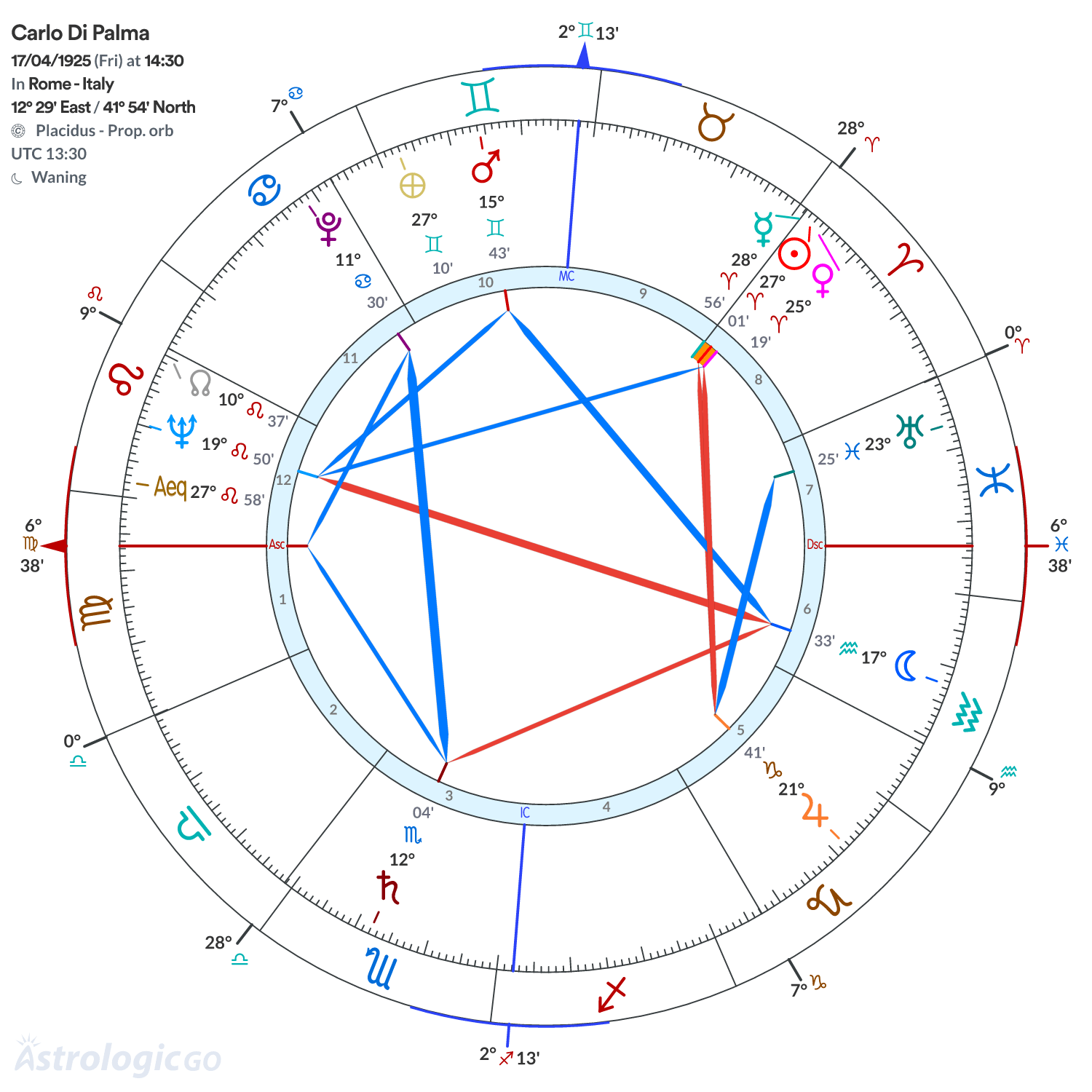
↣ Sun in Aries - 27°01' - in house 9
↣ Moon in Aquarius - 17°34' - in house 6
↣ Mercury in Aries - 28°57' - in house 9 - retrograde
↣ Venus in Aries - 25°20' - in house 9
↣ Mars in Gemini - 15°44' - in house 10
↣ Jupiter in Capricorn - 21°42' - in house 5
↣ Saturn in Scorpio - 12°05' - in house 3 - retrograde
↣ Uranus in Pisces - 23°26' - in house 7/8
↣ Neptune in Leo - 19°50' - in house 12 - retrograde
↣ Pluto in Cancer - 11°31' - in house 11
↣ North Node in Leo - 10°37' - in house 12 - retrograde
↣ Ascendant in Virgo - 06°38' - in house 1
↣ Midheaven in Gemini - 02°14' - in house 10
↣ Equatorial Ascendant in Leo - 27°58'
Influences in houses
↣ Sun in house 9
↣ Moon in house 6
↣ Mercury in house 9
↣ Venus in house 9
↣ Mars in house 10
↣ Jupiter in house 5
↣ Saturn in house 3
↣ Uranus in house 7/8
↣ Neptune in house 12
↣ Pluto in house 11
↣ North Node in house 12
↣ Ascendant in house 1
↣ Midheaven in house 10
Aspects
↣ Sun and Mercury conjunction (1°56' applying)
↣ Sun and Venus conjunction (1°41' applying)
↣ Sun and Jupiter square (5°19' separating)
↣ Sun and Equatorial Ascendant trine (0°57' separating)
↣ Sun and Ascendant parallel
↣ Moon and Mars trine (1°49' separating)
↣ Moon and Saturn square (5°29' separating)
↣ Moon and Neptune opposition (2°17' applying) antiparallel
↣ Moon and North Node opposition (6°56' separating) antiparallel
↣ Moon and Equatorial Ascendant opposition (10°25' separating)
↣ Mercury and Venus conjunction (3°37' applying)
↣ Mercury and Saturn antiparallel
↣ Mercury and Equatorial Ascendant trine (0°59' applying)
↣ Venus and Jupiter square (3°38' separating)
↣ Venus and Neptune trine (5°29' separating)
↣ Venus and Equatorial Ascendant trine (2°38' separating)
↣ Venus and Ascendant parallel
↣ Mars and Neptune sextile (4°07' applying)
↣ Mars and North Node sextile (5°07' separating)
↣ Jupiter and Uranus sextile (1°44' applying)
↣ Jupiter and Pluto antiparallel
↣ Saturn and Pluto trine (0°34' applying)
↣ Saturn and North Node square (1°27' applying)
↣ Saturn and Ascendant sextile (5°26' applying)
↣ Neptune and Equatorial Ascendant conjunction (8°07' separating)
↣ Pluto and Ascendant sextile (4°52' applying)
↣ Pluto and Midheaven parallel
Birth data
- Chart date
- 17/04/1925
- Chart time
- 14:30
- Date and time quality
- AA Birth record cited what does this mean?
- Data origin
- Astro-Databank
- Location
-
 Rome, Italy
 - Latitude and longitude
- 41°54' North · 12°29' East
- Time zone
- 01:00 East
The data used to calculate the charts comes from public sources, as do the descriptive texts. We use sources such as Wikipedia.

About
Carlo Di Palma was among the most influential Italian cinematographers of the postwar era, renowned for his command of black-and-white and for pioneering uses of color. He began very young as an assistant camera operator on key neorealist productions and, throughout the 1950s and 1960s, photographed numerous films directed by Pontecorvo, Germi, Petri and Montaldo. His sense of color drew international attention in collaboration with Michelangelo Antonioni, notably on Il deserto rosso and Blow-Up, works that helped define a new visual idiom in modern cinema.
Beginning in the 1980s he moved part of his activity to the United States, where he developed a longstanding collaboration with Woody Allen, shooting successes such as Hannah and Her Sisters and Crimes and Misdemeanors, which brought him awards and critical recognition. Concurrently, he directed three comedies in the 1970s, all featuring Monica Vitti, who was also his companion for several years.
A recipient of multiple Nastri d’Argento and a BAFTA nominee for Blow-Up, Di Palma left both technical and aesthetic contributions: the capacity to make color a dramatic, expressive force. He continued working into his later years on lighting projects for classical events, remaining a touchstone for subsequent cinematographers.
Charts like this one
- Sun Aries 1,113 charts
- Moon Aquarius 1,110 charts
- Ascendant Virgo 1,239 charts
- Born on April 17 35 charts