Birth Chart
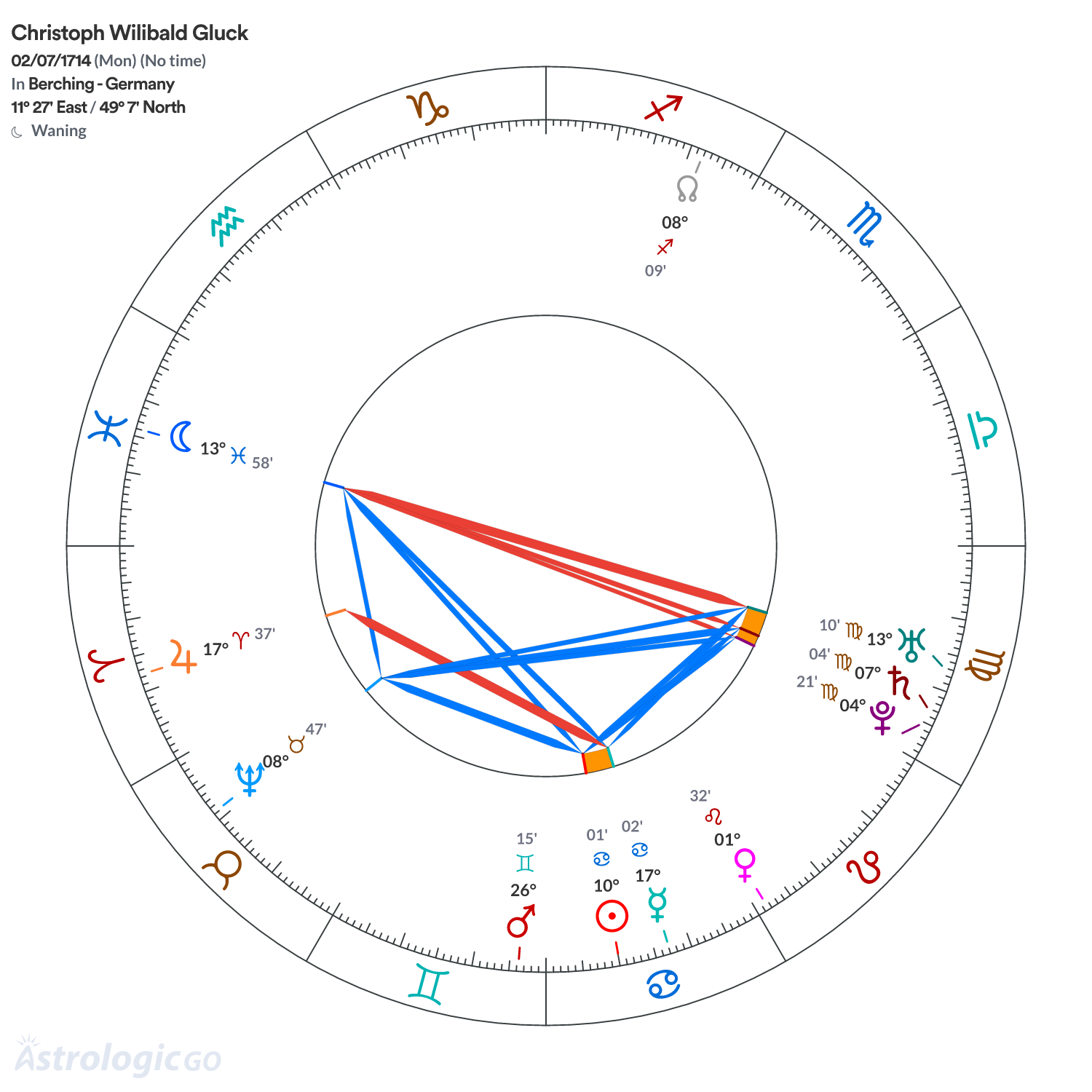
Christoph Wilibald Gluck
Sun Cancer
Moon Pisces
When the birth time is unknown, the chart is calculated for 12:00 noon without using the astrological houses system. Are the planets in the wrong houses?
Influences in signs
↣ Sun in Cancer - 10°01'
↣ Moon in Pisces - 13°58'
↣ Mercury in Cancer - 17°02'
↣ Venus in Leo - 01°33'
↣ Mars in Gemini - 26°15'
↣ Jupiter in Aries - 17°37'
↣ Saturn in Virgo - 07°04'
↣ Uranus in Virgo - 13°10'
↣ Neptune in Taurus - 08°48'
↣ Pluto in Virgo - 04°22'
↣ North Node in Sagittarius - 08°09' - retrograde
Aspects
↣ Sun and Moon trine (3°57' separating)
↣ Sun and Mercury conjunction (7°02' separating) parallel
↣ Sun and Mars parallel
↣ Sun and Saturn sextile (2°57' separating)
↣ Sun and Uranus sextile (3°09' applying)
↣ Sun and Neptune sextile (1°13' separating)
↣ Sun and Pluto sextile (5°39' separating) parallel
↣ Sun and North Node antiparallel
↣ Moon and Mercury trine (3°05' applying)
↣ Moon and Saturn opposition (6°54' separating)
↣ Moon and Uranus opposition (0°48' separating)
↣ Moon and Neptune sextile (5°10' separating)
↣ Moon and Pluto opposition (9°36' separating)
↣ Moon and North Node square (5°49' separating)
↣ Mercury and Mars parallel
↣ Mercury and Jupiter square (0°34' applying)
↣ Mercury and Uranus sextile (3°52' separating)
↣ Venus and Pluto parallel
↣ Venus and North Node antiparallel
↣ Saturn and Uranus conjunction (6°06' applying)
↣ Saturn and Neptune trine (1°44' applying)
↣ Saturn and Pluto conjunction (2°42' separating)
↣ Saturn and North Node square (1°05' applying)
↣ Uranus and Neptune trine (4°22' separating)
↣ Uranus and North Node square (5°01' separating)
↣ Neptune and Pluto trine (4°27' separating)
↣ Pluto and North Node square (3°48' applying) antiparallel
Birth data
- Chart date
- 02/07/1714
- Chart time
- No time
- Date and time quality
- XX Time not informed what does this mean?
- Data origin
- Astro-Databank
- Location
-
 Berching, Germany
 - Latitude and longitude
- 49°07' North · 11°27' East
- Time zone
- 00:46 East
The data used to calculate the charts comes from public sources, as do the descriptive texts. We use sources such as Wikipedia.

About
Christoph Willibald Gluck was a German composer central to the reform of opera seria between the 18th and 19th centuries. Trained in Milan with Giovanni Battista Sammartini, he began his career writing operas in the traditional Italian style but gradually moved away from Baroque artificiality in search of a more natural, dramatic, and integrated expression.
The milestone of this transformation was Orfeo ed Euridice (1762); other decisive works include Alceste (1767), Iphigénie en Aulide (1774), and Iphigénie en Tauride (1779). Inspired by Greek tragedy, French opera, and Enlightenment ideals, Gluck proposed practical principles to subordinate music to drama, reducing ornamentation and prioritizing clarity and expressive intent.
His reform provoked intense controversy but established him as one of the most important operatic composers in history, with notable influence in Austria, Germany, and France. In addition to operas, he wrote symphonies, sacred music, and chamber works, although these lesser pieces have fallen into relative obscurity. Gluck’s legacy is primarily artistic and conceptual: he did not found a school, but his ideas about dramatic-musical integration profoundly affected the European operatic repertoire.


