Birth Chart
Costa-Gavras
Konstantinos Gavras
Sun Aquarius
Moon Virgo
When the birth time is unknown, the chart is calculated for 12:00 noon without using the astrological houses system. Are the planets in the wrong houses?
Influences in signs
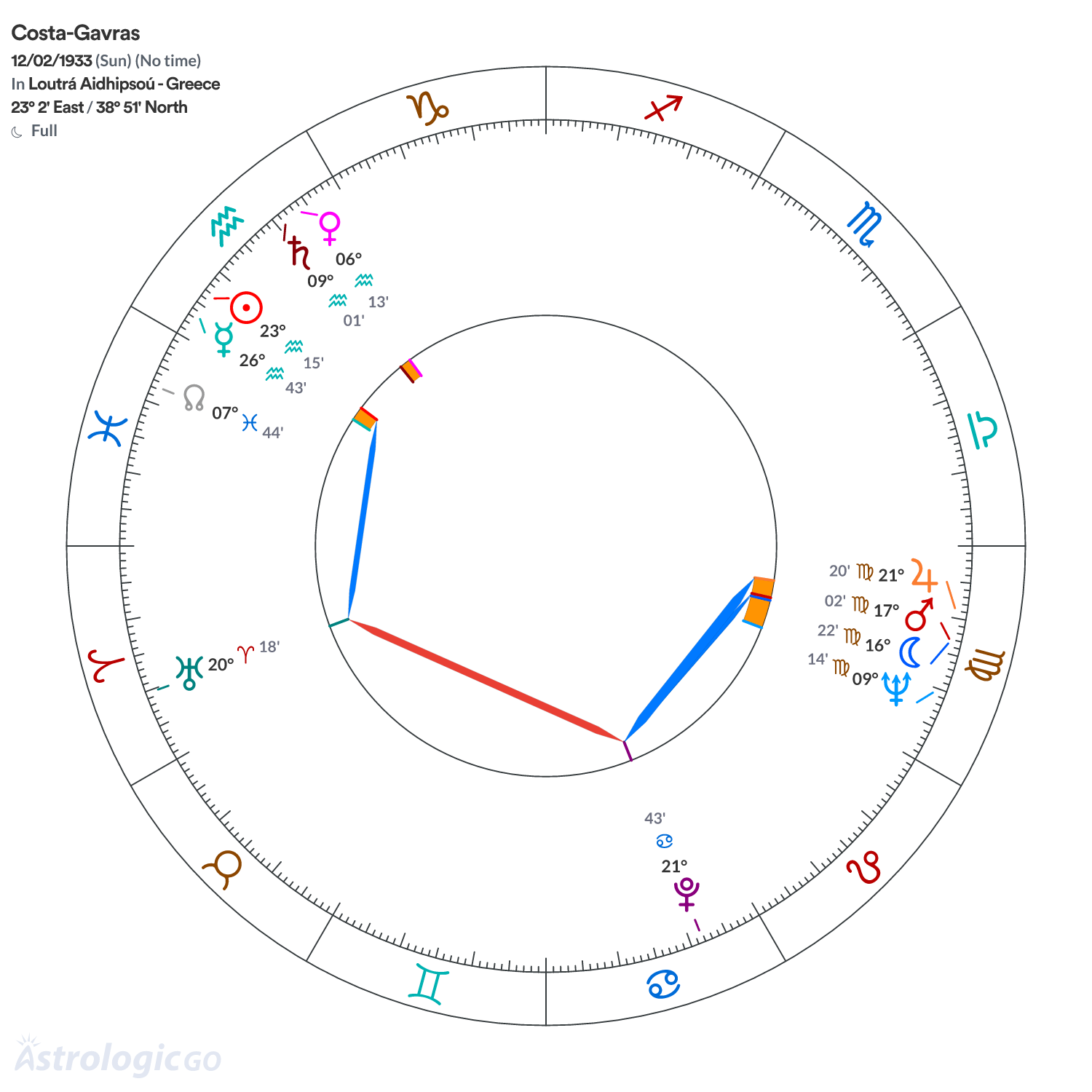
↣ Sun in Aquarius - 23°16'
↣ Moon in Virgo - 16°22'
↣ Mercury in Aquarius - 26°43'
↣ Venus in Aquarius - 06°13'
↣ Mars in Virgo - 17°02' - retrograde
↣ Jupiter in Virgo - 21°21' - retrograde
↣ Saturn in Aquarius - 09°02'
↣ Uranus in Aries - 20°19'
↣ Neptune in Virgo - 09°14' - retrograde
↣ Pluto in Cancer - 21°44' - retrograde
↣ North Node in Pisces - 07°44'
Aspects
↣ Sun and Mercury conjunction (3°27' separating) parallel
↣ Sun and Uranus sextile (2°57' separating)
↣ Moon and Mars conjunction (0°41' applying)
↣ Moon and Jupiter conjunction (4°59' applying) parallel
↣ Moon and Neptune conjunction (7°07' separating)
↣ Moon and Pluto sextile (5°22' applying)
↣ Moon and North Node opposition (8°38' separating)
↣ Venus and Saturn conjunction (2°49' applying) parallel
↣ Mars and Jupiter conjunction (4°19' separating)
↣ Mars and Neptune conjunction (7°48' applying) parallel
↣ Mars and Pluto sextile (4°42' separating)
↣ Mars and North Node antiparallel
↣ Jupiter and Pluto sextile (0°23' separating)
↣ Uranus and Pluto square (1°25' applying)
↣ Neptune and North Node opposition (1°30' applying) antiparallel
Birth data
- Original name
- Konstantinos Gavras
- Chart date
- 12/02/1933
- Chart time
- No time
- Date and time quality
- XX Time not informed what does this mean?
- Data origin
- Astro-Databank
- Location
-
 Loutrá Aidhipsoú, Greece
 - Latitude and longitude
- 38°51' North · 23°02' East
- Time zone
- 02:00 East
The data used to calculate the charts comes from public sources, as do the descriptive texts. We use sources such as Wikipedia.

About
Costa-Gavras (Konstantinos Gavras) is a Greek-born filmmaker who became a French citizen and whose work became a touchstone of political and protest cinema. Trained at IDHEC in Paris after studying at the Sorbonne, he worked as an assistant to established directors before achieving international recognition. His films often tackle dictatorships, repression, and abuses of power, while also entering the territory of contemporary social fiction.
He gained wide acclaim with Z (1969), a feature inspired by the assassination of Greek politician Grigoris Lambrakis, which won the Oscar and Golden Globe for Best Foreign Film and defined his combative approach. Over his career he directed notable films such as State of Siege (1972), Missing (1982) — winner of the Palme d’Or at Cannes — and Music Box (1989), which was honored in Berlin.
Twice named president of the French Cinémathèque, Costa-Gavras also examined the ties between institutions and state crimes, the effects of dictatorships in Latin America, and the dynamics of contemporary capitalism in films such as Capital (2012). His work left a durable imprint on engaged cinema, influencing generations of filmmakers and public debate about politics and memory.


