Birth Chart
Duke Ellington
Edward Kennedy Ellington
Sun Taurus
Moon Sagittarius or Capricorn
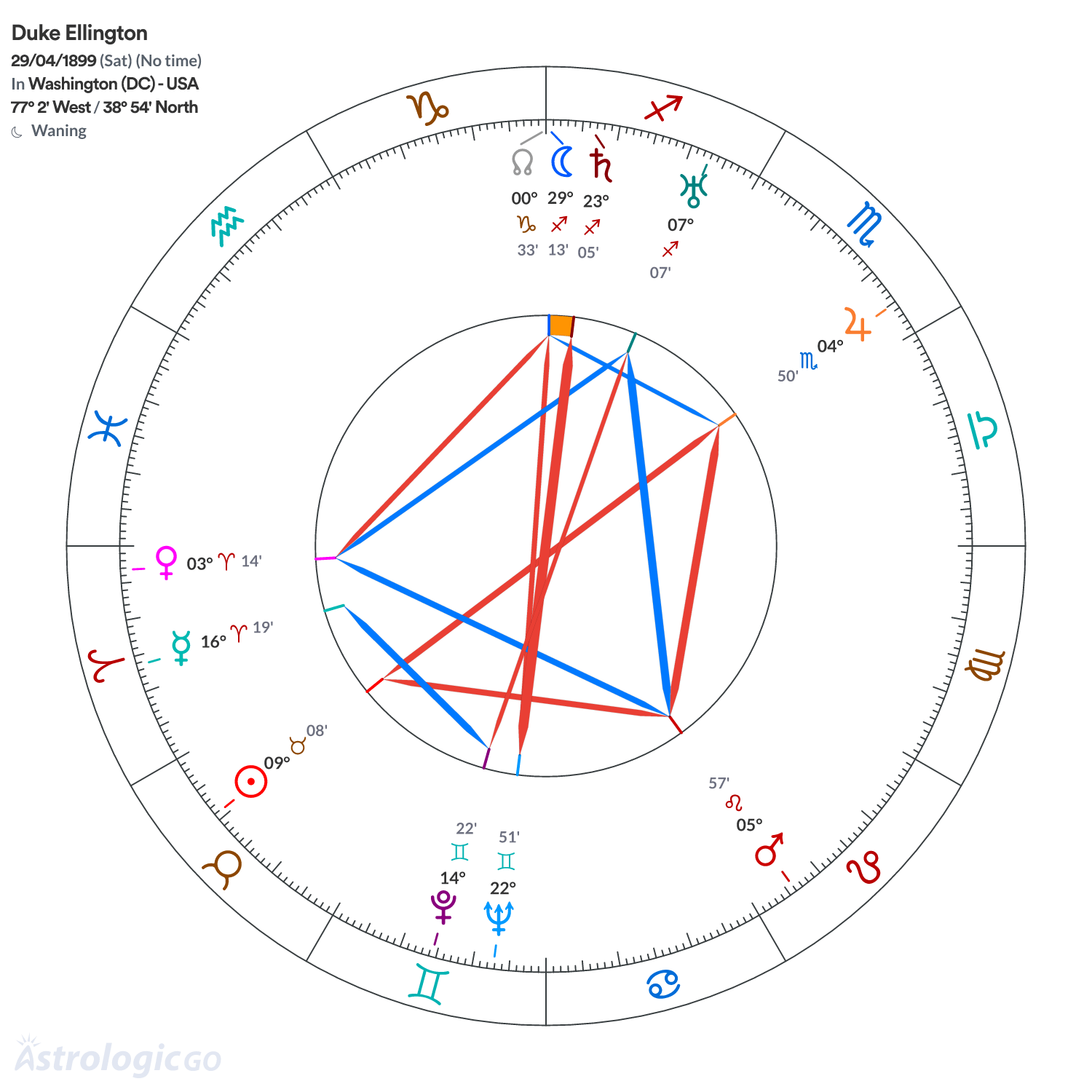
When the birth time is unknown, the chart is calculated for 12:00 noon without using the astrological houses system. Are the planets in the wrong houses?
Influences in signs
↣ Sun in Taurus - 09°08'
↣ Moon in Sagittarius - 29°13'
↣ Mercury in Aries - 16°20'
↣ Venus in Aries - 03°14'
↣ Mars in Leo - 05°57'
↣ Jupiter in Scorpio - 04°50' - retrograde
↣ Saturn in Sagittarius - 23°05' - retrograde
↣ Uranus in Sagittarius - 07°08' - retrograde
↣ Neptune in Gemini - 22°52'
↣ Pluto in Gemini - 14°22'
↣ North Node in Capricorn - 00°34' - retrograde
Aspects
↣ Sun and Mars square (3°11' separating)
↣ Sun and Jupiter opposition (4°18' separating)
↣ Moon and Venus square (4°01' applying)
↣ Moon and Jupiter sextile (5°37' applying)
↣ Moon and Saturn conjunction (6°08' separating)
↣ Moon and Neptune opposition (6°22' separating)
↣ Moon and North Node conjunction (1°20' applying) parallel
↣ Mercury and Pluto sextile (1°58' separating)
↣ Venus and Mars trine (2°43' applying)
↣ Venus and Uranus trine (3°53' applying)
↣ Venus and North Node square (2°41' separating)
↣ Mars and Jupiter square (1°06' separating)
↣ Mars and Uranus trine (1°11' applying) antiparallel
↣ Jupiter and North Node sextile (4°17' applying)
↣ Saturn and Uranus parallel
↣ Saturn and Neptune opposition (0°14' applying) antiparallel
↣ Saturn and North Node conjunction (7°28' separating)
↣ Uranus and Neptune antiparallel
↣ Uranus and Pluto opposition (7°15' separating)
↣ Neptune and North Node opposition (7°42' applying)
Birth data
- Original name
- Edward Kennedy Ellington
- Chart date
- 29/04/1899
- Chart time
- No time
- Date and time quality
- XX Time not informed what does this mean?
- Data origin
- Astro-Databank
- Location
-
 Washington (DC), USA
 - Latitude and longitude
- 38°54' North · 77°02' West
- Time zone
- 05:00 West
The data used to calculate the charts comes from public sources, as do the descriptive texts. We use sources such as Wikipedia.

About
Duke Ellington, the stage name of Edward Kennedy Ellington, was one of the greatest composers, pianists, and bandleaders of the 20th century and a central figure in the history of jazz in the United States. Over a career spanning from the 1920s into the 1960s and 1970s, he wrote hundreds of pieces—many of them standards of the jazz repertoire, such as "Mood Indigo," "Satin Doll," and "Caravan," and he was associated with hits linked to Billy Strayhorn like "Take the A Train." His work combined sonic experimentation with formal refinement and at times engaged with structures from classical music in ambitious projects such as "Black, Brown and Beige" and "Such Sweet Thunder."
As leader of his orchestra, Ellington tailored compositions to the timbre and virtuosity of the musicians who accompanied him for decades, creating distinctive and lasting sounds. This practice fostered notable collaborators—among them Johnny Hodges, Ben Webster, and Paul Gonsalves—and contributed to innovations in jazz, particularly in the 1930s and 1940s. His influence crossed borders: he received major international honors, including the Presidential Medal of Freedom and the Legion of Honour.
Ellington’s legacy remains alive both through the enduring presence of his compositions in the global repertoire and through institutional memorialization—schools, memorials, and critical reassessments that emphasize his sustained creativity up to his final years.


