Birth Chart
Elie Wiesel
Eliezer Wiesel
Sun Libra
Moon Aries
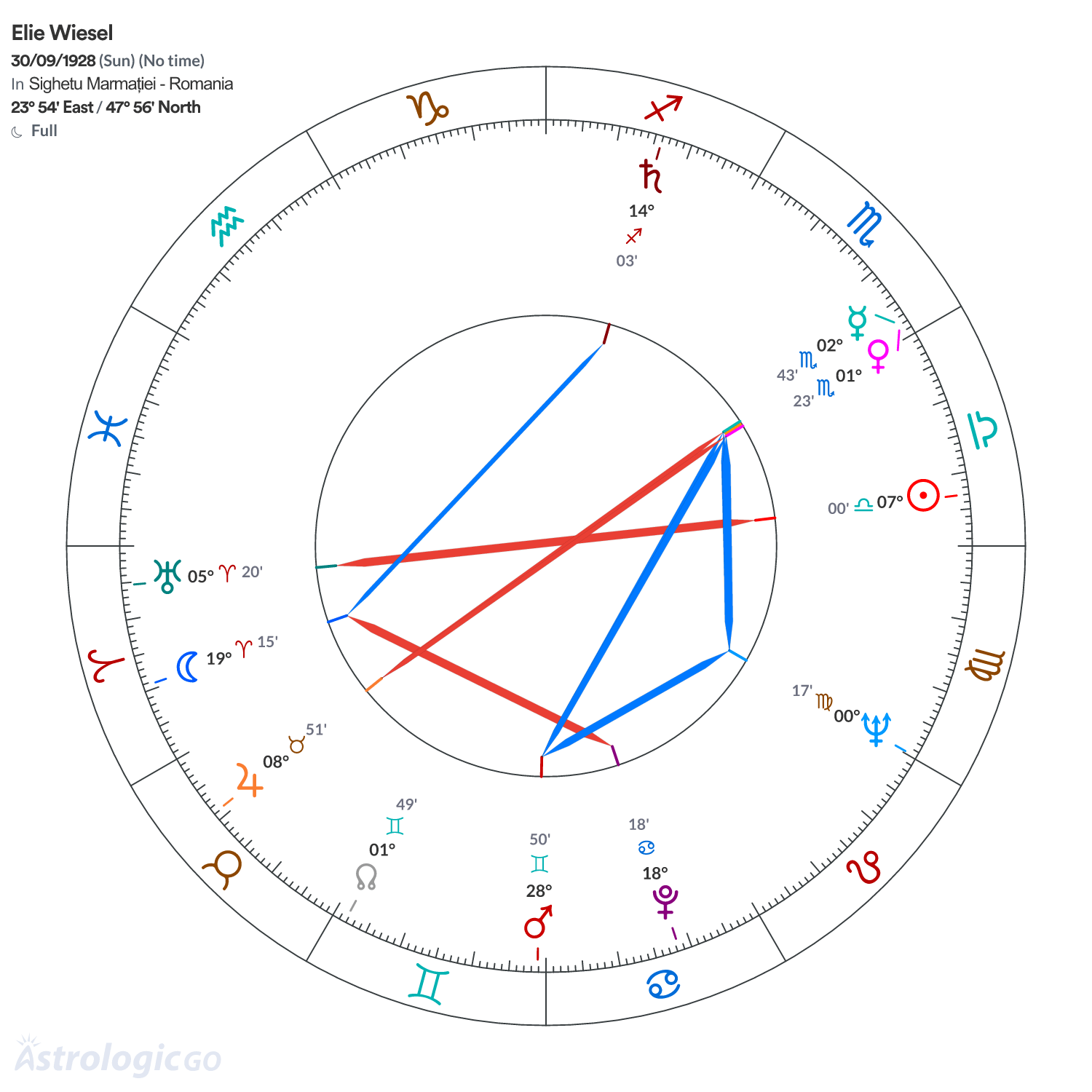
When the birth time is unknown, the chart is calculated for 12:00 noon without using the astrological houses system. Are the planets in the wrong houses?
Influences in signs
↣ Sun in Libra - 07°00'
↣ Moon in Aries - 19°16'
↣ Mercury in Scorpio - 02°43'
↣ Venus in Scorpio - 01°23'
↣ Mars in Gemini - 28°51'
↣ Jupiter in Taurus - 08°52' - retrograde
↣ Saturn in Sagittarius - 14°03'
↣ Uranus in Aries - 05°20' - retrograde
↣ Neptune in Virgo - 00°17'
↣ Pluto in Cancer - 18°19'
↣ North Node in Gemini - 01°49' - retrograde
Aspects
↣ Sun and Uranus opposition (1°40' separating) antiparallel
↣ Sun and North Node trine (5°11' separating)
↣ Moon and Saturn trine (5°12' separating)
↣ Moon and Pluto square (0°57' separating)
↣ Mercury and Venus conjunction (1°20' applying)
↣ Mercury and Mars trine (3°52' separating)
↣ Mercury and Jupiter opposition (6°08' applying)
↣ Mercury and Neptune sextile (2°26' separating)
↣ Venus and Mars trine (2°32' separating)
↣ Venus and Jupiter opposition (7°28' applying)
↣ Venus and Neptune sextile (1°06' separating) antiparallel
↣ Mars and Neptune sextile (1°26' applying)
↣ Saturn and Pluto antiparallel
↣ Saturn and North Node antiparallel
↣ Uranus and North Node sextile (3°31' separating)
↣ Neptune and North Node square (1°32' applying)
↣ Pluto and North Node parallel
Birth data
- Original name
- Eliezer Wiesel
- Chart date
- 30/09/1928
- Chart time
- No time
- Date and time quality
- XX Time not informed what does this mean?
- Data origin
- Astro-Databank
- Location
-
 Sighetu Marmaţiei, Romania
 - Latitude and longitude
- 47°56' North · 23°54' East
- Time zone
- 01:36 East
The data used to calculate the charts comes from public sources, as do the descriptive texts. We use sources such as Wikipedia.

About
Elie Wiesel was a writer, professor, and political activist born in Romania whose work became a key reference on the experience of the Holocaust. Author of about 57 books, he wrote primarily in French and English; Night — an account based on his experience as a prisoner in Auschwitz and Buchenwald — is his best-known work and established his voice as a witness and memorialist of the Nazi genocide.
As a public figure, Wiesel spent much of his life defending human rights, speaking repeatedly about the Holocaust and intervening in numerous international crises: among others, the persecutions of Soviet and Ethiopian Jews, South African apartheid, the genocides in Rwanda and Bosnia, and the conflicts in Darfur and the Middle East. He was also a fervent defender of Israel and took part in initiatives aimed at peace between Israelis and Palestinians.
An academic and educator, he taught humanities at Boston University, which created a center in his name. He received international awards, including the Nobel Peace Prize in 1986, and helped found and promote memorial institutions such as the United States Holocaust Memorial Museum. His legacy endures in human rights activism and in the preservation of Holocaust memory.


