Birth Chart
Emilie Du Chatelet
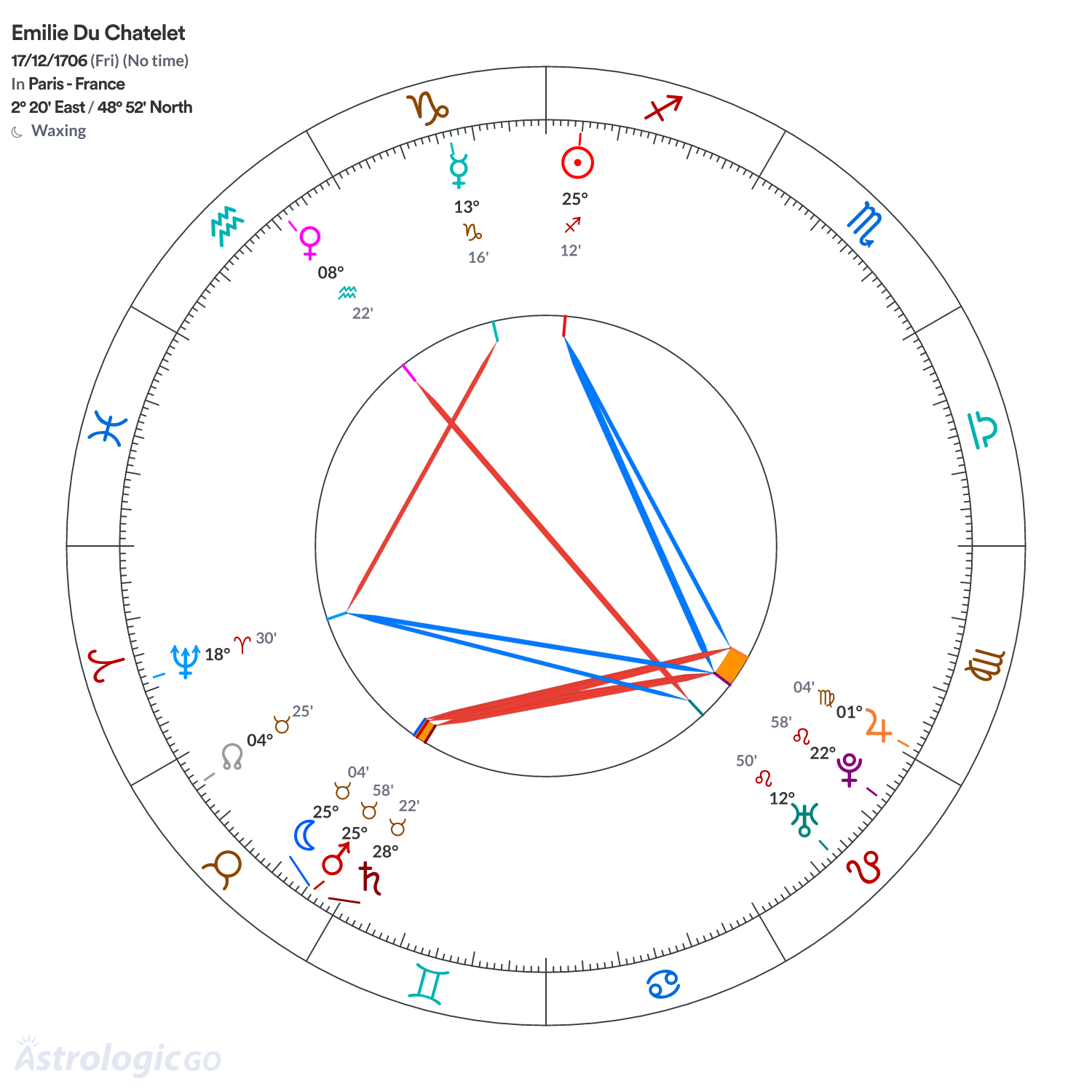
Sun Sagittarius
Moon Taurus or Gemini
When the birth time is unknown, the chart is calculated for 12:00 noon without using the astrological houses system. Are the planets in the wrong houses?
Influences in signs
↣ Sun in Sagittarius - 25°13'
↣ Moon in Taurus - 25°04'
↣ Mercury in Capricorn - 13°16'
↣ Venus in Aquarius - 08°22'
↣ Mars in Taurus - 25°59' - retrograde
↣ Jupiter in Virgo - 01°04' - retrograde
↣ Saturn in Taurus - 28°22' - retrograde
↣ Uranus in Leo - 12°51' - retrograde
↣ Neptune in Aries - 18°30' - retrograde
↣ Pluto in Leo - 22°58' - retrograde
↣ North Node in Taurus - 04°26' - retrograde
Aspects
↣ Sun and Jupiter trine (5°52' applying)
↣ Sun and Pluto trine (2°15' separating) antiparallel
↣ Moon and Venus antiparallel
↣ Moon and Mars conjunction (0°54' applying) parallel
↣ Moon and Jupiter square (6°00' applying)
↣ Moon and Saturn conjunction (3°18' applying)
↣ Moon and Pluto square (2°06' separating)
↣ Mercury and Neptune square (5°14' applying)
↣ Venus and Uranus opposition (4°29' applying)
↣ Venus and North Node square (3°57' separating)
↣ Mars and Jupiter square (5°06' separating)
↣ Mars and Saturn conjunction (2°24' separating)
↣ Mars and Pluto square (3°00' applying)
↣ Jupiter and Saturn square (2°42' separating)
↣ Jupiter and Pluto conjunction (8°06' separating)
↣ Jupiter and North Node trine (3°21' applying) parallel
↣ Saturn and Uranus parallel
↣ Saturn and Pluto square (5°24' applying)
↣ Uranus and Neptune trine (5°39' separating)
↣ Neptune and Pluto trine (4°28' applying)
Birth data
- Chart date
- 17/12/1706
- Chart time
- No time
- Date and time quality
- XX Time not informed what does this mean?
- Data origin
- Astro-Databank
- Location
-
 Paris, France
 - Latitude and longitude
- 48°52' North · 2°20' East
- Time zone
- 00:09 East
The data used to calculate the charts comes from public sources, as do the descriptive texts. We use sources such as Wikipedia.

About
Émilie du Châtelet was a prominent figure of the French Enlightenment, known for integrating theoretical work and experiment in physics and mathematics. An author and researcher, she published in 1737 an essay on the nature and propagation of fire that anticipated the concept of infrared radiation and, in 1740, Institutions de Physique — a pedagogical work that reconciled ideas from Leibniz, Willem Jacob ’s Gravesande and others, explaining the relationship among mass, velocity and kinetic energy (E ∝ mv²).
Her intellectual collaboration with Voltaire, sustained at Cirey-sur-Blaise, played a decisive role in spreading Newtonian ideas in France; together they conducted experiments on heat and energy that reinforced observations of Newtonian mechanics. The culmination of her work was the French translation of Newton’s Principia Mathematica, published posthumously in 1759, accompanied by extensive commentary and notes that made the work a reference throughout continental Europe.
Raised in letters, languages and the sciences, Du Châtelet combined learning with pedagogical skill, translating classics and writing for both lay and academic readers. Her advocacy of the concept of “vis viva” proportional to the square of velocity and her critical readings of physical concepts influenced the development of modern physics and solidified her standing as an authority on Newtonian physics.


