Birth Chart
Franz Xaver von Baader
Benedikt Franz Xaver Bader
Sun Aries
Moon Gemini
Ascendant Capricorn
Influences in signs
↣ Sun in Aries - 06°41' - in house 2
↣ Moon in Gemini - 09°16' - in house 4/5
↣ Mercury in Pisces - 24°31' - in house 2
↣ Venus in Pisces - 17°52' - in house 2
↣ Mars in Taurus - 14°59' - in house 3
↣ Jupiter in Cancer - 11°11' - in house 6
↣ Saturn in Taurus - 19°04' - in house 4
↣ Uranus in Aries - 20°18' - in house 2/3
↣ Neptune in Leo - 28°28' - in house 7 - retrograde
↣ Pluto in Capricorn - 07°52' - in house 12
↣ North Node in Pisces - 16°24' - in house 2 - retrograde
↣ Ascendant in Capricorn - 26°14' - in house 1
↣ Midheaven in Scorpio - 25°50' - in house 10
↣ Equatorial Ascendant in Aquarius - 21°07'
Influences in houses
↣ Sun in house 2
↣ Moon in house 4/5
↣ Mercury in house 2
↣ Venus in house 2
↣ Mars in house 3
↣ Jupiter in house 6
↣ Saturn in house 4
↣ Uranus in house 2/3
↣ Neptune in house 7
↣ Pluto in house 12
↣ North Node in house 2
↣ Ascendant in house 1
↣ Midheaven in house 10
Aspects
↣ Sun and Moon sextile (2°35' separating)
↣ Sun and Mercury antiparallel
↣ Sun and Jupiter square (4°30' applying)
↣ Sun and Pluto square (1°11' applying)
↣ Mercury and Venus conjunction (6°40' separating)
↣ Mercury and Saturn sextile (5°28' separating)
↣ Mercury and North Node conjunction (8°07' separating)
↣ Mercury and Ascendant sextile (1°42' separating)
↣ Mercury and Midheaven trine (1°19' separating)
↣ Venus and Mars sextile (2°52' separating)
↣ Venus and Saturn sextile (1°12' applying)
↣ Venus and North Node conjunction (1°28' separating) parallel
↣ Mars and Jupiter sextile (3°49' separating)
↣ Mars and Saturn conjunction (4°04' applying)
↣ Mars and North Node sextile (1°25' applying)
↣ Mars and Equatorial Ascendant square (6°08' separating)
↣ Mars and Midheaven opposition (10°51' separating)
↣ Jupiter and Pluto opposition (3°19' separating)
↣ Jupiter and North Node trine (5°13' applying)
↣ Saturn and North Node sextile (2°40' separating)
↣ Saturn and Equatorial Ascendant square (2°03' separating)
↣ Saturn and Midheaven opposition (6°47' separating)
↣ Uranus and Equatorial Ascendant sextile (0°49' separating)
↣ Uranus and Ascendant square (5°56' separating)
↣ Neptune and Equatorial Ascendant opposition (7°21' applying)
↣ Neptune and Midheaven square (2°37' applying)
↣ Pluto and Midheaven parallel
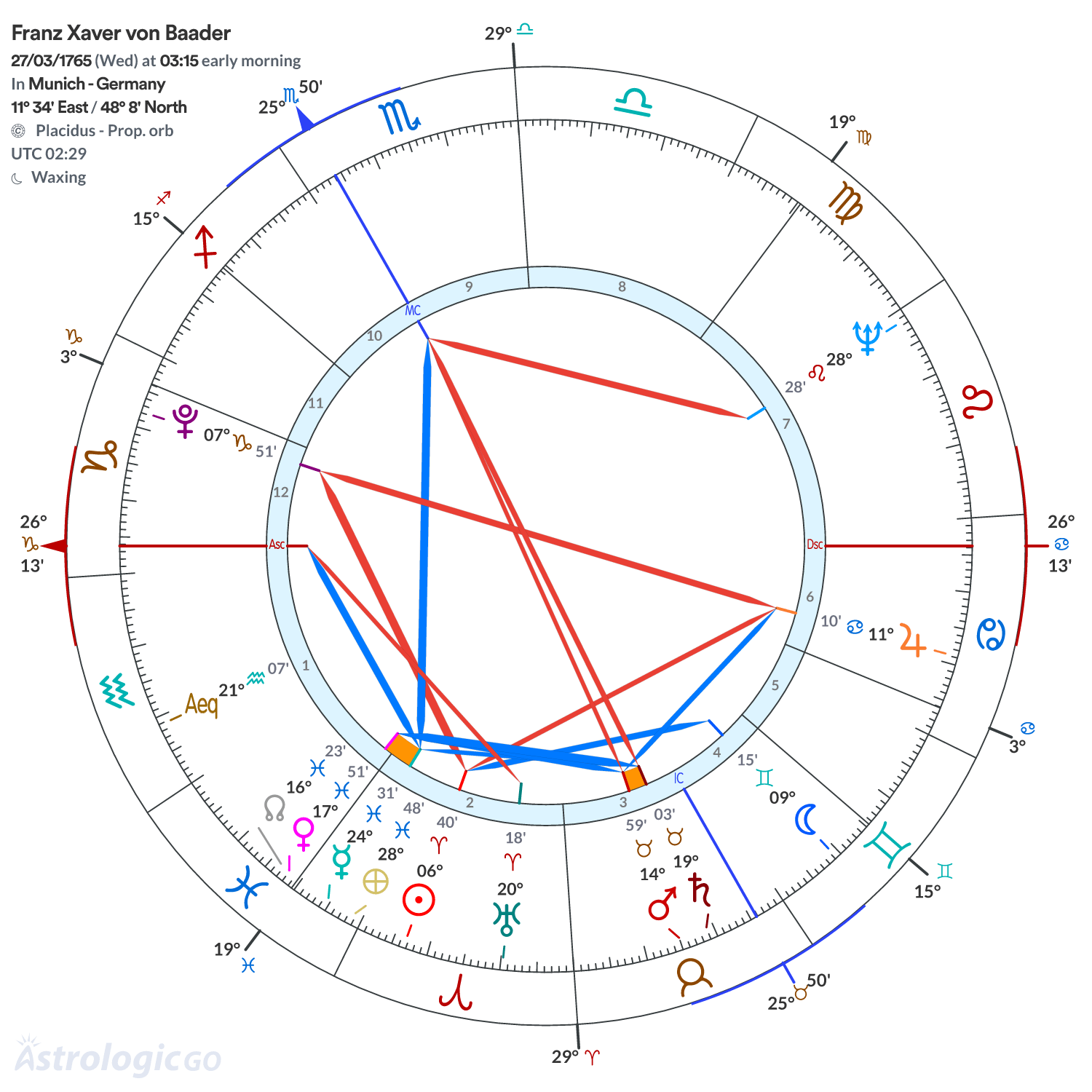
Birth data
- Original name
- Benedikt Franz Xaver Bader
- Chart date
- 27/03/1765
- Chart time
- 03:15
- Date and time quality
- AA Birth record cited what does this mean?
- Data origin
- Astro-Databank
- Location
-
 Munich, Germany
 - Latitude and longitude
- 48°08' North · 11°34' East
- Time zone
- 00:46 East
The data used to calculate the charts comes from public sources, as do the descriptive texts. We use sources such as Wikipedia.

About
Franz Xaver von Baader was a multifaceted German intellectual—philosopher, theologian, physician and mining engineer—whose work exercised notable influence in the nineteenth century. Situated in the post-Enlightenment intellectual milieu, he became known as a Christian theosopher who sought to integrate mystical traditions (Jakob Böhme, Meister Eckhart), elements of Kabbalah and alchemy, Romanticism and the Naturphilosophie of his time into a synthetic philosophy often called “ideal realism.”
His technical career included managing mines in England and Scotland and industrial innovations that brought him recognition, while his academic work culminated in an appointment as professor of speculative philosophy and theology in Munich. He published critiques of modern philosophy, notably the series Fermenta Cognitionis, and lectures collected as Spekulative Dogmatik.
Baader pursued ontological and theological inquiries into love and androgyny, proposing that primordial humanity was androgynous and that sacramental love aimed at a symbolic restoration of that unity. His critique of the Enlightenment and of moral autonomy, together with dialogue with Catholic, Orthodox and Protestant currents, established him as a bridge between mysticism and modern philosophical thought.
Charts like this one
- Sun Aries 1,113 charts
- Moon Gemini 1,036 charts
- Ascendant Capricorn 884 charts
- Born on March 27 51 charts


