Birth Chart
G E Moore
George Edward Moore
Sun Scorpio
Moon Taurus
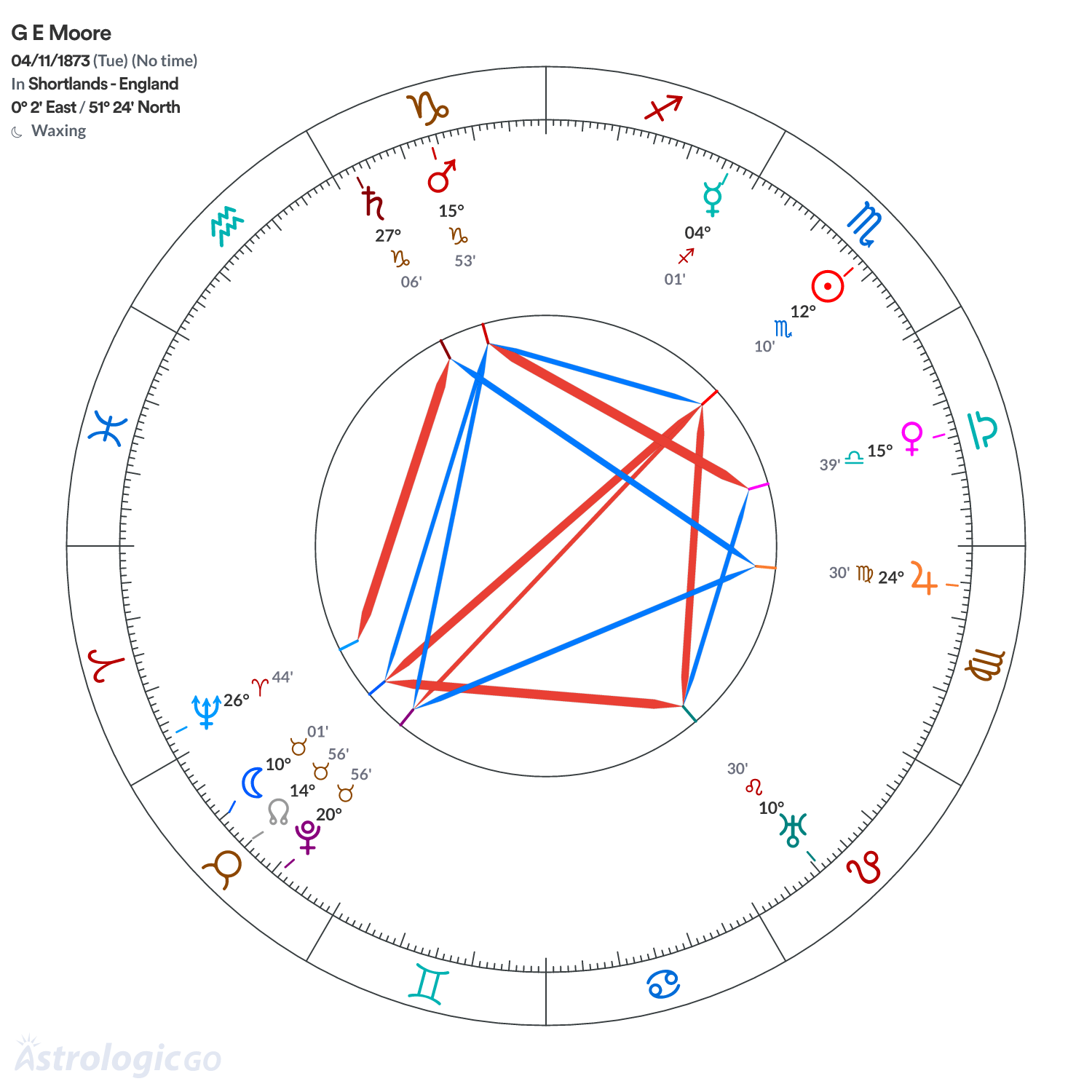
When the birth time is unknown, the chart is calculated for 12:00 noon without using the astrological houses system. Are the planets in the wrong houses?
Influences in signs
↣ Sun in Scorpio - 12°10'
↣ Moon in Taurus - 10°02'
↣ Mercury in Sagittarius - 04°01'
↣ Venus in Libra - 15°39'
↣ Mars in Capricorn - 15°54'
↣ Jupiter in Virgo - 24°30'
↣ Saturn in Capricorn - 27°06'
↣ Uranus in Leo - 10°31'
↣ Neptune in Aries - 26°44' - retrograde
↣ Pluto in Taurus - 20°56' - retrograde
↣ North Node in Taurus - 14°56' - retrograde
Aspects
↣ Sun and Moon opposition (2°09' applying) antiparallel
↣ Sun and Mars sextile (3°44' applying)
↣ Sun and Uranus square (1°40' separating)
↣ Sun and Pluto opposition (8°46' applying)
↣ Sun and North Node opposition (2°46' applying) antiparallel
↣ Moon and Mars trine (5°53' applying)
↣ Moon and Uranus square (0°29' applying)
↣ Moon and North Node conjunction (4°55' applying)
↣ Mercury and Mars parallel
↣ Venus and Mars square (0°15' applying)
↣ Venus and Uranus sextile (5°09' separating)
↣ Mars and Pluto trine (5°02' applying)
↣ Mars and North Node trine (0°58' separating)
↣ Jupiter and Saturn trine (2°36' applying)
↣ Jupiter and Pluto trine (3°34' separating) parallel
↣ Saturn and Neptune square (0°22' separating)
↣ Uranus and North Node square (4°26' applying)
↣ Pluto and North Node conjunction (6°00' applying)
Birth data
- Original name
- George Edward Moore
- Chart date
- 04/11/1873
- Chart time
- No time
- Date and time quality
- XX Time not informed what does this mean?
- Data origin
- Astro-Databank
- Location
-
 Shortlands, England
 - Latitude and longitude
- 51°24' North · 0°02' East
- Time zone
- 00:00
The data used to calculate the charts comes from public sources, as do the descriptive texts. We use sources such as Wikipedia.

About
George Edward Moore was an English philosopher central to the emergence of analytic philosophy, alongside Bertrand Russell and Ludwig Wittgenstein. As a professor at Cambridge, he became known for rejecting the then‑dominant idealism and for valuing common sense as a philosophical method, influencing debates in ethics, epistemology, and metaphysics.
His best‑known work, Principia Ethica, and essays such as “A Defence of Common Sense” and “A Proof of the External World” marked the reaction against ethical naturalism: Moore formulated the so‑called “naturalistic fallacy” and the open question argument, arguing that value does not reduce to natural properties and cannot be defined analytically.
Moore was also a public intellectual—editor of the journal Mind, a prominent member of the Cambridge Apostles, president of the Cambridge University Moral Sciences Club, and for a time head of the British Ethical Union. He received the Order of Merit in 1951.
His legacy is clear, cautious writing, a direct influence on colleagues and subsequent generations of philosophers, and a lasting contribution to metaethics and twentieth‑century philosophical methodology.