Birth Chart
Hans Christian Oersted
Sun Leo
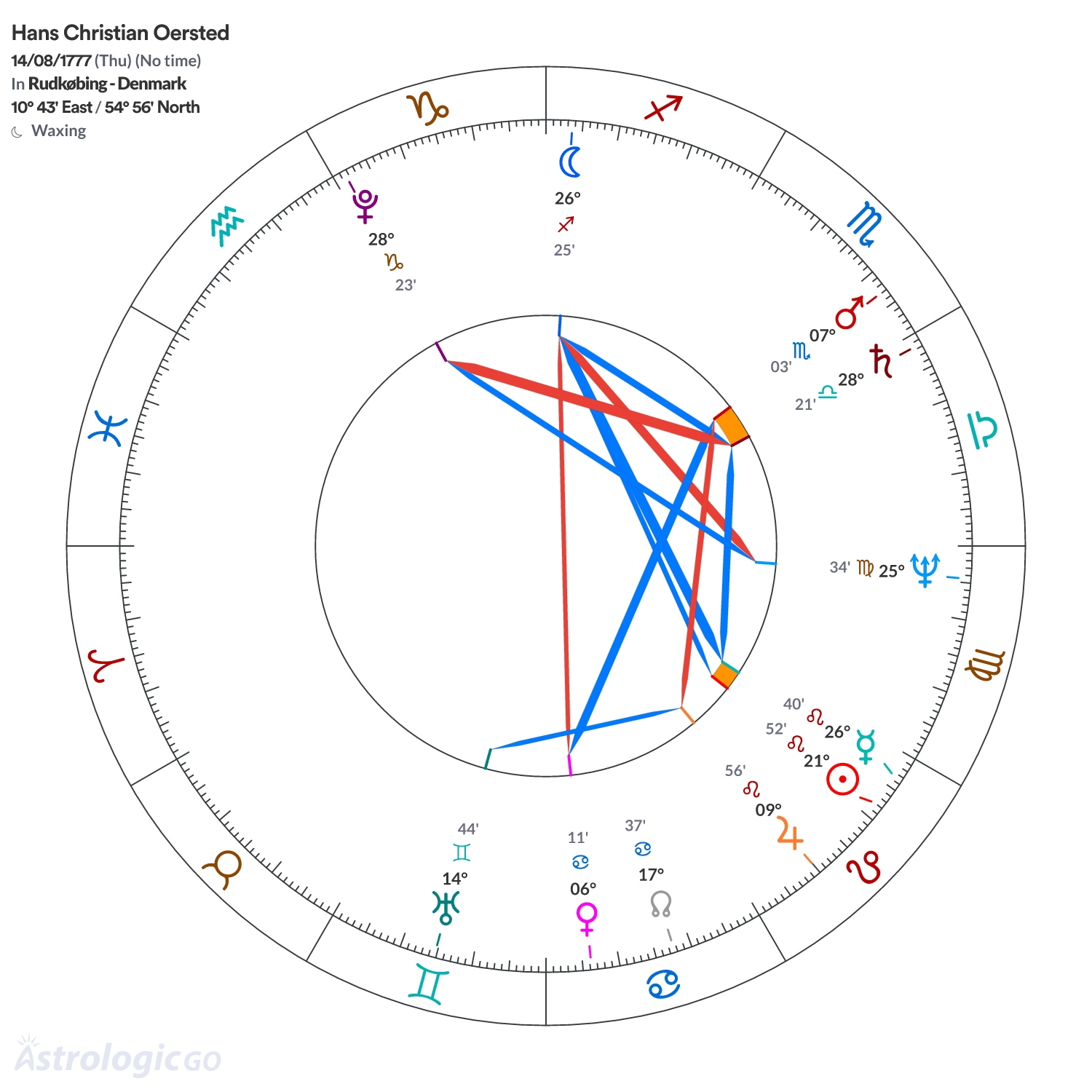
Moon Sagittarius or Capricorn
When the birth time is unknown, the chart is calculated for 12:00 noon without using the astrological houses system. Are the planets in the wrong houses?
Influences in signs
↣ Sun in Leo - 21°52'
↣ Moon in Sagittarius - 26°25'
↣ Mercury in Leo - 26°41'
↣ Venus in Cancer - 06°11'
↣ Mars in Scorpio - 07°03'
↣ Jupiter in Leo - 09°57'
↣ Saturn in Libra - 28°22'
↣ Uranus in Gemini - 14°44'
↣ Neptune in Virgo - 25°34'
↣ Pluto in Capricorn - 28°23' - retrograde
↣ North Node in Cancer - 17°37'
Aspects
↣ Sun and Moon trine (4°33' separating)
↣ Sun and Mercury conjunction (4°49' separating) parallel
↣ Sun and Mars antiparallel
↣ Moon and Mercury trine (0°16' applying)
↣ Moon and Venus opposition (9°46' applying) antiparallel
↣ Moon and Saturn sextile (1°56' applying)
↣ Moon and Uranus antiparallel
↣ Moon and Neptune square (0°51' separating)
↣ Moon and North Node antiparallel
↣ Mercury and Mars antiparallel
↣ Mercury and Saturn sextile (1°41' applying)
↣ Venus and Mars trine (0°52' applying)
↣ Mars and Jupiter square (2°54' applying)
↣ Mars and Saturn conjunction (8°41' separating)
↣ Jupiter and Uranus sextile (4°47' applying)
↣ Saturn and Pluto square (0°01' applying)
↣ Uranus and North Node parallel
↣ Neptune and Pluto trine (2°49' applying)
Birth data
- Chart date
- 14/08/1777
- Chart time
- No time
- Date and time quality
- XX Time not informed what does this mean?
- Data origin
- Astro-Databank
- Location
-
 Rudkøbing, Denmark
 - Latitude and longitude
- 54°56' North · 10°43' East
- Time zone
- 00:43 East
The data used to calculate the charts comes from public sources, as do the descriptive texts. We use sources such as Wikipedia.

About
Hans Christian Ørsted was a Danish physicist and chemist whose 1820 observation—that an electric current deflects a compass needle—opened the systematic study of electromagnetism. The discovery showed that electric currents produce magnetic fields and prompted subsequent investigations that would lead researchers such as André‑Marie Ampère to formulate the mathematical description of electromagnetic interactions.
As a professor at the University of Copenhagen, Ørsted expanded physics and chemistry teaching and laboratory facilities, training generations of scientists and establishing modernized academic programs. His view of the unity of nature guided both experimental research and philosophical reflection, influencing post‑Kantian debates on science and experience.
Beyond his contributions to electromagnetism, Ørsted isolated aluminum in 1825 by reducing aluminum chloride, a noteworthy step in the history of chemistry. He also published poetry and essays, demonstrating wide intellectual interests. His legacy endures in institutions bearing his name and in numerous scientific and cultural honors in Denmark and abroad.


