Birth Chart
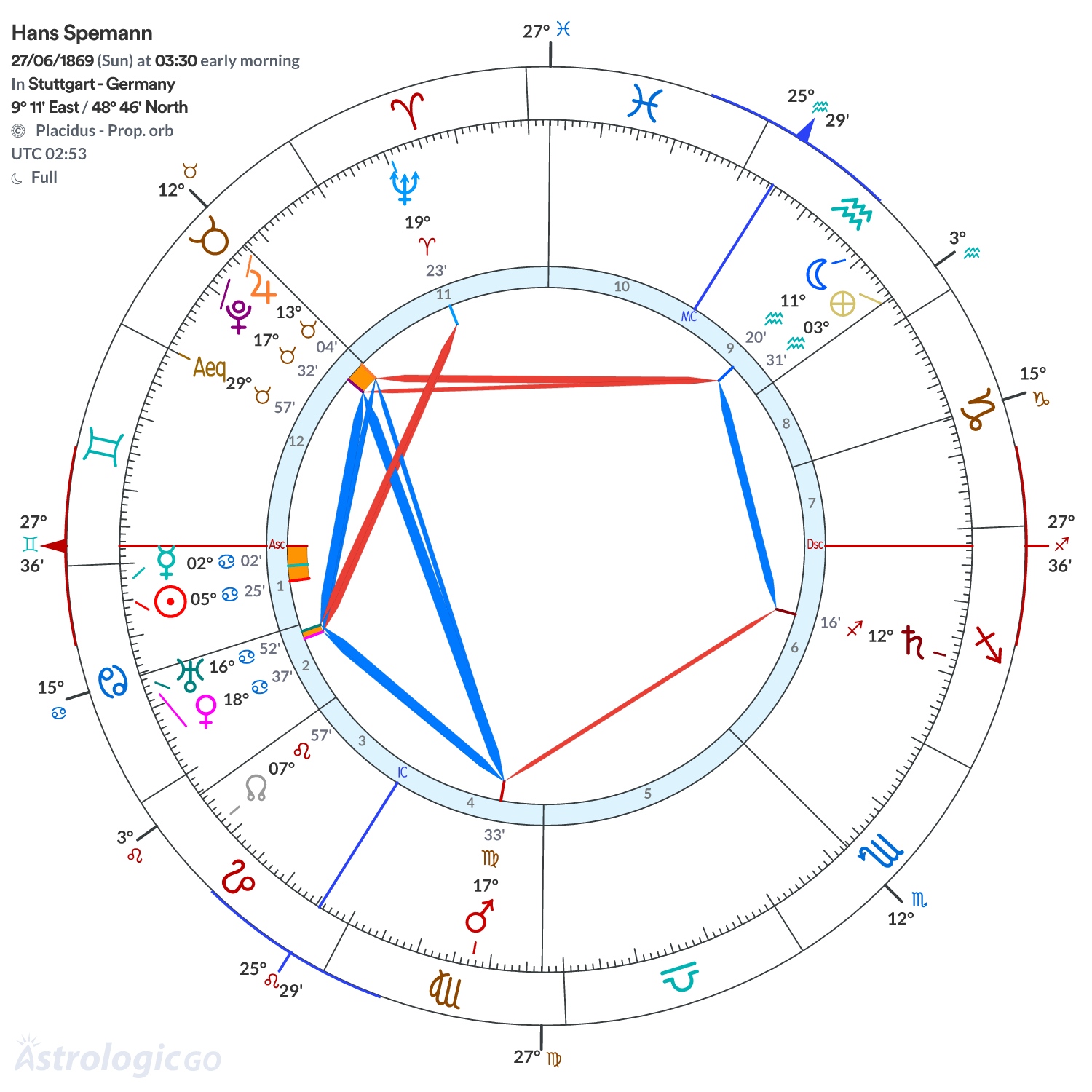
Hans Spemann
Sun Cancer
Moon Aquarius
Ascendant Gemini
Influences in signs
↣ Sun in Cancer - 05°26' - in house 1
↣ Moon in Aquarius - 11°20' - in house 9
↣ Mercury in Cancer - 02°03' - in house 1 - retrograde
↣ Venus in Cancer - 18°37' - in house 2
↣ Mars in Virgo - 17°33' - in house 4/5
↣ Jupiter in Taurus - 13°04' - in house 12
↣ Saturn in Sagittarius - 12°16' - in house 6 - retrograde
↣ Uranus in Cancer - 16°53' - in house 2
↣ Neptune in Aries - 19°24' - in house 11
↣ Pluto in Taurus - 17°33' - in house 12
↣ North Node in Leo - 07°57' - in house 3
↣ Ascendant in Gemini - 27°37' - in house 1
↣ Midheaven in Aquarius - 25°29' - in house 10
↣ Equatorial Ascendant in Taurus - 29°57'
Influences in houses
↣ Sun in house 1
↣ Moon in house 9
↣ Mercury in house 1
↣ Venus in house 2
↣ Mars in house 4/5
↣ Jupiter in house 12
↣ Saturn in house 6
↣ Uranus in house 2
↣ Neptune in house 11
↣ Pluto in house 12
↣ North Node in house 3
↣ Ascendant in house 1
↣ Midheaven in house 10
Aspects
↣ Sun and Mercury conjunction (3°23' separating)
↣ Sun and Venus parallel
↣ Sun and Uranus parallel
↣ Sun and Ascendant conjunction (7°49' applying) parallel
↣ Moon and Mercury antiparallel
↣ Moon and Jupiter square (1°44' applying)
↣ Moon and Saturn sextile (0°56' applying)
↣ Moon and Pluto square (6°13' applying)
↣ Moon and North Node opposition (3°23' separating) antiparallel
↣ Mercury and North Node parallel
↣ Mercury and Ascendant conjunction (4°26' applying)
↣ Venus and Mars sextile (1°05' separating)
↣ Venus and Jupiter sextile (5°33' separating)
↣ Venus and Uranus conjunction (1°45' separating) parallel
↣ Venus and Neptune square (0°46' applying)
↣ Venus and Pluto sextile (1°04' separating)
↣ Venus and Ascendant parallel
↣ Mars and Jupiter trine (4°29' separating)
↣ Mars and Saturn square (5°17' separating)
↣ Mars and Uranus sextile (0°40' separating)
↣ Mars and Neptune parallel
↣ Mars and Pluto trine (0°00' applying)
↣ Jupiter and Uranus sextile (3°49' applying)
↣ Jupiter and Pluto conjunction (4°29' applying)
↣ Jupiter and North Node square (5°07' separating)
↣ Saturn and North Node trine (4°19' applying)
↣ Uranus and Neptune square (2°31' applying)
↣ Uranus and Pluto sextile (0°40' applying)
↣ Uranus and Ascendant parallel
Birth data
- Chart date
- 27/06/1869
- Chart time
- 03:30
- Date and time quality
- AA Birth record in hand what does this mean?
- Data origin
- Astro-Databank
- Location
-
 Stuttgart, Germany
 - Latitude and longitude
- 48°46' North · 9°11' East
- Time zone
- 00:37 East
The data used to calculate the charts comes from public sources, as do the descriptive texts. We use sources such as Wikipedia.

About
Hans Spemann was a German biologist and embryologist whose seminal work on embryonic development reshaped twentieth-century biology. A professor in Rostock and later Freiburg, he became known for his skill in experimental micro surgery applied to amphibian embryos, a method that made it possible to investigate how regions of the embryo direct the formation of tissues and organs.
Spemann’s fame rests mainly on the experiments on organizer centers, carried out in collaboration with Hilde Mangold, which showed that certain groups of cells can induce the formation of embryonic structures when transplanted into another embryo. This discovery of “embryonic induction” provided the conceptual basis for later studies of morphogenetic signaling and was recognized with the Nobel Prize in Physiology or Medicine in 1935.
Beyond his direct role in pioneering techniques—including, in 1928, one of the earliest examples of somatic nuclear transfer in amphibians—Spemann advocated a holistic approach to development, shaped by the theoretical debates of his time. His work, including the book Embryonic Development and Induction (1938), left a lasting influence on experimental embryology and on the understanding of the mechanisms that regulate organismal formation.


