Birth Chart
John Henry Newman
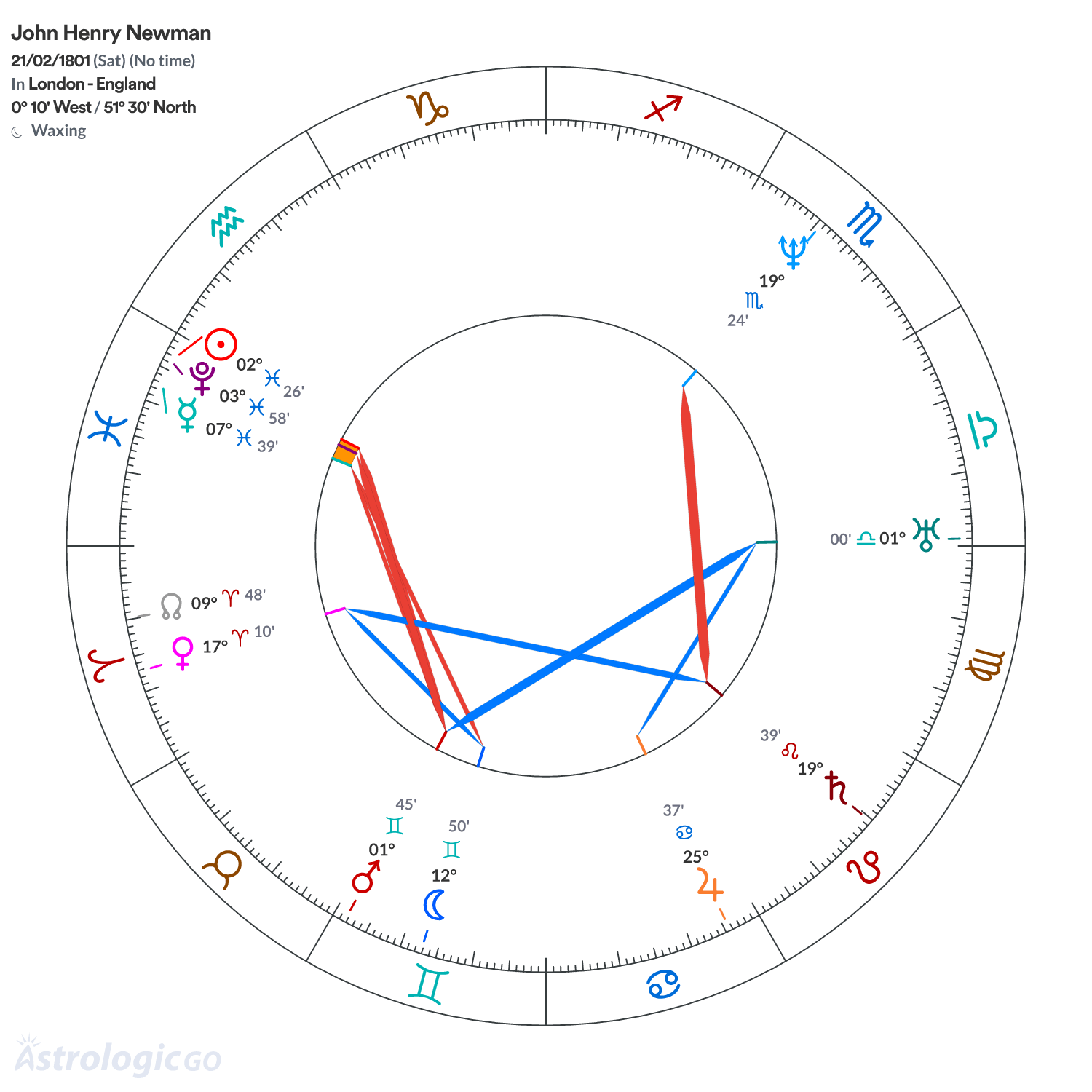
Sun Pisces
Moon Gemini
When the birth time is unknown, the chart is calculated for 12:00 noon without using the astrological houses system. Are the planets in the wrong houses?
Influences in signs
↣ Sun in Pisces - 02°27'
↣ Moon in Gemini - 12°51'
↣ Mercury in Pisces - 07°40'
↣ Venus in Aries - 17°11'
↣ Mars in Gemini - 01°45'
↣ Jupiter in Cancer - 25°37' - retrograde
↣ Saturn in Leo - 19°40' - retrograde
↣ Uranus in Libra - 01°00' - retrograde
↣ Neptune in Scorpio - 19°25' - retrograde
↣ Pluto in Pisces - 03°58'
↣ North Node in Aries - 09°49' - retrograde
Aspects
↣ Sun and Mercury conjunction (5°13' separating) parallel
↣ Sun and Mars square (0°42' separating)
↣ Sun and Pluto conjunction (1°31' applying)
↣ Moon and Mercury square (5°11' separating)
↣ Moon and Venus sextile (4°20' applying)
↣ Moon and North Node sextile (3°02' separating)
↣ Mercury and Mars square (5°55' separating)
↣ Mercury and Pluto conjunction (3°42' separating)
↣ Venus and Saturn trine (2°29' applying)
↣ Venus and North Node conjunction (7°22' separating)
↣ Mars and Jupiter parallel
↣ Mars and Uranus trine (0°45' separating)
↣ Mars and Pluto square (2°13' applying) antiparallel
↣ Jupiter and Uranus sextile (5°23' separating)
↣ Jupiter and Pluto antiparallel
↣ Saturn and Neptune square (0°15' applying) antiparallel
Birth data
- Chart date
- 21/02/1801
- Chart time
- No time
- Date and time quality
- XX Time not informed what does this mean?
- Data origin
- Astro-Databank
- Location
-
 London, England
 - Latitude and longitude
- 51°30' North · 0°10' West
- Time zone
- 00:01 West
The data used to calculate the charts comes from public sources, as do the descriptive texts. We use sources such as Wikipedia.

About
John Henry Newman was a theologian, priest, and a central figure in the nineteenth‑century intellectual and religious movement in England. Initially a leader within Oxford academic Anglicanism, he became known as a tutor and preacher and took part in the so‑called Oxford Movement, which sought to recover the patristic tradition and ecclesial authority. His writings and intellectual activity shaped debates about faith, reason, and the nature of the Church.
Over the course of his life he grew critical of the liberal Protestantism of his day and, after studying the early Church, converted to Catholicism in 1845. He was ordained a Catholic priest and founded an Oratory in Birmingham, playing an important role in reorganizing Catholic life in Victorian England and in the formation of religious and academic institutions.
Newman also held academic and administrative posts, including the rectorship of the Catholic University of Ireland, and received high ecclesiastical recognition, culminating in his appointment as a cardinal in 1879. His theological and autobiographical works—particularly his reflections on conscience, authority, and education—left a lasting legacy in the Christian tradition and in British religious thought.


